
 Andy WarholAmerican, 1928–1987
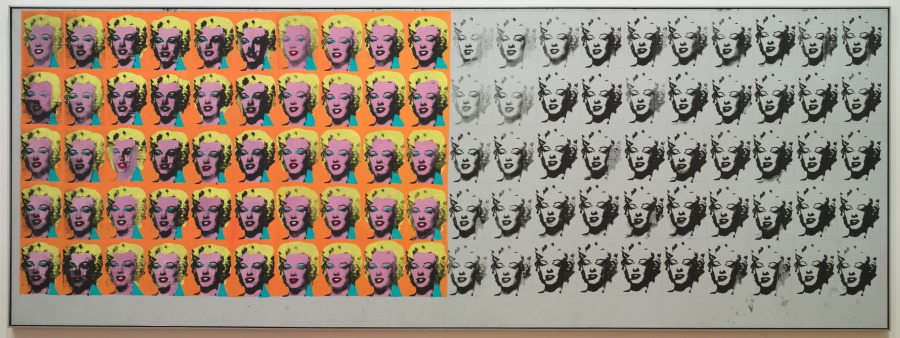
Marilyn (F. & S. 22)
Can I see it?
No, stolen and being sought
Where is “Marilyn (F. & S. 22)” now? No, stolen and being sought. Checked September 29, 2026.
Listed in the FBI's National Stolen Art File under no. 00412.
- Checked
- · Reported
- In this state since
- Source
- A register of stolen art
Details
In the catalog
Sources
- The FBI's National Stolen Art File
- Image: FBI National Stolen Art File
In the life of Andy Warhol
The whole life1963–1968
Warhol the filmmaker: hundreds of reels
From 1963 to 1968 Warhol shot several hundred reels: 472 four-minute portrait Screen Tests, dozens of short films and more than 150 narrative films, only 60 of which were ever released.
May 1965
Paris: announcing his retirement from painting
The second Flowers series was shown at Galerie Ileana Sonnabend in Paris; during the trip Warhol announced that he was retiring from painting to focus on film, saying he no longer believed in painting.
October 1965
First solo museum exhibition
Warhol's first solo museum exhibition was held in October 1965 at the Institute of Contemporary Art in Philadelphia.
1966
Manager of The Velvet Underground
In 1966 Warhol began managing the experimental rock band The Velvet Underground and let them rehearse at the Factory; he also financed their debut album, The Velvet Underground & Nico (1967).
1968
Moderna Museet exhibition and the “Electric Chairs”
By then Warhol had largely stopped painting, but he soon resumed and produced the Big Electric Chair paintings for his 1968 exhibition at the Moderna Museet in Stockholm.
3 June 1968
The shooting at the Factory
The writer Valerie Solanas, author of the SCUM Manifesto, who had appeared in his film I, a Man, shot Warhol and the art critic Mario Amaya; Amaya was lightly injured, while Warhol was seriously wounded and spent nearly two months in hospital. Solanas turned herself in to the police a few hours later, saying that Warhol had too much control over her life.

![Liz #3 [Early Colored Liz], Andy Warhol, 1963](/api/img?u=https%3A%2F%2Fwww.artic.edu%2Fiiif%2F2%2F362c0c2a-4576-2207-4ba9-2b87e6d0bad0%2Ffull%2F1686%2C%2F0%2Fdefault.jpg)