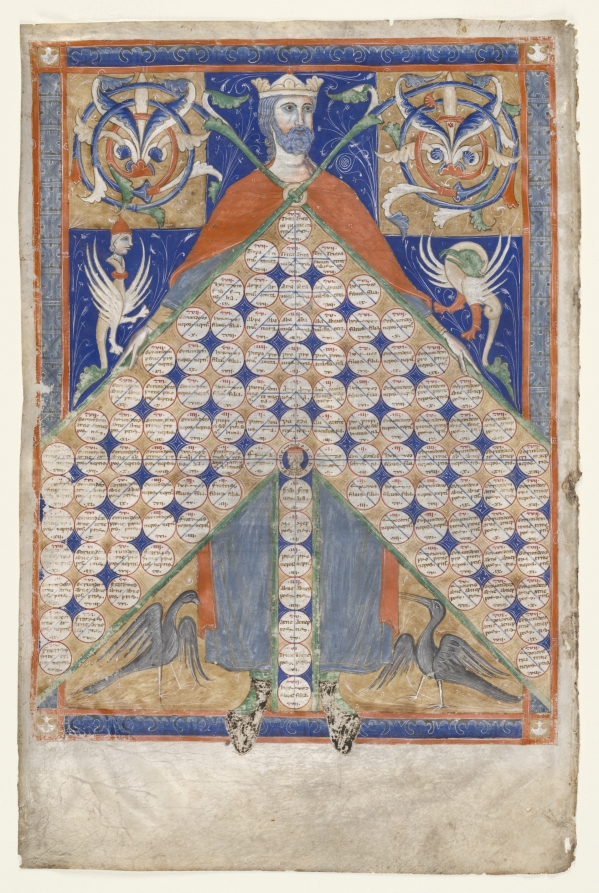
Leaf from Gratian's Decretum: Table of Consanguinity
Can I see it?
Not on view at present
Where is “Leaf from Gratian's Decretum: Table of Consanguinity” now? Collection: The Cleveland Museum of Art, Cleveland. Not on view at present. Checked September 29, 2026.

Cleveland, United States
It belongs to the collection, but is not on display at present.
- Checked
- In this state since
- Source
- The museum
About the painting
These leaves were excised from a copy of the handbook of canon law known simply as the Decretum written by Gratian, an Italian Camaldolese monk, in Bologna around 1130–40. The Decretum was widely copied and consulted throughout the Middle Ages. Consanguinity diagrams were used to show the degree of kinship between an individual and his or her "blood" relations. These tables followed an established tradition dating back to around 600 CE. Until church law was relaxed in 1215, a marriage could only be contracted by persons separated by seven degrees of relationship. After 1215 the degree of separation was reduced to four. Tables of Consanguinity were therefore used by church officials to regulate marriage.
The Cleveland Museum of Art
Details
- Accession number
- 1929.435.2
In the catalog
Sources
- The Cleveland Museum of Art
- Image: The Cleveland Museum of Art — Museum open access