 Pablo PicassoSpanish, 1881–1973
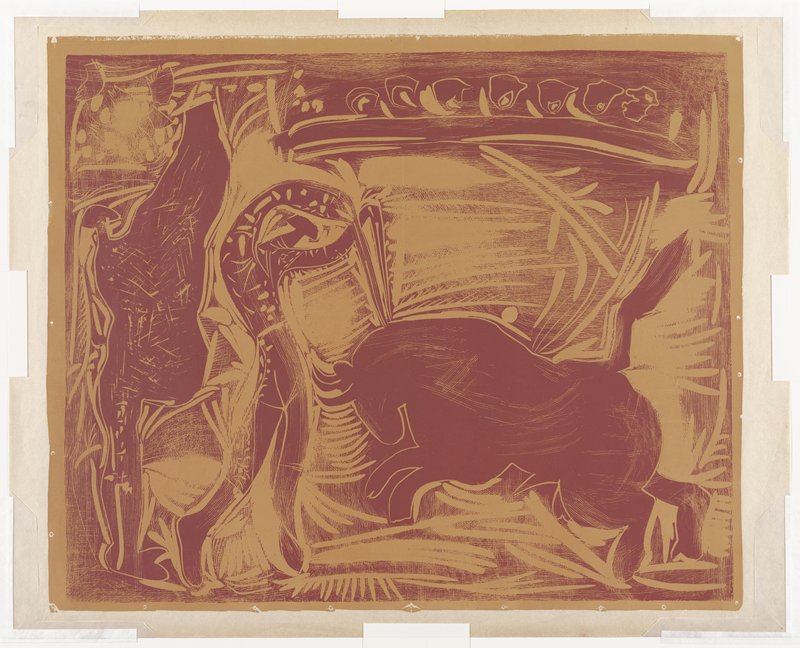
Le Banderillero (second state)
Can I see it?
Not on view at present
Where is “Le Banderillero (second state)” now? Collection: Minneapolis Institute of Art, Minneapolis. Not on view at present. Checked September 29, 2026.

Minneapolis, United States
It belongs to the collection, but is not on display at present.
- Checked
- In this state since
- Source
- The museum
About the work
This series of proofs reveals Picasso’s working method as he collaborated with master printer Hidalgo Arnéra using the reduction linoleum cut method—a process that seems to have materialized from their partnership. Reduction linocuts involve using a single block to print layers of ink and cutting the block between successive printings. Mia acquired a series of five proofs from Arnéra’s archive. They first engaged with the technique in the summer of 1959, and Picasso became fascinated by its possibilities. After making several small linocuts from this method, he made one larger one, and then threw himself into this large, energetic image of a banderillo confronting a powerful bull.
Read on
A banderillo is a bullfighter whose role is to thrust darts (banderillas) into the bull’s shoulders to anger and weaken the animal before the matador finishes it off. Picasso shows an arena filled with spectators where the lithe banderillo is doing his job. Behind him, to our left, the matador waves his cape. The bull lunges forward, head lowered with his horns nearly striking the banderillo, just as the darts strike their target. Abstract lines suggest the many vectors of force and motion in the brutal, balletic scene.
This print is the second state of the first block. Picasso cut away more of the block, adding many more lines of force, more spectators, and more decoration to the clothing of the banderillo and the matador. He also began to use some sort of scraper to roughen the surface of the linoleum, thus softening some of the lines and adding texture to areas such as the bull’s silhouette. Again, this was printed in chocolate-colored ink onto one of the caramel rectangles, again using the thin proofing paper.
Minneapolis Institute of Art
Details
- Accession number
- 2018.36.3
In the catalog
Sources
- Minneapolis Institute of Art
- Image: Minneapolis Institute of Art — © Estate of Pablo Picasso / Artists Rights Society (ARS), New York
In the life of Pablo Picasso
The whole life1958–1961 · Residence
Château of Vauvenargues
11 July 1959 – 11 October 1959
Exhibition: Documenta II
2 March 1961
Married: Jacqueline Roque
1961–1973 · Residence
Mas Notre-Dame-de-Vie de Mougins