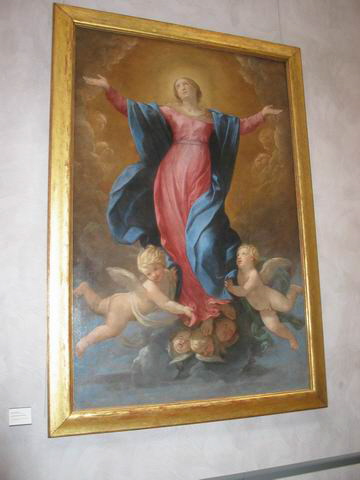
 Guido ReniItalian, 1575–1642
L'Assomption
May one see it?
Unknown: the museum keeps its counsel

Musée du Louvre
Paris, France
The owner is known. Whether it is on view today, the museum does not say, and we were not trained to guess.
- In this state since
- Sep 26, 2026
- Source
- The museum's own collection data
About the painting
Assumption of the Virgin is a 1637 oil on canvas painting by Guido Reni, now in the musée des Beaux-Arts de Lyon, which acquired it in 1805. It originally had a semi-circular panel above it showing God the Father—this is now in Bologna.
The Assumption was a recurring theme in Reni's work. This work was commissioned by Luigi Capponi, archbishop of Ravenna, to decorate one of the chapel altars in the Philippine church in Perugia. It was purchased for 400 piastres.
Particulars
- Accession number
- A 123
Sources
- Musée du Louvre: the museum's own open data · fetched 4 days ago
- Image: Musée du Louvre — © 2007 Musée du Louvre / Département des Peintures
Meanwhile, in the life of Guido Reni
The whole lifeby 1598
A quarrel with Ludovico Carracci and his departure from the academy
While at the academy Reni completed commissions for his first altarpieces, but by 1598 he had left it after an argument with Ludovico Carracci over unpaid work.
by 1601
He moves to Rome: the Farnese Palace frescoes
By the end of 1601 he and Albani move to Rome to work, under Annibale Carracci, Ludovico's cousin, on the frescoes of the Farnese Palace.
1607–1614
Under Paul V: one of the Borghese family's leading painters
After returning briefly to Bologna he goes back to Rome and becomes one of the premier painters under Pope Paul V (Borghese); between 1607 and 1614 he is one of the painters most patronized by the Borghese family.
c. 1614
He leaves Rome over low pay
According to rumour he was assigned to paint the papal Chapel of the Annunciation at Montecavallo, but, feeling underpaid by the papal ministers, Reni leaves Rome for Bologna once again, leaving the role of the city's pre-eminent artist to Domenichino.
1622
Naples: fleeing envious rivals
In 1622 he works on the decoration of the chapel of St Januarius in Naples, but soon has to leave, escaping persecution and revenge from the painters Lanfranco and Ribera, who envied him.
18 August 1642
Died