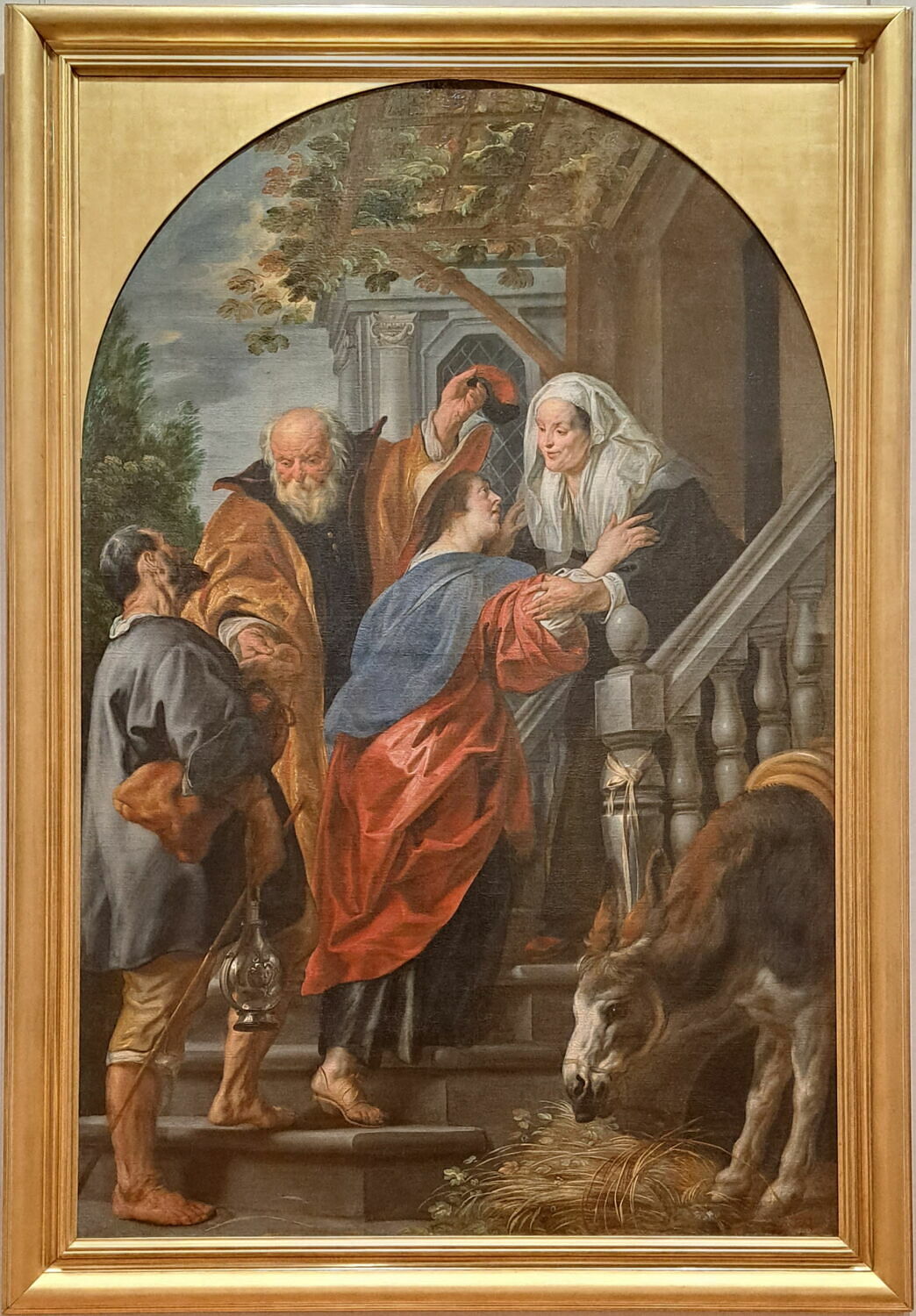
 Jacques JordaensFlemish, 1593–1678
La Visitation
May one see it?
Unknown

Paris, France
The owner is known; whether it is on view today is not.
- In this state since
- Source
- The museum
Particulars
- Accession number
- A 71
In the catalog
Sources
- Musée du Louvre
- Image: Musée du Louvre — © 2023 Musée du Louvre / Département des Peintures
Meanwhile, in the life of Jacques Jordaens
The whole life1621–1667
His workshop: fifteen pupils in the guild records
Between 1621 and 1667 the guild registered fifteen pupils with Jordaens (the best known being Jan Boeckhorst), and six more are named in court documents; his son Jacob and his cousin Arnoldus also trained with him. His fame drew foreigners: after 1642 the Polish painter Aleksander Jan Tricius became his pupil, and in 1645 Queen Christina of Sweden meant to send her protégé Georg Waldau, but the threat of war in Flanders prevented it.
c. 1635 – 1645
Publishes prints after his own designs
Like Rubens and van Dyck, Jordaens realised that prints spread an artist's fame and on his own initiative issued 14 engravings under privilege (cum privilegio), cut by Marinus Robyn van der Goes, Schelte a Bolswert, Paulus Pontius and other Antwerp engravers. Beneath each image stood his name as inventor and a short explanation in Latin verse.
1639–1640
Charles I's commission: “The Story of Cupid and Psyche”
Through the English king's agent in Brussels, Balthazar Gerbier, and the diplomat Cesare Alessandro Scaglia, Jordaens received a commission for 22 paintings for the Queen's House at Greenwich without knowing the patron or the destination; when Rubens, Gerbier's preferred choice, died on 30 May 1640, the whole commission passed to Jordaens. But Scaglia died in May 1641, only eight paintings reached the English court, and a dispute with his heirs over payment for seven of them dragged on into the next generation.
1640–1641
After Rubens's death, Antwerp's leading painter
With the deaths of Rubens in 1640 and van Dyck in 1641, Jordaens became the leading painter of Antwerp, and commissions came increasingly from abroad; Rubens's heirs asked him to finish “Perseus and Andromeda” for Philip IV. He never became a court painter: he worked mainly for wealthy townspeople and the clergy.