 Mikhail Nesterov1862–1942
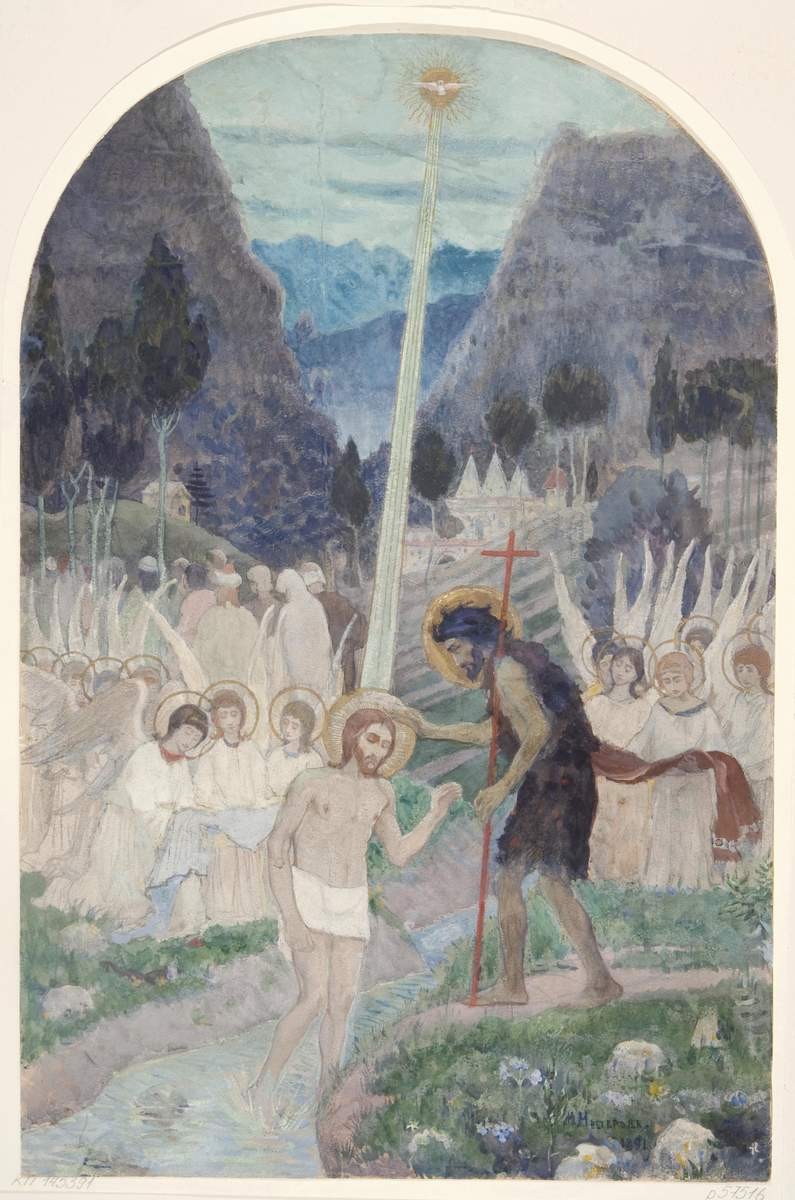
Крещение
May one see it?
Unknown

State Russian Museum
Saint Petersburg, Russia
The owner is known; whether it is on view today is not.
- In this state since
- Source
- The museum
About the work
In the museum's own words — in Russian
В 1895 году исполнением большой стенной картины „Крещение (Богоявление)“ Нестеров завершил свою работу над образами Владимирского собора в Киеве. Первый эскиз „Крещения“ был исполнен еще в 1891 году и хранится в Русском музее. Композицию этого произведения, как вспоминал позднее художник, он взял „с одного древнего образа из Братского монастыря“. Работая над фигурами Христа и Иоанна Предтечи, Нестеров исполнил множество натурных рисунков. Но главный интерес, по его словам, для него представлял пейзаж, через который он хотел сообщить произведению мистическое, религиозное настроение. В какой-то степени художнику это удалось. Критика, однако, упрекала Нестерова за искусственность колорита, неестественность поз Христа и Иоанна, болезненно-унылое впечатление, которое выносил зритель после созерцания картины. В дальнейшем художник учел эту довольно суровую оценку его труда. Во всяком случае церковная живопись Нестерова стала более нарядной, праздничной, „пасхальной“, что более соответствовало главным идеалам Православия. Павел Климов // Иисус Христос. СПб, 2000. С. 106.
State Russian Museum
Particulars
- Accession number
- Р-57516
What it shows
In the catalog
Sources
- State Russian Museum
- Image: State Russian Museum — © State Russian Museum
Meanwhile, in the life of Mikhail Nesterov
The whole life1889
“The Hermit” at the 17th Peredvizhniki show
Shown at the 17th Peredvizhniki exhibition, “The Hermit” caused a stir and placed the young Nesterov among the most outstanding painters of the day; the word “mood” recurred in almost every review. Pavel Tretyakov bought the painting.
May 1889
First journey abroad
With the money from selling “The Hermit” to Tretyakov, Nesterov set off on his first trip abroad: Warsaw, Vienna, Venice, Florence, Rome, Naples with Pompeii and Capri, Paris, Munich, Berlin, Dresden. He brought back dozens of studies on lemon-wood panels, most of them from Capri; his travel diary (20 April – 24 July 1889) is kept in the Presidential Library.
May – July 1889
Carpaccio in Venice, Bastien-Lepage in Paris
In Venice Nesterov was struck above all by Vittore Carpaccio's “naive composition” and “childlike faith”, in Rome by Raphael's frescoes and the Sistine Chapel. In Paris he saw the painting of Puvis de Chavannes and Bastien-Lepage, whose “Joan of Arc”, art historians agree, decisively shaped the concept of “The Vision to the Youth Bartholomew”.
1890
Invited to paint St Volodymyr's Cathedral
Professor Adrian Prakhov, who was in charge of decorating St Volodymyr's Cathedral in Kiev, saw “The Youth Bartholomew” and invited its author. After some hesitation Nesterov agreed — and ended up devoting more than 22 years to church murals and icons.
1890
“The Vision to the Youth Bartholomew” causes a sensation
The painting, for which Nesterov made landscape studies near the Trinity-Sergius Lavra while living in the village of Komyakino near Khotkovo, provoked the most conflicting opinions, became the sensation of the 18th Peredvizhniki exhibition and was bought by Tretyakov. To the end of his days the artist considered it his finest work.
1890s
Studies Byzantine art
To master monumental painting, new to him, Nesterov travelled to Rome, Palermo, Constantinople and Ravenna, where he could study the traditions of Byzantine art (other accounts name Rome and Istanbul).