 Boris Kustodiev1878–1927
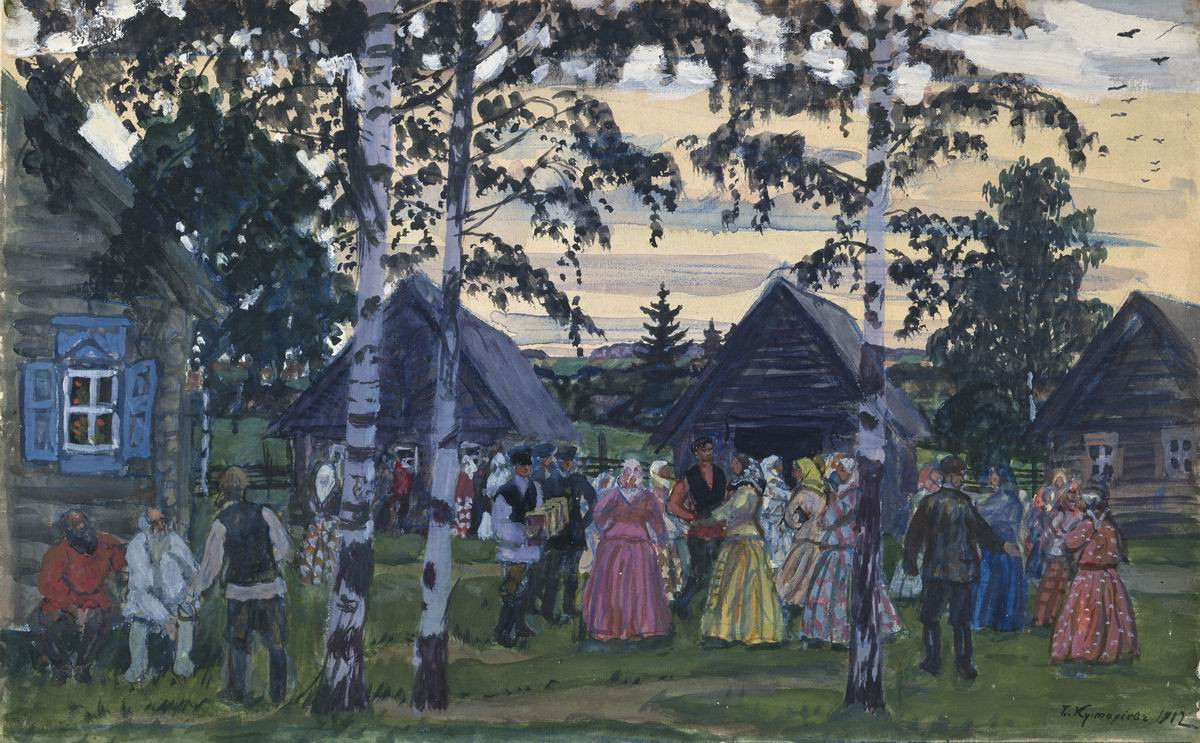
Хоровод
Can I see it?
Unknown
Where is “Хоровод” now? Collection: State Russian Museum, Saint Petersburg. Unknown.

Saint Petersburg, Russia
The owner is known; whether it is on view today is not.
- In this state since
- Source
- The museum
About the work
Museum text in Russian
Кустодиев никогда не повторяется в своих многочисленных «праздниках», «масленицах», «балаганах», «гуляниях», «красавицах». Хотя изображенные им города, площади, улицы и перекрестки, дома всегда узнаваемы, в каждой картине — всегда другие дома и другие улицы знакомого города. Он бесконечно разнообразен в изображении персонажей, всегда неповторимо индивидуальных и в то же время составляющих одну большую, живущую в мире и согласии семью. Его картины не вызывают эффекта неожиданного открытия чего-то нового, это, скорее, новые встречи со знакомым миром, полным тепла и уюта. Круглов В. Ф. Кустодиев: между лирикой и гиперболой // Борис Михайлович Кустодиев. К 125-летию со дня рождения. СПб, 2003. C. 8
Read on
В картинах Кустодиева о деревне объектом его внимания становится быт, поднятый над буднями — праздники с крестными ходами, хороводами, ярмарки — « Хоровод » (1912), « Крестный ход » (1915). Свойственные Кустодиеву поиски синтеза исключали всякое появление портретов конкретных крестьян или реальных групповых сцен. Там же. С. 36.
State Russian Museum
Details
- Accession number
- Р-13503
What it shows
In the catalog
Sources
- State Russian Museum
- Image: State Russian Museum — © State Russian Museum
In the life of Boris Kustodiev
The whole life1910
Joins the World of Art
Kustodiev first met the artists of the World of Art at the time of the 1905 Revolution; in 1910 he joined their association and subsequently took part in all their exhibitions.
7 October 1910
Leaves the Union of Russian Artists
A member of the Union of Russian Artists since 1907, Kustodiev left it together with other St Petersburg artists after a split provoked by Alexandre Benois's article on the 1909–1910 exhibition in the newspaper Rech.
1911
Treatment at a Swiss clinic
Severe symptoms forced Kustodiev to spend several months (other accounts say a year) in a private clinic at a Swiss mountain resort. Several operations brought only temporary relief.
1911
First stage work: “An Ardent Heart”
Kustodiev first worked in the theatre, designing the sets for Alexander Ostrovsky's An Ardent Heart; such was his success that further orders came pouring in.
1913
Designs “The Death of Pazukhin” at the Moscow Art Theatre
Kustodiev designed the sets and costumes for The Death of Pazukhin at the Moscow Art Theatre (other accounts date it to 1914).
1914
Gold medal at the Baltic Exhibition in Malmö
Kustodiev received a gold medal at the Baltic Exhibition in Malmö, Sweden.

![[Kopf der Mutter Rembrandts; The Artist's Mother: Head Only, Full Face; Tête de la mere de Rembrandt], Rembrandt, 1628](https://diglib.hab.de/varia/haum/rembrandt-ab3-0360/max/000001.jpg)

![[Ein Bauer mit hoher Mütze und Gehstock; A Peasant in a High Cap, Standing Leaning on a Stick; Juif à grand bonnet], Rembrandt, 1639](https://diglib.hab.de/varia/haum/rembrandt-ab3-0133/max/000001.jpg)
![[Bildnis der Mutter des Künstlers mit einem Tuch als Kopfbedeckung; Kopf der Mutter Rembrandts; The Artist's Mother in a Cloth Headdress, Looking Down: Head Only; Tête de la mere de Rembrandt], Rembrandt, 1633](https://diglib.hab.de/varia/haum/rembrandt-ab3-0358/max/000001.jpg)

![[Drei weibliche Kopfstudien, eine davon schlafend; Three Heads of Women: One Asleep; Trois têtes de femmes, dont une qui dort], Rembrandt, 1637](https://diglib.hab.de/varia/haum/rembrandt-v3-4750/max/000001.jpg)
![[Ein Pole mit einem Gehstock; Polander Leaning on a Stick; Polonois portant sabre et bâton], Rembrandt, 1631](https://diglib.hab.de/varia/haum/rembrandt-v3-4619-a/max/000001.jpg)
![[Alter Mann mit gespaltener Pelzmütze; Old Man with a Divided Fur Cap; Vieillard à barbe carrée], Rembrandt, 1640](https://diglib.hab.de/varia/haum/rembrandt-ab3-0281/max/000001.jpg)