 Paul GauguinFrench, 1848–1903
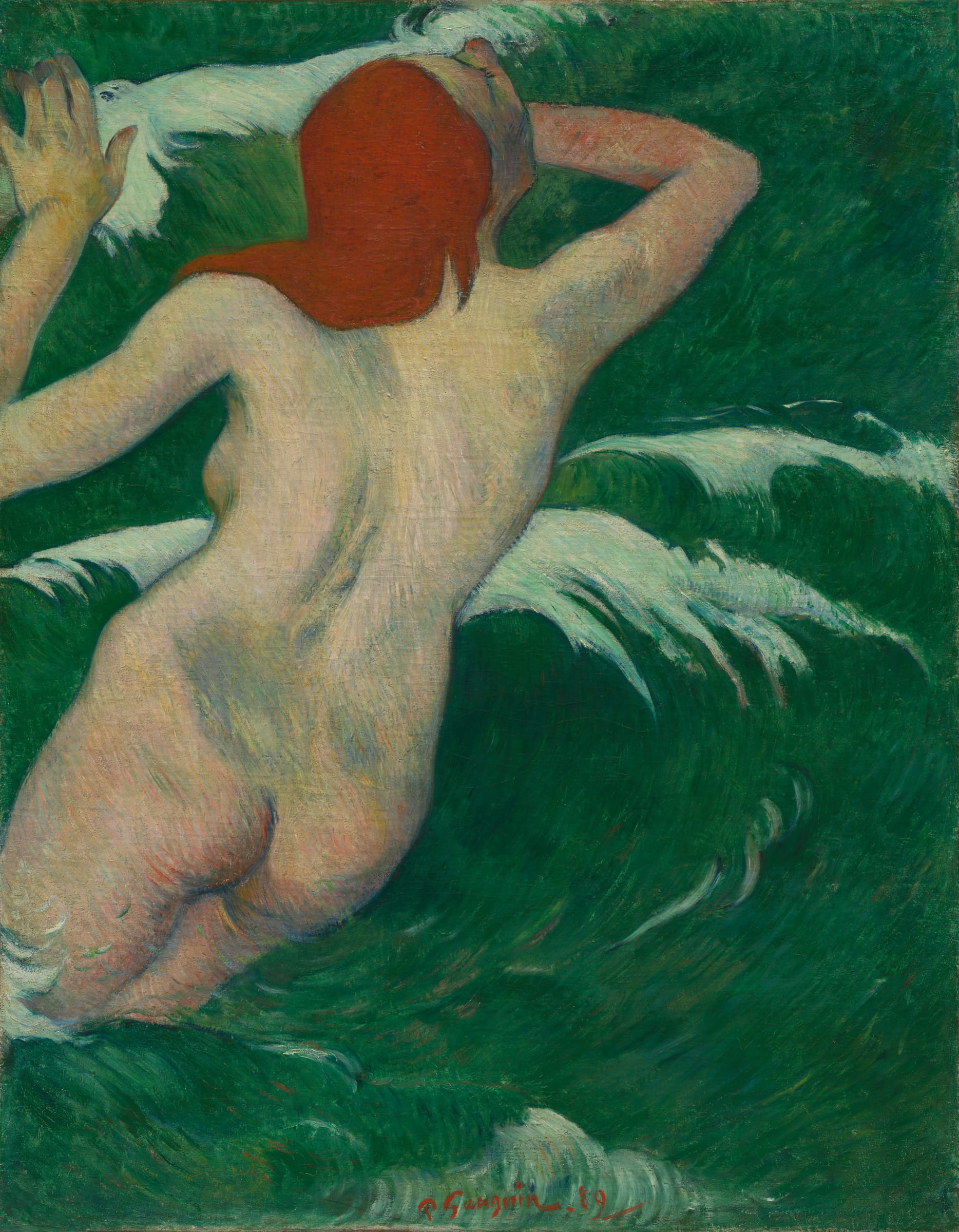
In the Waves (Dans les Vagues)
Can I see it?
Not on view at present
Where is “In the Waves (Dans les Vagues)” now? Collection: The Cleveland Museum of Art, Cleveland. Not on view at present. Checked October 12, 2026.

Cleveland, United States
It belongs to the collection, but is not on display at present.
- Checked
- In this state since
- Source
- The museum
About the painting
Painted at Pont-Aven in northwest France, this depiction of a nude figure throwing herself into the sea suggests a metaphor for a modern European woman forsaking civilization and abandoning herself to her natural, primitive instincts. The simplified lines and exaggerated colors, especially the contrasting green and orange, seem invented rather than observed from life. Exhibiting the painting at the Café Volpini in Paris in 1889, Gauguin established himself as a leader of the Symbolist movement in art.
The Cleveland Museum of Art
Details
- Accession number
- 1978.63
In the catalog
Sources
- The Cleveland Museum of Art
- Image: The Cleveland Museum of Art — CC0 (Cleveland Museum of Art Open Access)
In the life of Paul Gauguin
The whole life1870s–1891 · Workplace
Paris
1886–1891 · Workplace
Pont-Aven
1887 · Workplace
Martinique
1887
Panama and Martinique
In 1887–1888 Gauguin visited Panama, where he observed the construction of the Panama Canal, and traveled on with the painter Laval to Martinique. Martinique helped bring about an evolution in his art, making Japanese influences apparent.
October – December 1888
Nine Weeks with Van Gogh in Arles
In 1888, at Theo's insistence, Gauguin worked for nine weeks with Vincent van Gogh in his Yellow House in Arles. Their relationship deteriorated: on the evening of 23 December 1888, according to Gauguin's later account, Vincent came at him with a razor and then cut off his own ear; Gauguin left Arles, and they never saw each other again.
1 April 1891
Departure for Tahiti
On 1 April 1891, after a final visit to his wife and children in Copenhagen, Gauguin sailed for Tahiti, intending to escape European civilization and "everything that is artificial and conventional." He spent his first three months in Papeete, then set up a studio in a bamboo hut at Mataiea.