 Hendrick GoltziusDutch, 1558–1617
Hercules and Cacus
Can I see it?
Not on view at present
Where is “Hercules and Cacus” now? Collection: Minneapolis Institute of Art, Minneapolis. Not on view at present. Checked September 29, 2026.

Minneapolis, United States
It belongs to the collection, but is not on display at present.
- Checked
- In this state since
- Source
- The museum
About the work
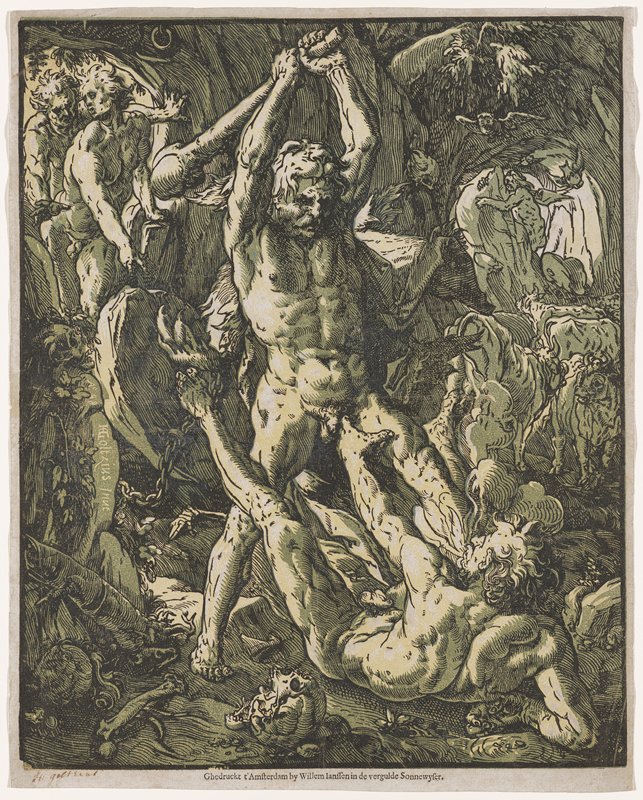
The story of Hercules and Cacus is a spinoff from the tenth of the hero’s famous Twelve Labors: rustling the cattle of the monster Geryon. Having stolen the cattle, Hercules was driving them through Italy, when he decided to spend the night on the Aventine Hill (one of the seven hills upon which Rome would later rise). In a cavern beneath the hill lived Cacus, a menacing, fire-breathing giant. As Hercules slept, Caucus made off with some of the cattle. When Hercules discovered that they were in Cacus’s cave, he went in and slew him with his club. We identify the main players by their attributes: Hercules wears a lion skin as a cape, and Cacus belches fire.
Hendrick Goltzius used the chiaroscuro printmaking technique to cast an eerie light on the action. Three wooden blocks were carved with different but interdependent designs and then printed in superimposed layers of different colors.
Minneapolis Institute of Art
Details
- Accession number
- 2022.35.1
In the catalog
Sources
- Minneapolis Institute of Art
- Image: Minneapolis Institute of Art — public domain
In the life of Hendrick Goltzius
The whole life1579–1587
Pupil: Jan Saenredam
late 1580s
Depression and consumption
From the late 1580s he suffered from depression and consumption; his family life was unhappy.
1585–1587
Pupil: Jacob de Gheyn II
1587
Founding of the Haarlem Academy
Together with Cornelis van Haarlem and Karel van Mander he founded an academy of art in Haarlem, later known as the Haarlem Mannerist Academy (some sources give 1583 or 1600). There, for the first time in the Netherlands, systematic study of anatomy and drawing from the nude model were introduced.
1590
Departure for Italy
He fled from his wife and, despite his illnesses, set out for Italy — via Hamburg and Munich to Venice, Bologna and Florence. Part of the way he traveled on foot, passing himself off as a commoner, "partly out of a love of mystification."