Albrecht DürerGerman, 1471–1528
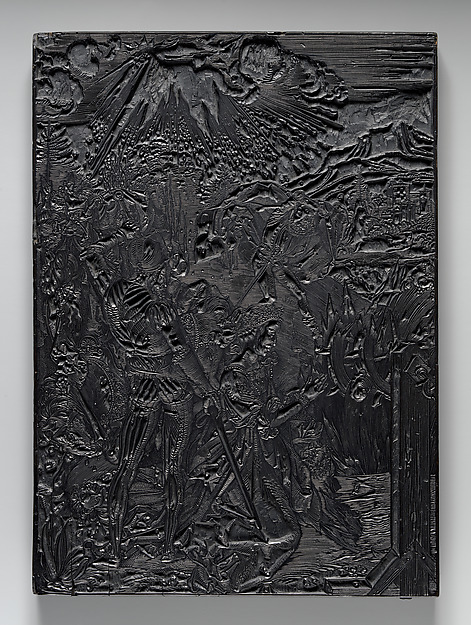
Hercules Conquering Cacus ("Ercules")
May one see it?
Not receiving at present

The Cleveland Museum of Art
Cleveland, United States
It belongs to the collection, but is not on display at present.

Collection: National Gallery of Art, Washington, D.C.
- Checked
- In this state since
- Source
- The museum's own collection data
About the work
Even though Dürer entitled this work Ercules, the narrative of the representation remains highly debated. The most recent interpretation suggests that Dürer adapted the scene from an obscure Roman tragedy, one he may have learned through his humanist friends. The story describes how prior to Hercules’ first heroic labor, the goddess Juno incited within him a monstrous rage. This resulted in the killing of a tyrant, seen under Hercules’ left foot, and the murder of his own family, represented here by his frightened wife Megara. A maniacal old woman-a Fury, goddess of vengeance and the embodiment of Hercules’ rage-prepares to assail Megara with an animal jawbone. According to this reading then, women are the source and manifestation of Hercules’ murderous wrath, an obvious contrast to his later heroism.
National Gallery of Art
Particulars
- Accession number
- 1953.6.62
What it shows
In the catalog
Comings and goings
Not on view at present
The Cleveland Museum of Art · Oct 2, 2026 — now · Verified
Was not on view
National Gallery of Art · Sep 29, 2026 — Oct 2, 2026 · Verified
Was not on view
The Cleveland Museum of Art · Sep 29, 2026 — Sep 29, 2026 · Verified
Was not on view
National Gallery of Art · Sep 29, 2026 — Sep 29, 2026 · Verified
Was not on view
The Cleveland Museum of Art · Sep 28, 2026 — Sep 29, 2026 · Verified
Was not on view
National Gallery of Art · Sep 28, 2026 — Sep 28, 2026 · Verified
Was not on view
The Cleveland Museum of Art · Sep 27, 2026 — Sep 28, 2026 · Verified
Was not on view
National Gallery of Art · Sep 27, 2026 — Sep 27, 2026 · Verified
Was not on view
Rijksmuseum · Sep 26, 2026 — Sep 27, 2026 · Verified
Was not on view
National Gallery of Art · Sep 26, 2026 — Sep 26, 2026 · Verified
Was not on view
The Cleveland Museum of Art · Sep 25, 2026 — Sep 26, 2026 · Verified
Was not on view
Rijksmuseum · Aug 30, 2026 — Sep 25, 2026 · Verified
Sources
- The Cleveland Museum of Art: the museum's own open data · fetched 6 days ago
- Image: National Gallery of Art — Museum open access
Meanwhile, in the life of Albrecht Dürer
The whole lifec. 1492 – 1494
Basel: woodcuts for the printers
In Basel, a centre of printing, Dürer stayed with Georg Schongauer. A woodblock for the title page of the Letters of St Jerome (1492), signed with his name on the back, led to the works of the “Master of the Bergmann Press” being attributed to him; he may also have worked on the woodcuts for Sebastian Brant's Ship of Fools.
July 1494
Marries Agnes Frey
Soon after returning to Nuremberg the 23-year-old Dürer married Agnes Frey, daughter of a prominent brass worker and amateur harpist; the match had been arranged in his absence, and marriage was required to open a workshop of his own. They had no children, and his letters suggest the marriage was not a happy one.
7 July 1494
Married: Agnes Dürer
1494–1495
First journey to Italy
Within three months of the wedding Dürer left alone for Italy, perhaps fleeing an outbreak of plague in Nuremberg. Crossing the Alps he made watercolour landscapes; in Venice he studied its art and judged Giovanni Bellini the best of its painters; Mantegna and Pollaiuolo left their mark on him.
1495
Opens his own workshop
Dürer opened his own workshop in Nuremberg, where over the next ten years he created much of his printmaking. His godfather, the publisher Anton Koberger, helped issue the first series; the city's crafts were governed by the Council rather than guilds, leaving him free to try new techniques and sell his own impressions.
![Madonna and Child [obverse], Albrecht Dürer, c. 1496/1499](https://api.nga.gov/iiif/878db7e6-10ae-4cae-ba5d-6d6f5c413ae8/full/!2400,2400/0/default.jpg)
![Lot and His Daughters [reverse], Albrecht Dürer, c. 1496/1499](https://api.nga.gov/iiif/7565a449-f82a-414b-9bda-c93f55a51b4d/full/!2400,2400/0/default.jpg)