 John ConstableBritish, 1776–1837
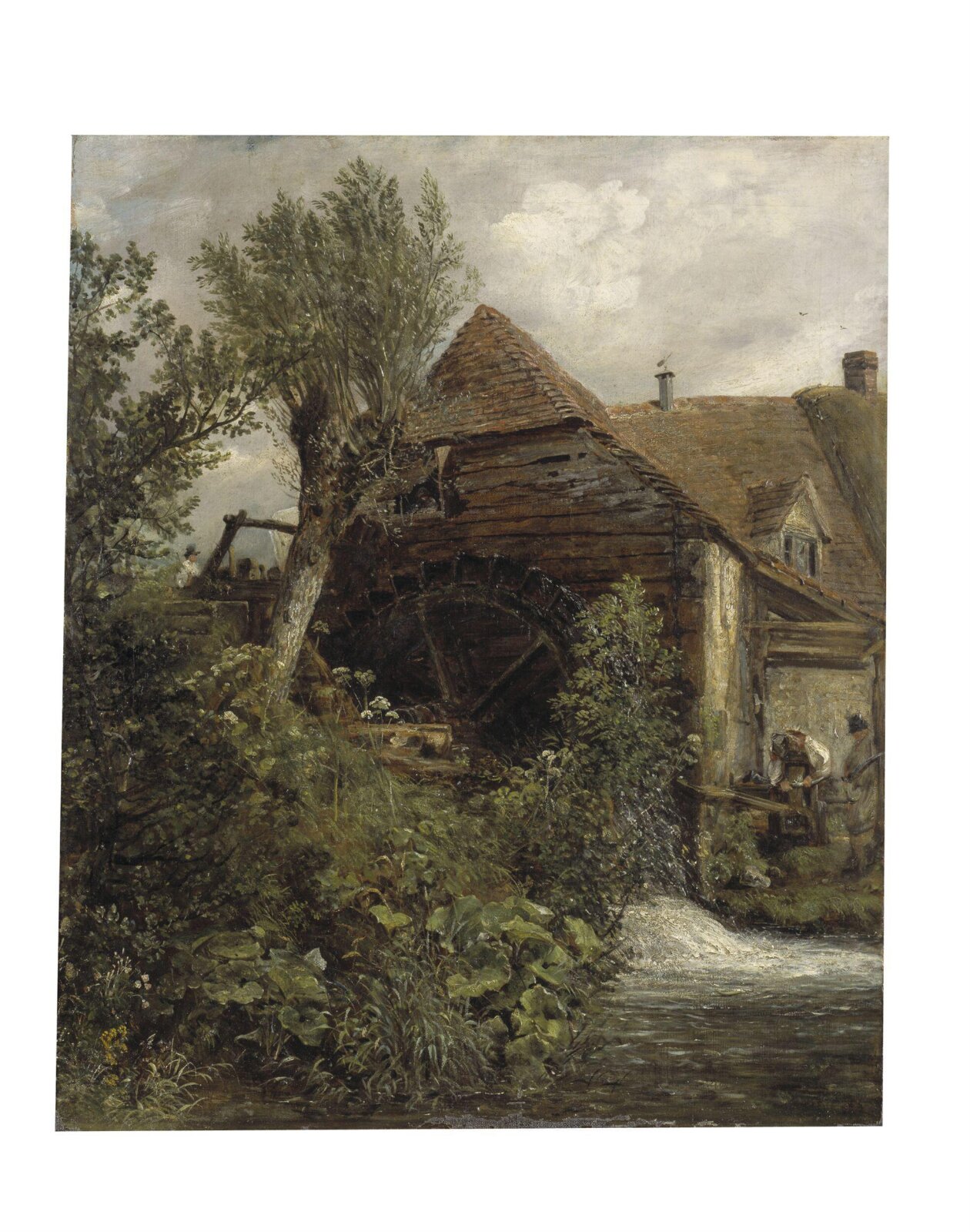
Gillingham Mill, Dorset
May one see it?
Yes, receiving visitors

Victoria and Albert Museum
RoomPaintings, Room 87, The Edwin and Susan Davies GalleriesLondon, United Kingdom
On public display.
- Checked
- 7 days ago
- In this state since
- Sep 25, 2026
- Source
- The museum's own collection data
About the painting
Object Type
Landscape painting in oil became steadily more popular throughout the 19th century. John Constable and J.M.W. Turner take credit for establishing landscape as a suitable theme for painting. Until then, history paintings had been considered more important, but increasingly naturalistic oil paintings of picturesque views of the British landscape appealed to a wider section of the art-buying public.
People
John Constable (1776-1837) may have originally been commissioned by John Pern Tinny to paint this picture as it is thought that Tinny had a family connection with the mill, which was also known as 'Perne's mill.' The painting is based on a sketch made in 1823.
Subjects Depicted
Read on
The realistic recording of romantic, tumble down picturesque buildings was dear to Constable's heart and to many other painters who followed him. This recording was necessary since the mill was burnt down in 1825, and was replaced at once with one that was not as picturesque. According to a friend of Constable's, in a letter of 1825, 'The news is, that Mat. Parham's (alias Perne's) mill is burnt to the ground, and exists only on your canvas. A huge misshapen, new bright brick modern improved patent monster is starting up in its stead.'
Victoria and Albert Museum
Particulars
- Accession number
- 1632-1888
What it shows
In the catalog
Sources
- Victoria and Albert Museum: the museum's own open data · fetched 7 days ago
- Image: Victoria and Albert Museum — © Victoria and Albert Museum, London
Meanwhile, in the life of John Constable
The whole life1821
“The Hay Wain” at the Royal Academy
The picture, shown as “Landscape: Noon”, found no buyer, but it was seen by the painter Théodore Géricault and the writer Charles Nodier. According to Delacroix, Géricault went back to France quite stunned and invited Constable to Paris, while Nodier urged French artists to look to nature rather than to trips to Rome.
1824
The Paris Salon: a gold medal
The Anglo-French dealer John Arrowsmith bought The Hay Wain and other works, and in 1824 they were shown at the Paris Salon, where they caused a sensation. The Hay Wain was awarded a gold medal by Charles X.
1824
Delacroix repaints the background of “The Massacre at Chios”
After seeing Constable’s pictures at Arrowsmith’s gallery, Delacroix repainted the background of his Massacre at Chios, saying the paintings had done him a great deal of good. In his journal he noted that Constable’s meadow greens are a combination of many different shades.
1824–1828
The family in Brighton for Maria’s health
When Maria began to show symptoms of tuberculosis, Constable took lodgings for the family in Brighton in the hope that sea air would restore her health, dividing his time between Brighton and Charlotte Street in London. He was unsure at first that Brighton suited painting, and complained to Fisher that the beach was only Piccadilly by the sea.
23 November 1828
The death of his wife Maria
After the birth of their seventh child the family returned to Hampstead, where Maria died of tuberculosis at the age of 41. “Hourly do I feel the loss of my departed Angel,” Constable wrote to his brother.
February 1829
Elected to the Royal Academy at fifty-two
In February 1829, three months after his wife’s death, Constable was elected a member of the Royal Academy, at the age of 52.



![Vallon à Helmingham [Helmingham Dell], Constable, John, 1e quart du XIXe siècle (peint à l'été 1823 (selon Beckett)) (1823)](https://collections.louvre.fr/media/cache/large/0000000021/0000065616/0000312650_OG.JPG)