 William EttyBritish, 1787–1849
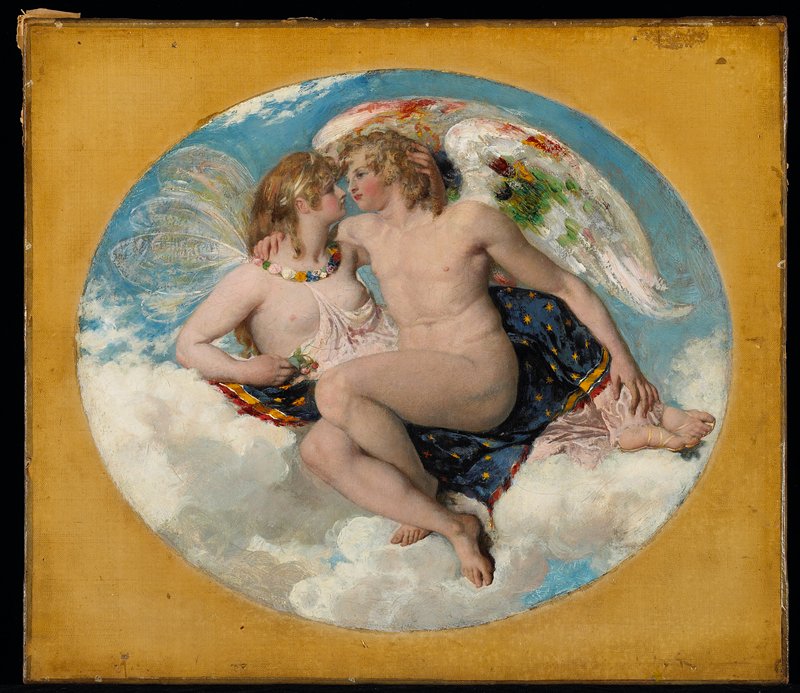
Cupid and Psyche
May one see it?
Yes, receiving visitors

Minneapolis Institute of Art
RoomG353Minneapolis, United States
On public display.
- Checked
- In this state since
- Source
- The museum
Particulars
- Accession number
- 63.49
In the catalog
Sources
- Minneapolis Institute of Art
- Image: Minneapolis Institute of Art — public domain
Meanwhile, in the life of William Etty
The whole life1820
Freeling commissions “Cleopatra”
Sir Francis Freeling, who had admired “The Coral Finder” at the exhibition, learned that it was already sold and commissioned from Etty a similar picture on a more ambitious scale for 200 guineas. Etty had for some time been musing on a painting of Cleopatra and based it loosely on the composition of “The Coral Finder”.
23 June 1822
Sets out for Italy with Richard Evans
Remembering the homesickness of his last journey, Etty travelled this time with Richard Evans, who had also studied under Lawrence; despite warnings of the heat, they set out on 23 June 1822 aiming to reach Rome. They crossed to France by the recently developed steamboat, reached Paris on 26 June and spent two weeks visiting Versailles and the galleries; Etty was most impressed by Rubens’s Marie de’ Medici cycle, elements of which he later reused in many of his own works.
10 August 1822
Rome: the Sistine Chapel and Canova
Passing through Dijon, Switzerland, Milan (where they saw Leonardo’s Last Supper and the Brera Gallery) and Florence, Etty and Evans reached Rome on 10 August 1822. Somewhat disappointed by the city, Etty was highly impressed by Michelangelo’s “almost Venetian” colour in the Sistine Chapel and, on Lawrence’s recommendation, met Antonio Canova shortly before the sculptor’s death.
1822–1823
Seven months in Venice
Feeling unsettled in Rome, Etty went to Venice intending to stay ten days, but with a letter of introduction from Charles Lock Eastlake he was taken into the house of Harry D’Orville, the British vice consul, and remained for over seven months. Long convinced that Venice was his spiritual home, he copied paintings in Venetian collections by day and attended the Academy’s life class by night, producing around 50 oil paintings and numerous pencil sketches.
1822–1823
“Il Diavolo”: watching him paint becomes a spectacle
In Venice Etty acquired the nickname “Il Diavolo” for the speed at which he painted, and watching him work became a spectacle in its own right: Gioachino Rossini, Ladislaus Pyrker, then Patriarch of Venice, and others came to see him. The Academy’s instructors admired his flesh tones, while Etty, devoted to his studies, exhibited no original work in 1823.
1823
Honorary Academician of the Venetian Academy
The members of the Venetian Academy of Fine Arts were so impressed by Etty that they elected him an Honorary Academician.