 Martin SchongauerGerman, 1440–1491
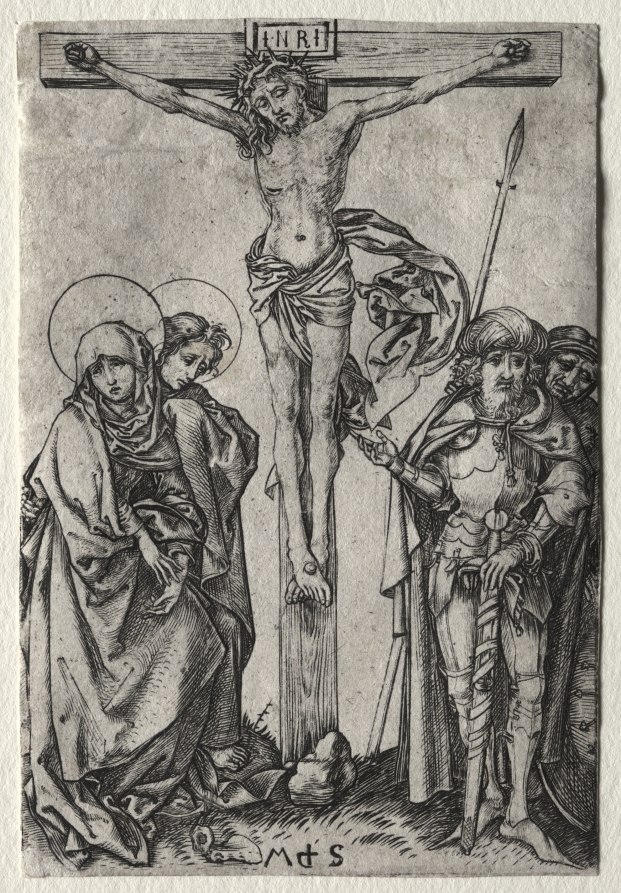
Christ on the Cross
Can I see it?
Not on view at present
Where is “Christ on the Cross” now? Collection: The Cleveland Museum of Art, Cleveland. Not on view at present. Checked October 12, 2026.

Cleveland, United States
It belongs to the collection, but is not on display at present.
- Checked
- In this state since
- Source
- The museum
About the work
Martin Schongauer engraved several variations of the Crucifixion, often inspired by fifteenth-century Netherlandish paintings of the same subject. Here, the thin and emaciated body of Christ hangs at the top of a central cross. On the left, saint John the Evangelist supports the fainting Virgin Mary. On the right, the Roman Centurion and the spear-bearing soldier Longinus (who would later stab Christ to make sure he was dead) look sorrowfully at the viewer and gesture toward Christ. The development of early printing methods during the fifteenth century offered more people personal devotional images that were previously limited to less affordable media, like paintings, sculptures, or illuminated manuscripts. Images of the Crucifixion like this functioned as devotional tools meant to help the faithful to meditate on Christ's sufferings, his sacrifice, and redemption of humanity.
The Cleveland Museum of Art
Details
- Accession number
- 1927.305
In the catalog
Sources
- The Cleveland Museum of Art
- Image: The Cleveland Museum of Art — Museum open access
In the life of Martin Schongauer
The whole lifec. 1466 – 1469
Learns painting from Caspar Isenmann
After early training in his father’s goldsmith workshop, he is thought to have learned painting from Colmar’s leading master Caspar Isenmann, a neighbour of his parents and a follower of Early Netherlandish painting. The older view that Master E. S. taught him engraving is now doubted by scholars.
not after 1469
Journeyman travels through Burgundy and the Netherlands
He makes the journeyman’s tour expected of artists of his time, begun by 1469 at the latest: he visits Burgundy and the Netherlands and gets to know the work of Rogier van der Weyden, Dirk Bouts, the Cologne school around Stefan Lochner and the Flemish school of Jan van Eyck. He is thought to have worked for a time with Hans Pleydenwurff in Nuremberg, and some scholars believe he also visited Spain, perhaps Portugal.
early 1470s
Begins signing his engravings with a monogram
He is thought to have begun signing his engravings with the monogram M†S in the early 1470s; 116 engravings are attributed to him, and none of them is dated.
1471
Sets up his own workshop in Colmar
By 1471 he has his own workshop: that year payments are made for an altarpiece for the Dominican church in Colmar, now in the museum and regarded as a workshop production.
c. 1471 – 1491
Twenty years at the head of German engraving
He dominates German engraving for about twenty years: his 116 engravings are known in Germany and Italy, reach England and Spain, and in Italy their maker is nicknamed “Beautiful Martin”; according to Vasari, Michelangelo copied his Temptation of St Anthony.
2 February 1491
Died