.jpg?width=96) Vincent van GoghDutch, 1853–1890
Vincent van GoghDutch, 1853–1890The Starry Night
May one see it?
Yes, receiving visitors

The Museum of Modern Art
RoomMoMA, Floor 5, 501New York, United States
On public display.
- Checked
- 11 days ago
- Source
- The museum's own collection data
About the painting
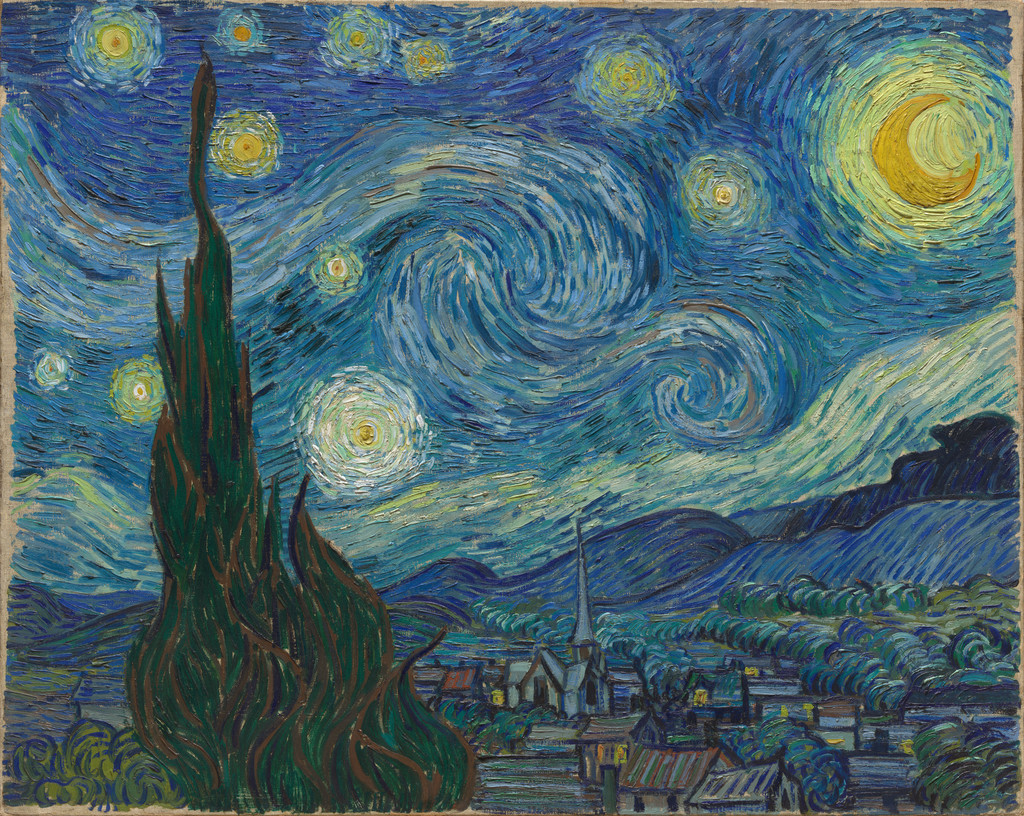
The Starry Night is an oil-on-canvas painting by the Dutch Post-Impressionist painter Vincent van Gogh. Painted in June 1889, it depicts the view from the east-facing window of his asylum room at Saint-Rémy-de-Provence, just before sunrise, with the addition of an imaginary village. It has been in the permanent collection of the Museum of Modern Art in New York City since 1941, acquired through the Lillie P. Bliss Bequest. Described as a "touchstone of modern art", The Starry Night has been regarded as one of the most recognizable paintings in the Western canon.
Read on
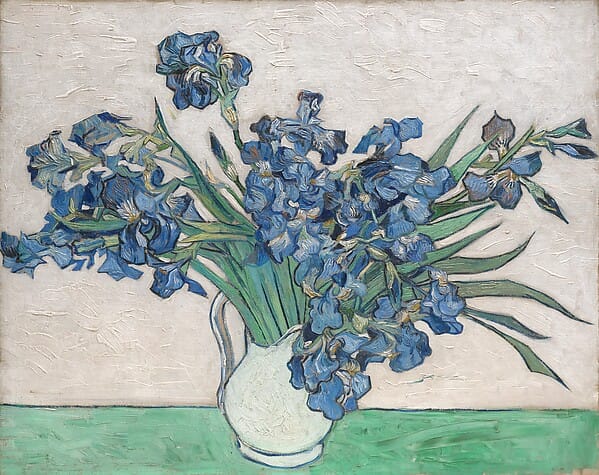
The painting was created in mid-June 1889, inspired by the view from Van Gogh’s bedroom window at the Saint-Paul-de-Mausole mental asylum near Saint-Rémy-de-Provence. The former monastery functioned as a mental asylum, where Van Gogh voluntarily admitted himself on 8 May 1889, following a mental breakdown and his infamous act of self-mutilation that occurred in late December 1888. Catering to wealthy patients, the facility was less than half full at the time of Van Gogh's admission, allowing the artist access to both a second-story bedroom and a ground-floor studio. During his year-long stay, he remained highly productive, creating many paintings including Irises, a self-portrait, and The Starry Night.
The painting's celestial elements include Venus, which was visible in the sky at the time, and the Moon, although the Moon's depiction is not astronomically accurate. The cypress trees in the foreground were exaggerated in scale compared to other works. Van Gogh's letters suggest he viewed them primarily in aesthetic rather than symbolic terms. The village in the painting is an imaginary addition, based on sketches rather than the actual landscape seen from the asylum.
The Starry Night has been subject to various interpretations, ranging from religious symbolism to representations of Van Gogh’s emotional turmoil. Some art historians link the swirling sky to contemporary astronomical discoveries, while others see it as an expression of Van Gogh’s personal struggles. Van Gogh himself was critical of the painting, referring to it as a "failure" in letters to his brother, Theo. The artwork was inherited by Theo upon Vincent's death. Following Theo's death six months after Vincent's, the work was owned by Theo's widow, Jo, who sold it to Émile Schuffenecker in 1901, who sold it back to Jo in 1905. From 1906 to 1938 it was owned by one Georgette P. van Stolk, of Rotterdam. Paul Rosenberg bought it from van Stolk in 1938 and sold it (by exchange) to the Museum of Modern Art in New York in 1941, which rarely loans it out. Scientific analysis of the painting has confirmed Van Gogh’s use of ultramarine and cobalt blue for the sky, with indian yellow and zinc yellow for the stars and moon.
Particulars
- Accession number
- 472.1941
Sources
- The Museum of Modern Art: the museum's own open data · fetched 11 days ago
- Image: The Museum of Modern Art — © the artist or rights holder
Meanwhile, in the life of Vincent van Gogh
The whole lifeFebruary 1888
To Arles, dreaming of a “Studio of the South”
The public still neither accepted nor bought his paintings, and in February 1888 Van Gogh left for Arles in the south of France to found a “Studio of the South”, a brotherhood of like-minded artists in which he gave Gauguin the leading role. Theo backed the plan with money.
23 October 1888
Gauguin arrives in Arles
After much pleading Gauguin arrived in Arles, and in November the two painted together: Gauguin portrayed Van Gogh in “The Painter of Sunflowers”, and their first joint outing was to the Alyscamps. At Gauguin's suggestion Vincent painted from memory, producing “Memory of the Garden at Etten”.
23 December 1888
The severed ear
After an altercation on the evening of 23 December, Van Gogh, seemingly hearing voices, severed his left ear, wholly or in part, with a razor and delivered it, wrapped in paper, to a woman at a brothel. Next morning a policeman found him unconscious; in hospital he was diagnosed with “acute mania with generalised delirium”.
May 1889
Voluntarily into the Saint-Paul asylum
Van Gogh left Arles and voluntarily entered the Saint-Paul-de-Mausole asylum, a former monastery in Saint-Rémy-de-Provence, accompanied by the Protestant clergyman Frédéric Salles. Of his two cells with barred windows one became a studio, and the clinic and its garden became the main subjects of his paintings.
27 July 1890
A fatal wound: a revolver shot
Out painting, Van Gogh shot himself in the chest with a revolver he had bought to scare off birds while working outdoors; the bullet passed below his heart, and he made his own way back to his room at the inn. Theo arrived the next day and stayed with him to the end; according to Theo, Vincent's last words were: “The sadness will last forever.”
29 July 1890
Died