ART WIKI32,963 on view
MapCollectionArtistsMuseumsExhibitionsJournal
Sign in

ART WIKI

Where the masterpiece hangs, and when they let you in.

Collections: Art Institute of Chicago, Getty Villa, Harvard Art Museums, Hirshhorn Museum and Sculpture Garden, J. Paul Getty Museum, Minneapolis Institute of Art, Musée du Louvre, National Gallery of Art, National Museum of Asian Art, National Portrait Gallery (Smithsonian), Pushkin State Museum of Fine Arts, Rijksmuseum, Smithsonian American Art Museum, SMK — National Gallery of Denmark, State Hermitage Museum, State Russian Museum, The Cleveland Museum of Art, The Metropolitan Museum of Art, The Museum of Modern Art, Tretyakov Gallery, Victoria and Albert Museum, Whitney Museum of American Art, State Catalogue of the Museum Fund of Russia (274 museums), Europeana (19 museums), Wikidata (6 museums), Paris Musées (12 museums), and Joconde, the French Ministry of Culture's museum database (495 museums). Images belong to their rights holders.

Sections

  • Map
  • Search
  • Collection
  • Masterpieces
  • On view now
  • Artists

More

  • Museums & galleries
  • Exhibitions
  • Journal
  • Where the data comes from
  • Privacy & cookies
HomeMapBrowse
  1. Collection/
  2. Kupferstich-Kabinett Dresden/
  3. Auf der Bühne
Auf der Bühne, Edgar Degas, 1876
Edgar Degas, portraitEdgar DegasFrench, 1834–1917

Auf der Bühne

1876 · Print

May one see it?

Unknown

Kupferstich-Kabinett Dresden

Dresden, Germany

The owner is known; whether it is on view today is not.

In this state since
Sep 27, 2026
Source
The museum
On the mapMuseum page

Particulars

1876 · aged 42
18341917

In the catalog

PrintsRealismImpressionism19th century

Sources

  • Kupferstich-Kabinett Dresden
  • Image: Kupferstich-Kabinett Dresden — In Copyright

Meanwhile, in the life of Edgar Degas

The whole life
  1. 1870s

    From “de Gas” back to plain “Degas”

    The archives disproved the legend of an ancient noble line: the artist's paternal ancestors were bakers, and the name “de Gas” was invented by his father, who commissioned a false genealogy. In the 1870s Edgar returned to the plain spelling, Degas.

  2. 1873–1874

    His brother's debts: he sells his house and collection

    After his father's death Degas learned that his brother René had run up enormous business debts. To save the family's reputation he sold his house and an inherited art collection and for the first time in his life depended on sales of his own work.

  3. 1874

    The first Impressionist exhibition

    Disenchanted with the Salon, Degas joined a group of young artists organizing an independent exhibiting society. He took a leading role in organizing the eight shows of 1874–1886 and exhibited in all but one, despite constant conflicts with the group.

  4. 13 February 1874

    Goncourt notes Degas's laundresses and dancers

    Edmond de Goncourt wrote in his diary that Degas had chosen laundresses and dancers as his chief modern subjects, finding in their fabrics an occasion for light and delicate tones. After visiting the studio he called Degas the man who best caught the soul of modern life.

  5. mid-1870s

    Back to etching, and monotype

    After a ten-year break Degas returned to etching, at first guided by his old friend Ludovic-Napoléon Lepic, and began experimenting with lithography and monotype; he produced some 300 monotypes.

  6. 1877

    Friendship with Mary Cassatt

    Degas invited Mary Cassatt to show in the third Impressionist exhibition, having admired her portrait “Ida” at the Salon of 1874. He introduced her to pastel and engraving, while she helped him sell paintings and promoted his reputation in the United States.
More by Edgar Degas

All works
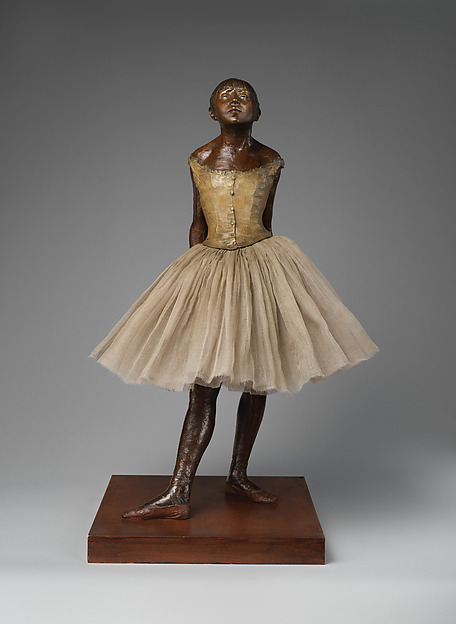
The Little Fourteen-Year-Old Dancer, Edgar Degas, modeled 1881, cast 1922, modern tutu

The Little Fourteen-Year-Old Dancer

modeled 1881, cast 1922, modern tutu · The Metropolitan Museum of Art

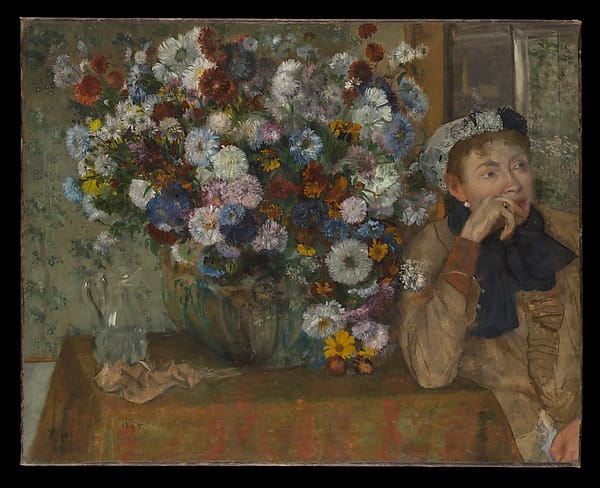
A Woman Seated beside a Vase of Flowers (Madame Paul Valpinçon?), Edgar Degas, 1865

A Woman Seated beside a Vase of Flowers (Madame Paul Valpinçon?)

1865 · The Metropolitan Museum of Art

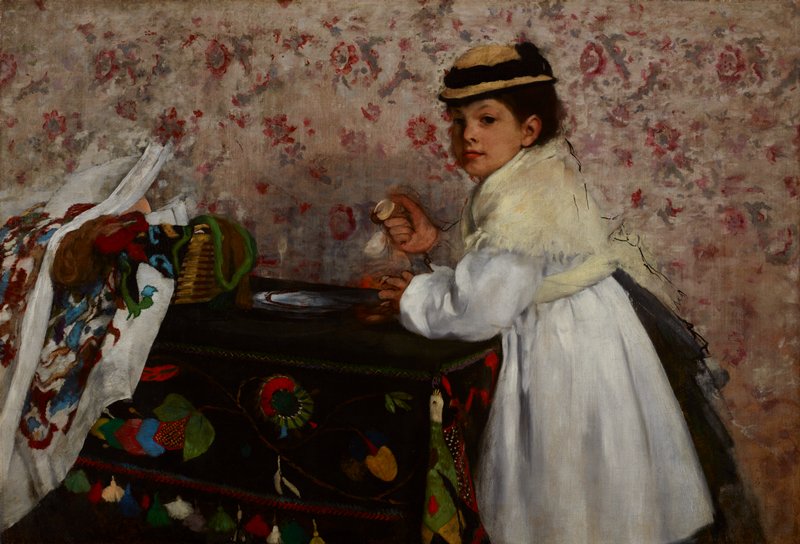
Portrait of Mlle. Hortense Valpinçon, Edgar Degas, c. 1871

Portrait of Mlle. Hortense Valpinçon

c. 1871 · Minneapolis Institute of Art

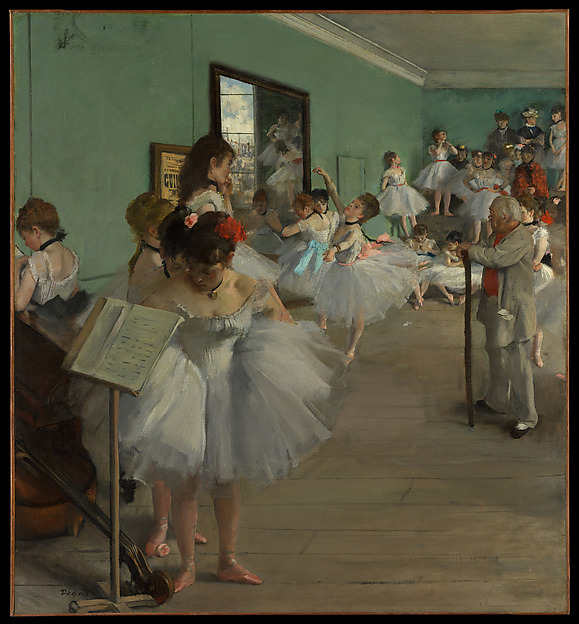
The Dance Class, Edgar Degas, 1874

The Dance Class

1874 · The Metropolitan Museum of Art

Woman Having Her Hair Combed, Edgar Degas, ca. 1886–88

Woman Having Her Hair Combed

ca. 1886–88 · The Metropolitan Museum of Art

Study in the Nude of Little Dancer Aged Fourteen (Nude Little Dancer), Edgar Degas, original wax c. 1878-1881, cast 1920/1926

Study in the Nude of Little Dancer Aged Fourteen (Nude Little Dancer)

original wax c. 1878-1881, cast 1920/1926 · National Gallery of Art

Horse Galloping on the Right Foot, Edgar Degas, late 1880s

Horse Galloping on the Right Foot

late 1880s · National Gallery of Art

Horse Trotting, the Feet Not Touching the Ground, Edgar Degas, 1870s

Horse Trotting, the Feet Not Touching the Ground

1870s · National Gallery of Art

From the collection of Kupferstich-Kabinett Dresden

Museum page
Der Erzengel Michael, Raphael

Raphael

Der Erzengel Michael

Kopf einer jungen Frau mit Turban und Perlenkette, Raphael

Raphael

Kopf einer jungen Frau mit Turban und Perlenkette

Plakat: I. Kunstausstellung der Wiener Secession, Gustav Klimt, 1898

Gustav Klimt

Plakat: I. Kunstausstellung der Wiener Secession, 1898

Jan Antonides van der Linden, Professor der Medizin in Leiden, Rembrandt, 1665

Rembrandt van Rijn

Jan Antonides van der Linden, Professor der Medizin in Leiden, 1665

Jan Antonides van der Linden, Professor der Medizin in Leiden, Rembrandt, 1665

Rembrandt van Rijn

Jan Antonides van der Linden, Professor der Medizin in Leiden, 1665

Diana und Aktaion, Rembrandt, 1663–1665

Rembrandt van Rijn

Diana und Aktaion, 1663–1665

Petrus am Totenbett der Tabea, Rembrandt, 1662–1665

Rembrandt van Rijn

Petrus am Totenbett der Tabea, 1662–1665

Die Frau mit dem Pfeil (Venus und Cupido?), Rembrandt, 1661

Rembrandt van Rijn

Die Frau mit dem Pfeil (Venus und Cupido?), 1661