ART WIKI33,040 on view
MapCollectionArtistsMuseumsExhibitionsJournal
Sign in

ART WIKI

Where the masterpiece hangs, and when they let you in.

Collections: Art Institute of Chicago, Getty Villa, Harvard Art Museums, Hirshhorn Museum and Sculpture Garden, J. Paul Getty Museum, Minneapolis Institute of Art, Musée du Louvre, National Gallery of Art, National Museum of Asian Art, National Portrait Gallery (Smithsonian), Pushkin State Museum of Fine Arts, Rijksmuseum, Smithsonian American Art Museum, SMK — National Gallery of Denmark, State Hermitage Museum, State Russian Museum, The Cleveland Museum of Art, The Metropolitan Museum of Art, The Museum of Modern Art, Tretyakov Gallery, Victoria and Albert Museum, Whitney Museum of American Art, State Catalogue of the Museum Fund of Russia (274 museums), Europeana (19 museums), Wikidata (6 museums), Paris Musées (12 museums), and Joconde, the French Ministry of Culture's museum database (495 museums). Images belong to their rights holders.

Sections

  • Map
  • Search
  • Collection
  • Masterpieces
  • On view now
  • Artists

More

  • Museums & galleries
  • Exhibitions
  • Journal
  • Where the data comes from
  • Privacy & cookies
HomeMapBrowse
  1. Collection/
  2. Minneapolis Institute of Art/
  3. Apollo Belvedere (Apollo Pythius)
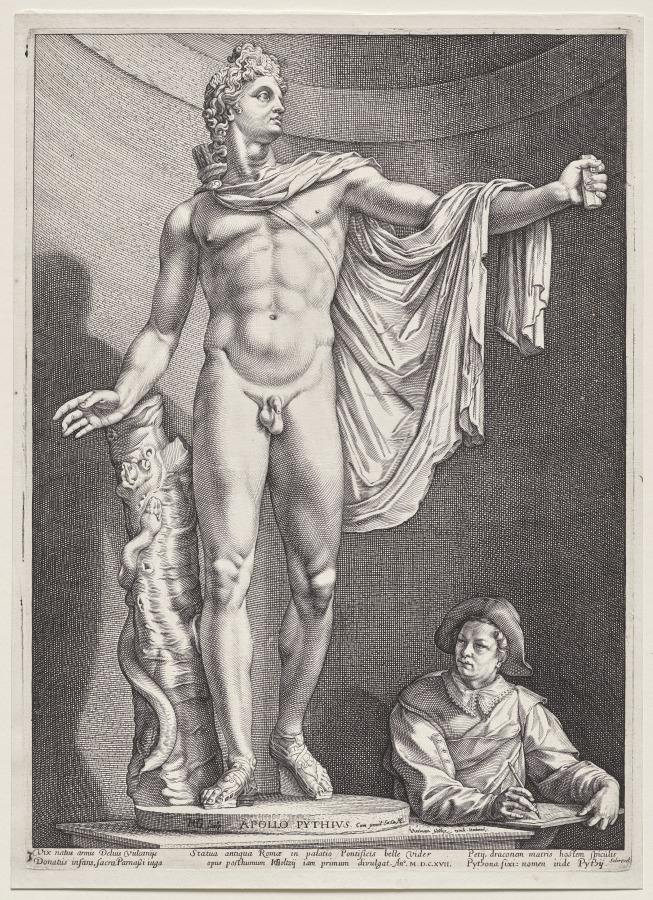
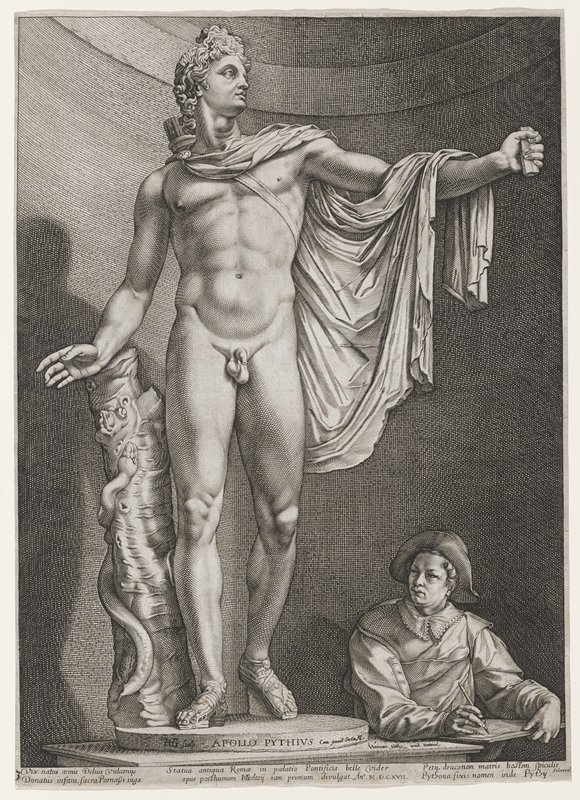
Apollo Belvedere (Apollo Pythius), Hendrick Goltzius, 1590–94 (published 1617)
Hendrick Goltzius, portraitHendrick GoltziusDutch, 1558–1617

Apollo Belvedere (Apollo Pythius)

1590–94 (published 1617) · Print

May one see it?

Not receiving at present

Minneapolis Institute of Art

Minneapolis, United States

It belongs to the collection, but is not on display at present.

Checked
9 days ago
In this state since
Sep 25, 2026
Source
The museum
On the mapMuseum page

About the work

By the late 1580s, Hendrick Goltzius had won a reputation as the greatest engraver of his time. He was so well known that when he travelled to Italy, 1590–91, to see the wonders of antiquity and the Renaissance, he went incognito for his safety and privacy. His ability to incise swelling and tapering lines in complex patterns is on full display in this engraving of the Apollo Belvedere, then already housed in the Vatican, where it remains today. Near the base of the sculpture, he shows a young artist studying the statue, just as he did.

Goltzius labeled the sculpture Apollo Pythius, because scholars interpreted it as showing Apollo having just slain Python, the chthonic (underworld) serpent guarding Delphi. We see the arrows in his quiver, and the fragmentary shaft in his left has represents his bow. Apollo better be careful, for another serpent is slithering up the tree.

Minneapolis Institute of Art

Particulars

1590–94 (published 1617)
15581617
Accession number
2020.21.1

In the catalog

PrintsEngravingRenaissance16th centuryNetherlands

Sources

  • Minneapolis Institute of Art
  • Image: Minneapolis Institute of Art — public domain

Meanwhile, in the life of Hendrick Goltzius

The whole life
  1. late 1580s

    Depression and consumption

    From the late 1580s he suffered from depression and consumption; his family life was unhappy.

  2. 1590

    Departure for Italy

    He fled from his wife and, despite his illnesses, set out for Italy — via Hamburg and Munich to Venice, Bologna and Florence. Part of the way he traveled on foot, passing himself off as a commoner, "partly out of a love of mystification."

  3. January 1591

    Eight months in Rome

    He arrived in Rome in January 1591 and stayed eight months (with a brief sojourn in Naples). He discovered Raphael, was especially impressed by Michelangelo and Giambologna, and studied art from classical sculpture to the masters of the Renaissance.

  4. August 1591

    Return to Haarlem with a collection of drawings

    He returned to Haarlem, bringing from Italy a large collection of drawings that he used for the rest of his life; from the Roman material three engravings of classical statues are known, including the Farnese Hercules.

  5. c. 1600

    Abandoning engraving for painting

    Around 1600, partial paralysis of his right hand (maimed in childhood in a fall onto burning coals) forced Goltzius to give up engraving and turn to painting; he handed over his print publishing to his stepson Jacob Matham. About fifty surviving paintings are attributed to him.

  6. 1 January 1617

    Died

More by Hendrick Goltzius

All works
Lot and his Daughters, Hendrick Goltzius, 1616

Lot and his Daughters

1616 · Rijksmuseum

Fall of Man, Hendrick Goltzius, 1608

Fall of Man

1608 · State Hermitage Museum

Baptism, Hendrick Goltzius, 1608

Baptism

1608 · State Hermitage Museum

Dying Adonis, Hendrick Goltzius, 1609

Dying Adonis

1609 · Rijksmuseum

Vertumnus and Pomona, Hendrick Goltzius, 1613

Vertumnus and Pomona

1613 · Rijksmuseum

The Fall of Man, Hendrick Goltzius, 1616

The Fall of Man

1616 · National Gallery of Art

Apollo, Hendrick Goltzius, 1588

Apollo

1588 · The Cleveland Museum of Art

Apollo Belvedere, Hendrick Goltzius, 1592

Apollo Belvedere

1592 · The Cleveland Museum of Art

Neighbors at Minneapolis Institute of Art

Museum page
Olive Trees, Vincent van Gogh, 1889

Vincent van Gogh

Olive Trees, 1889

Grainstack, Sun in the Mist, Claude Monet, 1891

Claude Monet

Grainstack, Sun in the Mist, 1891

Lucretia, Rembrandt van Rijn, 1666

Rembrandt van Rijn

Lucretia, 1666

Self-Portrait with Dr. Arrieta, Francisco José de Goya y Lucientes, 1820

Francisco de Goya

Self-Portrait with Dr. Arrieta, 1820

Study for Improvisation V, Vassily Kandinsky, 1910

Vasily Kandinsky

Study for Improvisation V, 1910

Tahitian Landscape, Paul Gauguin, 1891

Paul Gauguin

Tahitian Landscape, 1891

Chestnut Trees at Jas de Bouffan, Paul Cézanne, c. 1885–86

Paul Cézanne

Chestnut Trees at Jas de Bouffan, c. 1885–86

The Union of England and Scotland (Charles I as the Prince of Wales), Peter Paul Rubens, 1633–34

Peter Paul Rubens

The Union of England and Scotland (Charles I as the Prince of Wales), 1633–34