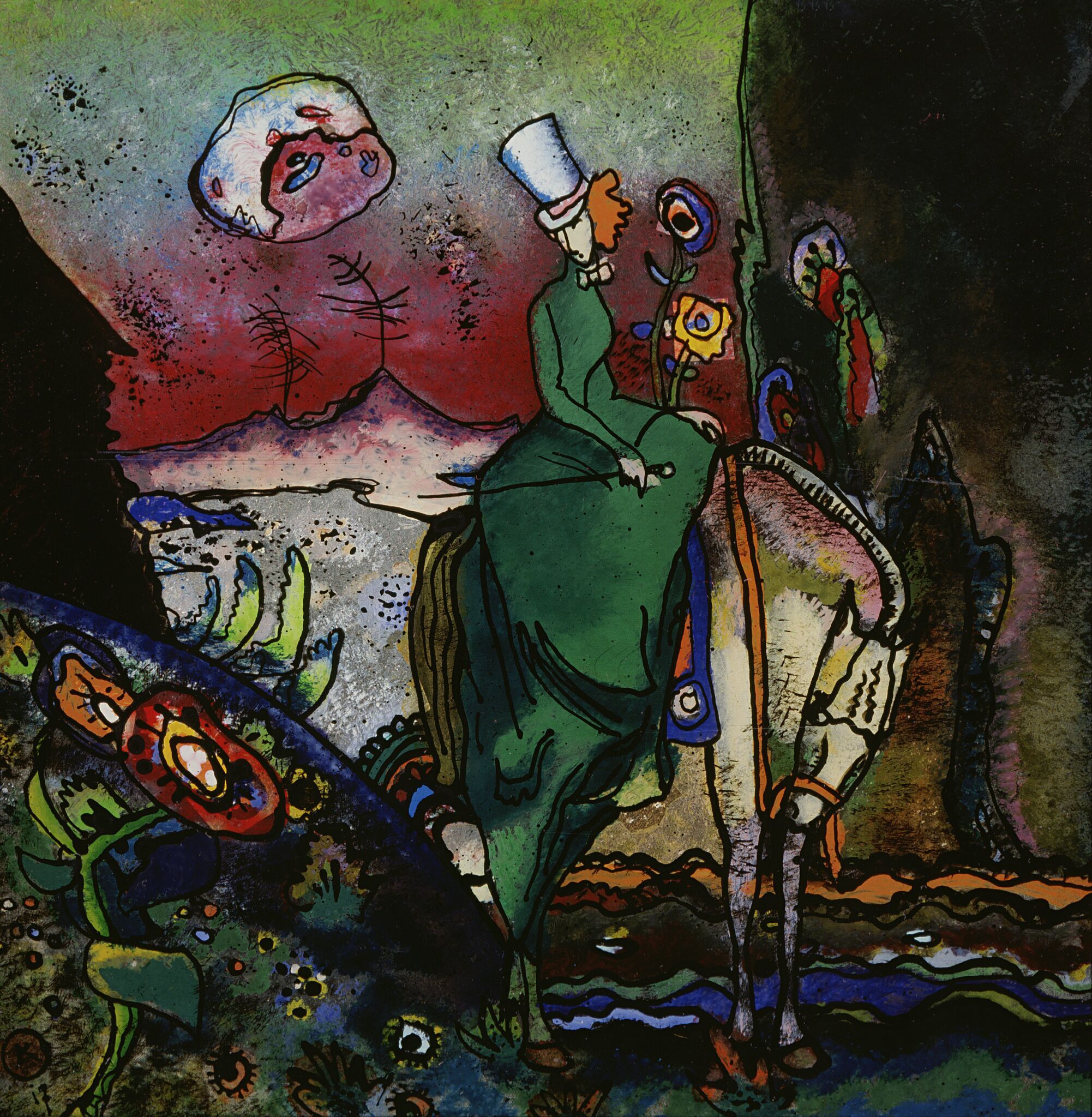
 Vasily KandinskyFrench, 1866–1944
Амазонка
May one see it?
Unknown

Tretyakov Gallery
Moscow, Russia
The owner is known; whether it is on view today is not.
- In this state since
- Source
- The museum
About the work
In the museum's own words — in Russian
В конце 1910-х годов Кандинский вновь обратился к технике работы на стекле, продолжая опыты по «развеществлению» предметной формы, начатые им еще в 1911–1912 годах. С этой техникой художник познакомился в Мюнхене, а уже в Москве создал целую серию с изображением галантных сцен в духе «Мира искусства».
В своем эссе 1913 года, рассказывая о пути движения к беспредметности, Кандинский выводит «Композицию VI» именно из своей подстекольной живописи. Художник настоятельно подчеркивает, что именно в этой зародившейся в Средневековье форме народного баварского искусства он и находит суть искусства будущего – беспредметность.
Read on
Когда возникла необходимость реставрировать одну из этих работ, представилась возможность заглянуть «по ту сторону» живописи и увидеть внутреннюю поверхность стекла. Оказалось, что «двуликое» стекло у Кандинского действительно таит в себе возможность трансформации материи. С лицевой стороны видна собственно «подстекольная живопись» – изящный, полностью фигуративный рисунок пером с раскраской яркими локальными пятнами, а с оборотной стороны разворачивается динамичная, экспрессивная композиция цветных форм, почти теряющих фигуративные очертания.
Исследование процесса исполнения этой композиции позволяет доказать, что сама технология создания подстекольной живописи – от уточняющего контура к подмалевку, от детали к общему, от видимого к скрытому – подсказала Кандинскому принципы преодоления предметности и инициировала эксперименты по «растворению вещественных форм».
Tretyakov Gallery
Particulars
- Accession number
- 22622
In the catalog
Sources
- Tretyakov Gallery
- Image: Tretyakov Gallery — © State Tretyakov Gallery
Meanwhile, in the life of Vasily Kandinsky
The whole life1916
The break with Münter in Stockholm
The relationship between Kandinsky and Münter worsened through mutual tension and disappointment over his reluctance to marry, and formally ended in Stockholm in 1916.
29 January 1917
Marries Nina Andreevskaya
Kandinsky, already fifty, married Nina Nikolaevna Andreevskaya, the daughter of a captain and a student of the Moscow Higher Courses for Women.
February 1917
Married: Nina Nikolajewna Andreevskaja
19 November 1917
Birth of his son Vsevolod
A son, Vsevolod, was born to Kandinsky and Nina; the boy was baptized in the Neopalimovskaya church near Devichye Pole in Moscow on 7 January 1918.
1917–1921
Cultural politics in revolutionary Moscow
After the revolution Kandinsky worked actively in public life: he helped protect monuments, founded the Museum of Painterly Culture and the Russian Academy of Artistic Sciences, taught at the Vkhutemas, sat on the fine arts collegium of the People's Commissariat for Education and chaired the All-Russian purchasing commission. He also became vice-president of the RAKhN.
1918–1921
The Institute of Artistic Culture: rejected by the radicals
Kandinsky became the first director of the Institute of Artistic Culture in Moscow, but the institute's radical members judged his spiritual, expressionist view of art too individualistic and bourgeois. He painted little in these years but taught a great deal, using a programme of form and colour analysis.
_MET_DP236124.jpg?width=1280)