 Vasily KandinskyFrench, 1866–1944
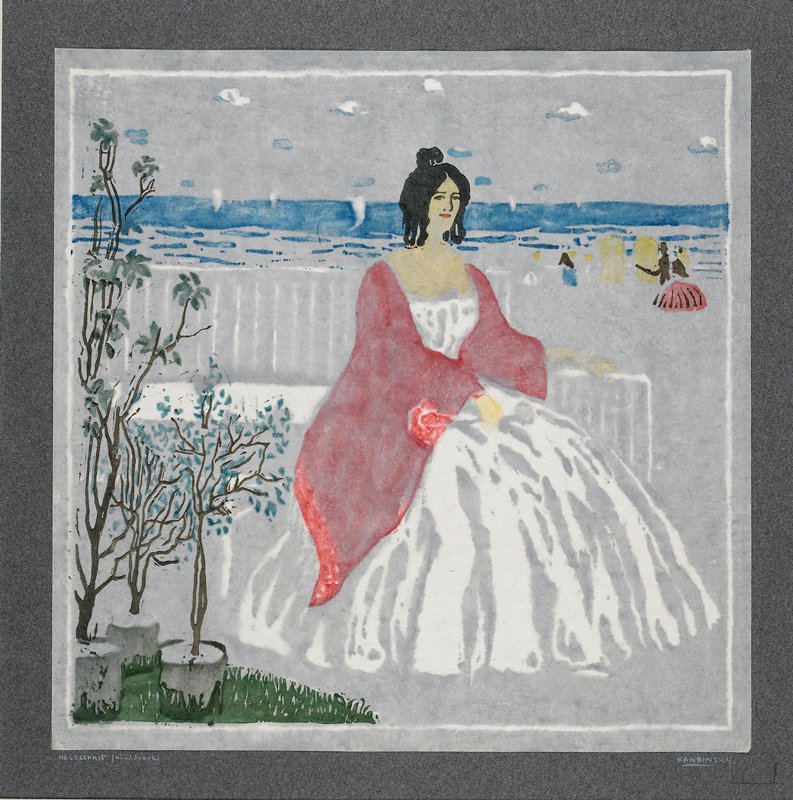
Am Strande
May one see it?
Not receiving at present

Minneapolis, United States
It belongs to the collection, but is not on display at present.
- Checked
- In this state since
- Source
- The museum
About the work
It makes sense that Vassily Kandinsky found woodcut to be a springboard to abstract painting. His color woodcuts forced him to flatten planes, ignore perspective, and reduce forms to their essentials, all of which would later be key to his abstractions. In 1903 and 1904 he made some forty-eight woodcuts, including On the Beach. The print's romantic mood can be traced to Kandinsky's personal life: in 1903 his student Gabriele Münter had joined him in the Bavarian town of Kallmünz, and he was falling deeply in love with her. Rather than typical oil-based color, Kandinsky inked his blocks with watercolor, resulting in a translucency well suited to his figure's exotic costume.
Minneapolis Institute of Art
Particulars
- Accession number
- P.353
In the catalog
Sources
- Minneapolis Institute of Art
- Image: Minneapolis Institute of Art — © Minneapolis Institute of Art
Meanwhile, in the life of Vasily Kandinsky
The whole life1900–1901
The Academy of Fine Arts: Franz von Stuck's class
In 1900 Kandinsky entered the Munich Academy of Fine Arts and until 1901 studied under Franz von Stuck.
1901
Founds the Phalanx association and school
Kandinsky founded the artists' association Phalanx and, within it, a painting school where he taught.
1902
Becomes close to Gabriele Münter
In summer the Phalanx school went to Kallmünz, and there the thirty-five-year-old Kandinsky grew close to a twenty-six-year-old student, Gabriele Münter. Their relationship was never formalized, although he divorced his first wife only in 1911.
1903
Engaged to Münter while still married
In the summer of 1903 Kandinsky and Münter became engaged while he was still married to Anna; until 1908 they travelled widely through Europe, Russia and North Africa.

_MET_DP236124.jpg?width=1280)