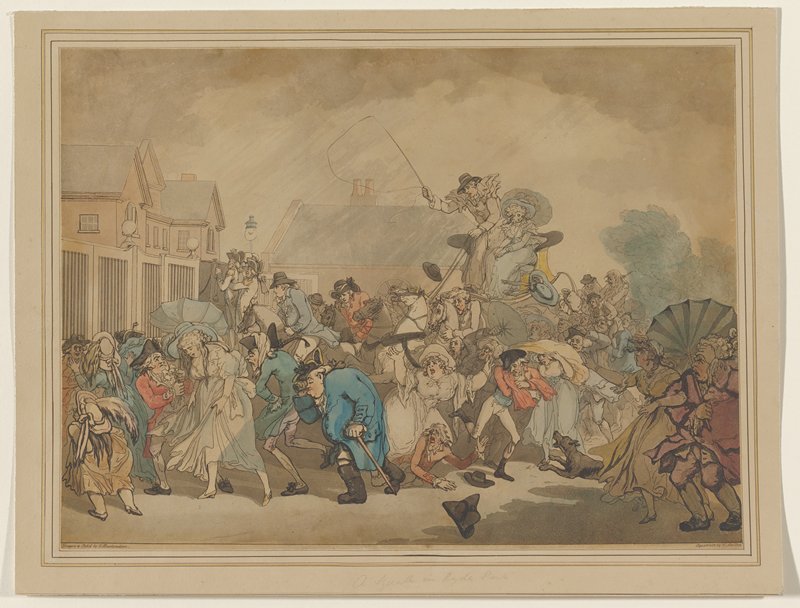
 Thomas RowlandsonBritish, 1756–1827
A Squall in Hyde Park
Can I see it?
Not on view at present
Where is “A Squall in Hyde Park” now? Collection: Minneapolis Institute of Art, Minneapolis. Not on view at present. Checked September 29, 2026.

Minneapolis, United States
It belongs to the collection, but is not on display at present.
- Checked
- In this state since
- Source
- The museum
Details
- Accession number
- P.16, 968
In the catalog
Sources
- Minneapolis Institute of Art
- Image: Minneapolis Institute of Art — public domain
In the life of Thomas Rowlandson
The whole life13 July 1757
Born in the City of London
He was born in Old Jewry, in the City of London, to William and Mary Rowlandson, and was baptised on 23 July 1757 at St Mary Colechurch. His father, a weaver, had moved into trading supplies for the textile industry; the birth date of 13 July 1757 comes from the baptismal record, whereas most earlier biographies give 1756.
1772
Becomes a student at the Royal Academy
On leaving school in 1772 he became a student at the Royal Academy. He studied there for six years, but about a third of that time was spent in Paris.
1772–1774
Sent to study in Paris
At sixteen he was sent to Paris, where for two years he studied in a “drawing academy”, drawing the human figure and developing his youthful skill in caricature; he may have studied under Jean-Baptiste Pigalle. On his return to London he took classes at the Royal Academy, then based at Somerset House, and later made frequent tours of the Continent, filling his portfolios with sketches of life and character.
1774 · Workplace
Paris
1775
Exhibits “Dalilah Payeth Sampson a Visit while in Prison at Gaza”
In 1775 he showed at the Royal Academy a drawing, “Dalilah Payeth Sampson a Visit while in Prison at Gaza” (described elsewhere as a painting made that year); he began to be spoken of as a promising student.
1784
“Vauxhall” at the Royal Academy
His drawing of Vauxhall, shown at the Royal Academy exhibition of 1784, was engraved by Pollard, and the print was a success. His scenes of London street life, such as the Vauxhall pleasure gardens with their jostling soldiers, students, tarts and society beauties, are counted among his finest works.