Max ErnstFrankreich, 1891–1976
The Blue Forest
Darf man es sehen?
Ja, es empfängt Besucher

Art Institute of Chicago
Saal396Chicago, Vereinigte Staaten
Öffentlich ausgestellt. Wer dafür bürgt, steht unten.
- Geprüft
- vorgestern
- Unverändert seit
- 19. Aug. 2026
- Quelle
- Sammlungsdaten des Museums selbst
About the painting
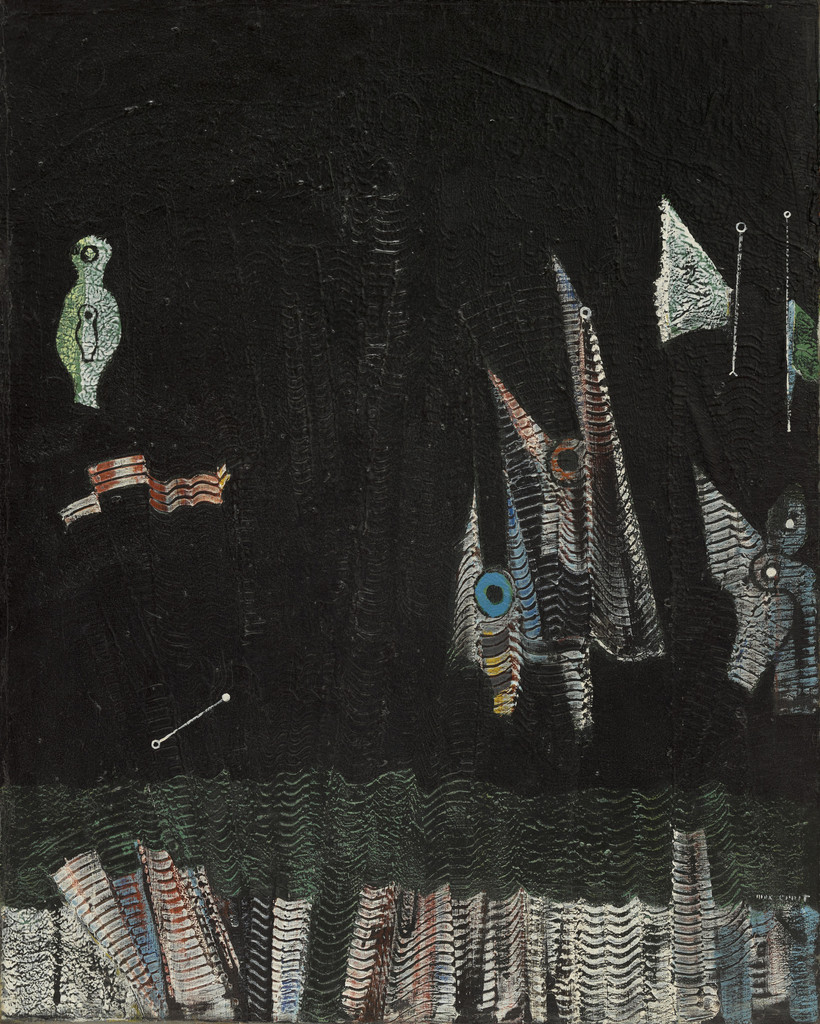
Max Ernst was one of the most materially inventive artists associated with Surrealism, exhibiting a protean imagination that led him to produce work in an unusually wide range of styles and techniques. This painting belongs to a period, from 1925 to 1928, that was perhaps the most productive and creative of his long career. Most of the artist's extraordinarily rich work of these years depended, directly or indirectly, on a technique referred to as frottage (rubbing), which Ernst used to stimulate his imagination, encouraged in this by Surrealist theories about the processes of inspiration. This technique consisted in placing a piece of paper over a textured object or surface and then rubbing it with a pencil or other tool to obtain an image.
Read on
Using this method as his point of departure, Ernst produced in 1925 a series of exceptionally beautiful drawings, thirty-four of which were published the following year under the title Histoire naturelle (Natural History). This painting shares with these drawings a stark and delicate beauty. Like many other works of this period, it was produced by adapting frottage to oil painting. The techniques used included scraping paint off the canvas, a procedure Ernst called grattage (scraping), or rubbing a cloth dipped in paint over the canvas, as it lay on a variety of textured surfaces from wood planks and wire mesh, as in this case, to string, chair caning, shells, and many other materials. As the title of Ernst's portfolio of drawings indicates, many of his works of these years allude to the natural world. The "Forest" series, exemplified by this painting, resumed a popular Romantic theme that continued to fascinate Surrealist artists(compare, for example, the work of Ernst's close friend Jean Arp) as a repository of mysterious, primeval forces.
Here the chance patterns produced by the wood grain of several wood planks have been transformed into a cluster of towering forms, outlined against a pale sky flecked with blue, yellow, and green. The forest's floor presents a honeycomb pattern seemingly produced by means of a wire mesh, a pattern that is echoed in the sky in scattered bursts of color. The spare simplicity of this image enhances its associative powers, as we are drawn into our own cosmic reverie about a primordial world, encompassing far more than the forest mentioned in the title. Ernst's works thus become, in his own words, a kind of "hypnotic language [that] takes us back to a lost paradise, to cosmic secrets, and teaches us to understand the language of the universe."
—Entry, Margherita Andreotti, Art Institute of Chicago Museum Studies, Vol. 20, No. 2, The Joseph Winterbotham Collection at The Art Institute of Chicago (1994), p. 158-159.
This is one of thirty-five works that comprise the Winterbotham Collection. Click here to learn more about the collection.
Art Institute of ChicagoCC BY 4.0
Angaben
- Inventarnummer
- 1988.221
What it shows
Im Katalog
Quellen
- Art Institute of Chicago: the museum's own open data · abgerufen vor 5 Tagen
- Bild: Art Institute of Chicago — © the artist or rights holder
Derweil im Leben von Max Ernst
Das ganze Leben1923
The Salon des Indépendants: a warm welcome from the Cubists
In 1923 Ernst exhibited at the Salon des Indépendants: the critics ignored his work, but the Cubists Georges Braque, Juan Gris and Louis Marcoussis responded warmly. La belle jardinière, shown there, was bought the next year by the Düsseldorf exhibition centre and later removed at the Nazis’ demand; in 1937 Ernst saw it in a photograph of the “degenerate art” exhibition, and it was most likely destroyed.
1924
To Saigon after the Éluards
In March 1924 Paul Éluard abruptly left for Monaco and then for Vietnam. To raise the fare Ernst sold paintings to the gallery owner Johanna Ey; he met Éluard and Gala in Singapore and Saigon, but Gala stayed with Paul. Ernst went on exploring South-East Asia for several more months.
1926
“Histoire naturelle”: a portfolio of frottages
At Jeanne Bucher’s press Ernst published Histoire naturelle, a portfolio of drawings in the frottage technique, with an introduction by Hans Arp.
1926
The first large show at Galerie van Leer
In 1926 the Paris gallery van Leer held Ernst’s first large exhibition; in place of a preface the catalogue printed poems by Paul Éluard, Benjamin Péret and Robert Desnos.
1926
Diaghilev’s ballet and Breton’s scandal
In 1926 Ernst and Joan Miró designed Romeo and Juliet for Sergei Diaghilev’s company; Breton, indignant at the work with the Ballets Russes, made a scandal at the premiere, and in La Révolution surréaliste he and Aragon accused Ernst and Miró of belittling the idea of surrealism. The next issue, however, carried two of Ernst’s works with an apologia by Éluard.
1927
Married: Marie-Berthe Aurenche