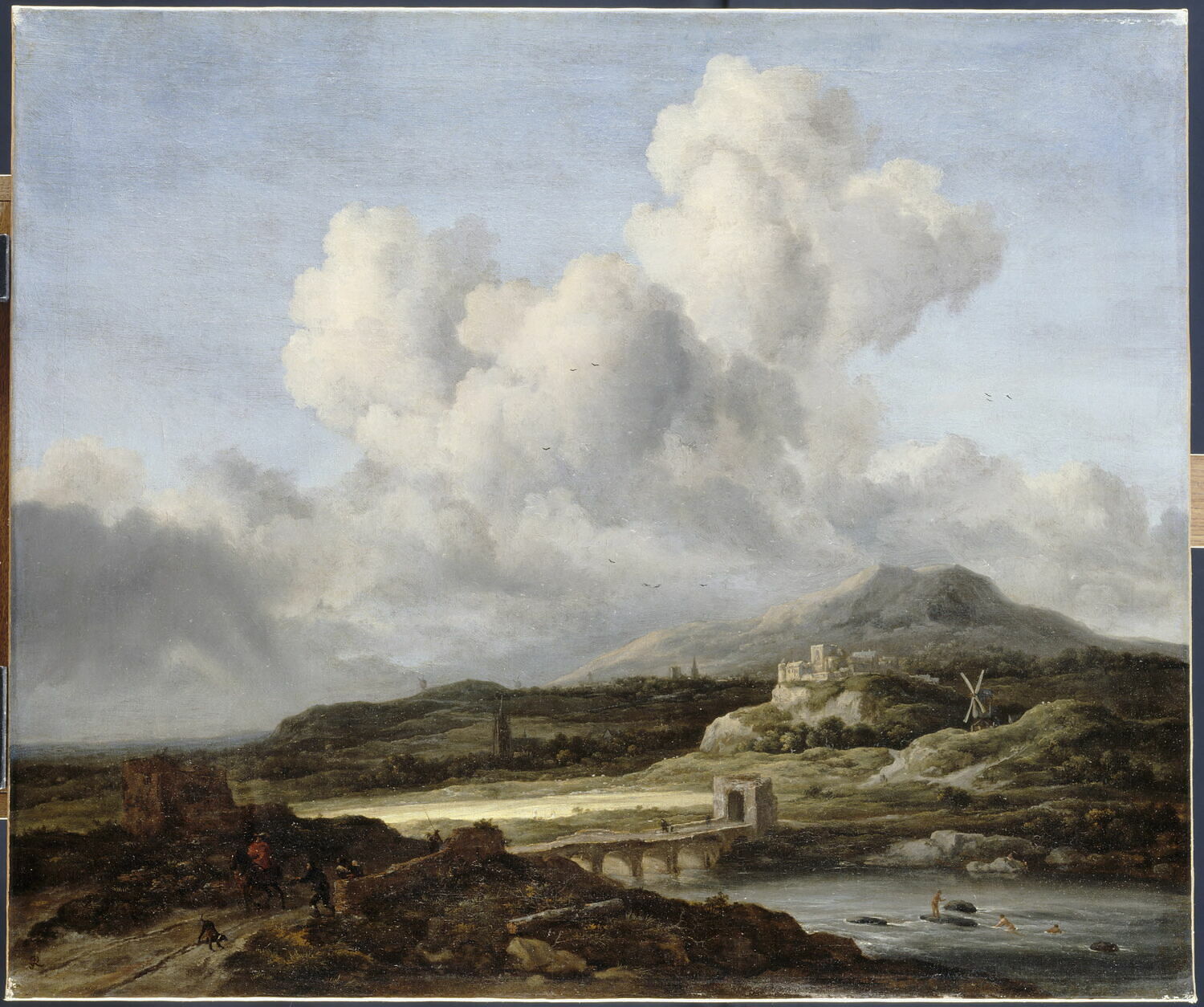
 Jacob Isaacksz. van RuisdaelNiederlande, 1628–1682
Le Coup de soleil
Kann ich es sehen?
Ja, derzeit ausgestellt
Wo ist „Le Coup de soleil“ heute? Louvre, Salle 837, Aile Richelieu, Niveau 2, Paris. Ja, derzeit ausgestellt. Geprüft 26. September 2026.

Schließt bald· bis 18:00
Öffentlich ausgestellt.
- Geprüft
- Unverändert seit
- Quelle
- Das Museum
Über das Gemälde
The Ray of Light, also known as Le Coup de Soleil, (c. 1665) is an oil on canvas painting by the Dutch painter Jacob van Ruisdael.
It is an example of Dutch Golden Age painting and is now in the collection of the Louvre Museum.
This painting was documented by Hofstede de Groot in 1911, who wrote; "664. THE BURST OF SUNSHINE (" Le Coup de Soleil ").
Mehr lesen
Sm. 11. A road leads diagonally across the picture from the left foreground to the right distance. On the left a horseman in a red cloak rides forward; a beggar asks him for alms. A dog runs in front. In the centre the road crosses a stone bridge of four arches over a river to a ruined square tower with an archway. The broad river flows to the right, where three persons bathe near rocks in mid stream. On the farther bank are hills, with a ruined castle half-way up the slope. To the right is a wind-mill; farther back is a village with a church tower. A ray of sunlight, breaking through thick clouds, falls on a field in the left middle distance. The figures, though ascribed in the catalogue to Ph. Wouwerman, are by Ruisdael himself. The picture is strongly influenced by Rembrandt's landscapes, especially in composition. [Cf. 788.]
Signed with the monogram on the left; canvas, 33 inches by 39 inches.
Engraved by Laurent in the Musée Français. In the collection of King Louis XVI.
In the Louvre, Paris, 1902 catalogue, No. 2560; it was valued by the experts in 1816 (at 15,000 francs)".
Influences:
Angaben
- Inventarnummer
- INV 1820
Im Katalog
Quellen
- Louvre
- Bild: Louvre — © 2005 GrandPalaisRmn (musée du Louvre) / Thierry Le Mage
Im Leben von Jacob Isaacksz. van Ruisdael
Das ganze Leben1661
Possibly travels to Germany with Hobbema
In 1661 Ruisdael possibly crossed the German border again with Meindert Hobbema, travelling via the Veluwe, Deventer and Ootmarsum.
1668
Witness at the wedding of his pupil Meindert Hobbema
In 1668 Ruisdael witnesses the marriage of Meindert Hobbema, his only registered pupil. He himself never married — according to Houbraken, to reserve time to serve his old father.
1672
Still comfortable after the Disaster Year
There is no record of Ruisdael owning land or shares, yet he appears to have lived comfortably even after the downturn of the disaster year 1672: in inventories of 1650–1679 his paintings averaged 40 guilders against 19 for attributed paintings generally. The legend that he died poor in a Haarlem almshouse confuses him with his cousin Jacob Salomonszoon.