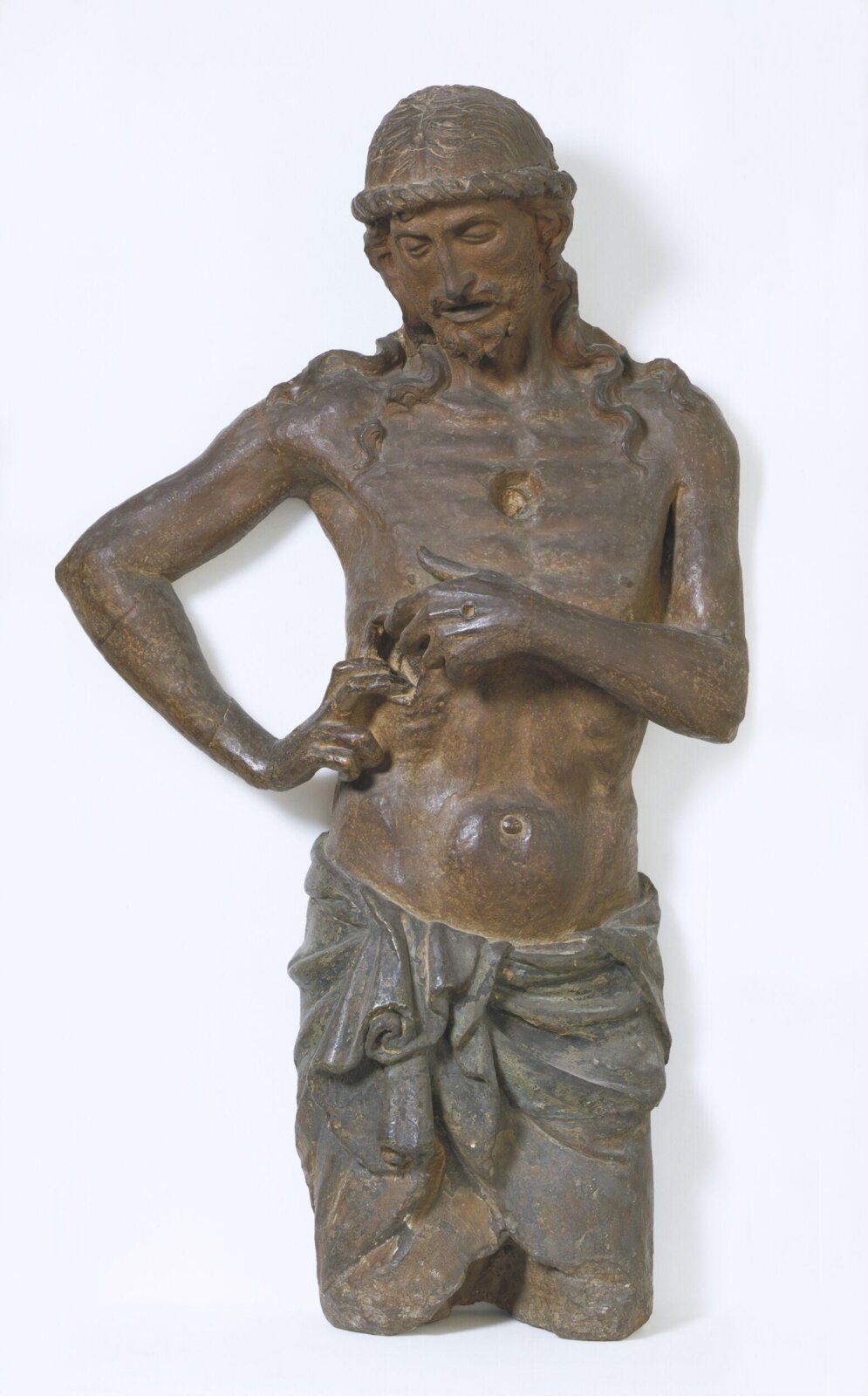
Christ showing his wound
Darf man es sehen?
Ja, es empfängt Besucher

London, Vereinigtes Königreich
SaalMedieval & Renaissance, Room 50a, The Paul and Jill Ruddock Gallery
Öffentlich ausgestellt.
- Geprüft
- Unverändert seit
- Quelle
- Das Museum
Über die Skulptur
A pained Christ peers down at his side wound where he was pierced with a spear. His hands, marked from where he was nailed to the cross, pull open the laceration, guiding the viewer’s gaze to his three visible wounds. The terracotta relief recalls the biblical episode of Doubting Thomas, in which the Apostle Thomas touches Christ’s side wound after the Resurrection, in disbelief that Christ had risen from the tomb. This sculpted Christ parts his lips as if saying 'Put your finger here, and see my hands.' (John 20:27, ESV)
Mehr lesen
The Christ showing his wound relief depicts the Vir Dolorum (Man of Sorrows) – an iconographic type that developed from the Byzantine Imago Pietatis icon and was popularized in Italy during the thirteenth century. The Vir Dolorum depicts Christ from the hips up as he emerges from the tomb during the Resurrection, displaying his rib and hand wounds. It developed in medieval Central Europe, though it only appeared in Italy in the late fourteenth century (Zsombor 2003).
Though the Vir Dolorum was popular, the specific iconographic type of the relief, with Christ opening his wound, was uncommon in Italy, making it a rare example (Zsombor 2003). The relief may have inspired the only other known example of this iconographic type – Verrocchio’s Man of Sorrows, now at the Museum of Fine Arts in Budapest, made about 50 years later.
Christ showing his wound may have originally been placed in the tympanum (a space above a doorway, typically decorated) of the entry to the Chiostro delle Ossa (Cloister of Bones), the cemetery of the hospital of Santa Maria Nuova in Florence. At approximately a meter in height (near life size), Christ’s three-quarter length body and wounds would have been visible from below. In this context, the side wound, which is sometimes understood as a door for sinners to salvation, perhaps gave mourners hope that their loved ones had reached salvation and were protected. (Peta Motture in Strozzi and Bormand 2013; Zsombor 2003).
The attribution and proposed original location of the relief is based on the Consecration of the Church of Sant’Egidio fresco painted by Bicci di Lorenzo around 1424-5, originally located in the Church of Sant'Egidio in the Hospital of Santa Maria Nuova, now in the museum of Santa Maria Nuova (For further discussion of the fresco and its dating see Walsh 1979, esp. pp. 23-5). The fresco scene unfolds in front of the church, with the Cloister of Bones visible on the left. Depicted above the church entrance is a relief of the Coronation of the Virgin. In the left background above the door to the cloister, Bicci depicted a relief of Christ showing his wounds, the general appearance of which is close to the V&A relief.
Tuscan painter Giorgio Vasari’s 1550 biographical series Le Vite (Lives of the Artists) provides further support in favour of an attribution to Dello Delli, a pioneer in terracotta sculpture in early fifteenth-century Florence. He notes that Delli made many terracotta works for the Church of Sant’Egidio: sculptures of the twelve apostles, the four Doctors of the Church, and the Coronation above the entrance, the only surviving sculpture described by Vasari.
It is likely that Dello Delli also sculpted the V&A Christ. Several stylistic similarities can be observed between Christ and the Coronation relief, most notably in the faces of Christ. The noses, deep-set eye sockets, moustache, and pattern of the hair curls falling on his shoulders are similar in both reliefs. Another distinct stylistic feature is the swirled, rose-like pattern of the folds of the loincloth of Christ and robes in the Coronation.
The back of Christ is flat, indicating it was likely placed against a wall. The figure was modelled by adding clay onto a flat surface, probably a wooden board (Peta Motture in Strozzi and Bormand 2013). The relief is an early and possibly experimental example of Florentine terracotta sculpture. Later fifteenth-century terracotta figures were often hollowed out. The back of the Coronation is also flat, further supporting the idea that the two reliefs were made by the same sculptor or workshop.
The original polychromy, now mostly lost save traces of blue on the loincloth, may have been added by Bicci di Lorenzo. A payment record confirms that Bicci di Lorenzo executed the painting and gilding of the Coronation relief in 1424. If Christ was sculpted by Delli for the same hospital complex, it was likely also painted by Bicci. In medieval and Renaissance Europe, sculpture production was highly collaborative. Sculpting would have been executed in a sculptor’s workshop, and surface decoration was often applied in a painter’s workshop.
Middeldorf was the first scholar to attribute the relief to Delli and suggested that the relief is the same one depicted in the fresco. Most scholarship on the relief since then has supported the attribution.
Conservators at the V&A discovered that the round cavity in Christ’s chest contained sand and a thorn, a relic of the crown of thorns, indicating the relief functioned as a reliquary. It is unclear if the cavity is original to the sculpture or was hollowed out later. If the relief was indeed placed above the Cloister of Bones, which was demolished around 1660 it may have been taken down and repurposed into a reliquary around that date (see Peta Motture in Strozzi and Bormand 2013).
The relief was extensively overpainted upon entering the collection; its state at the time is documented in historic photographs. The overpaint was removed during conservation, revealing some surviving original polychromy. The loincloth was originally painted blue. Late Medieval and Renaissance century sculptures of Christ with a blue loincloth survive across Tuscany.
Last updated: 24/07/2025
Victoria and Albert Museum
Angaben
- Inventarnummer
- A.43-1937
Was es zeigt
Im Katalog
Quellen
- Victoria and Albert Museum
- Bild: Victoria and Albert Museum — © Victoria and Albert Museum, London