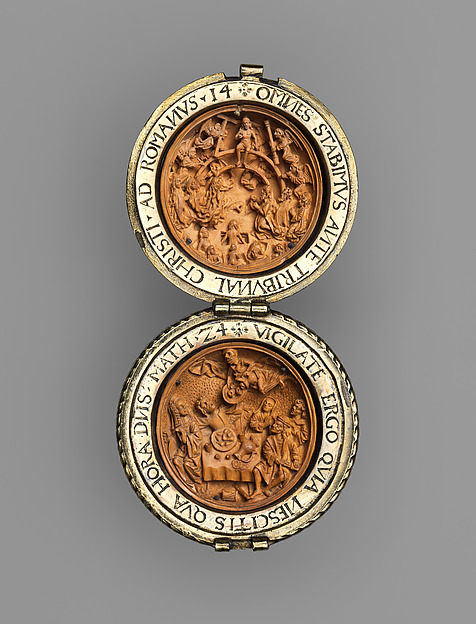
Jan van EyckHistorische Niederlande, 1390–1441
Jüngstes Gericht, Flügel eines Diptychons, Fragment
The Crucifixion; The Last Judgment
Kann ich es sehen?
Ja, derzeit ausgestellt
Wo ist „Jüngstes Gericht, Flügel eines Diptychons, Fragment“ heute? Metropolitan Museum of Art, Saal 605, New York City. Ja, derzeit ausgestellt. Geprüft 29. September 2026.

New York City, Vereinigte Staaten
Öffentlich ausgestellt.
- Geprüft
- Unverändert seit
- Quelle
- Das Museum
Über das Gemälde
The Crucifixion and Last Judgement diptych (or Diptych with Calvary and Last Judgement) consists of two small painted panels attributed to the Early Netherlandish artist Jan van Eyck, with areas finished by unidentified followers or members of his workshop. This diptych is one of the early oil-on-panel masterpieces of the Northern Renaissance, renowned for its unusually complex and highly detailed iconography, and for the technical skill evident in its completion. It was executed in a miniature format; the panels are just 56.5 cm (22.2 in) high by 19.7 cm (7.8 in) wide. The diptych was probably commissioned for private devotion.
Mehr lesen
The left-hand wing depicts the Crucifixion. It shows Christ's followers grieving in the foreground, soldiers and spectators milling about in the mid-ground and a portrayal of three crucified bodies in the upper-ground. The scene is framed against an expansive and foreboding sky with a view of Jerusalem in the distance. The right-hand wing portrays scenes associated with the Last Judgement: a hellscape at its base, the resurrected awaiting judgement in the centre-ground, and a representation of Christ in Majesty flanked by a Great Deësis of saints, apostles, clergy, virgins and nobility in the upper section. Portions of the work contain Greek, Latin and Hebrew inscriptions. The original gilt frames contain Biblical passages in Latin drawn from the books of Isaiah, Deuteronomy and Revelation. According to a date written in Russian on their reverse, the panels were transferred to canvas supports in 1867.
The earliest surviving mention of the work appears in 1841, when scholars believed the two panels were wings of a lost triptych. The Metropolitan Museum of Art acquired the diptych in 1933. At that time, the work was attributed to Jan's brother Hubert because key areas formally resembled pages of the Turin-Milan Hours, which were then believed to be of Hubert's hand. On the evidence of technique and the style of dress of the figures, the majority of scholars believe the panels are late works by Jan van Eyck, executed in the early 1430s and finished after his death. Other art historians hold that van Eyck painted the panels around the early 1420s and attribute the weaker passages to a younger van Eyck's relative inexperience.
Angaben
- Inventarnummer
- 33.92ab
Was es zeigt
Im Katalog
Ausstellungen
Ausgestellt · Saal 605
Metropolitan Museum of Art · 27. Sept. 2026 — jetzt · Geprüft
War ausgestellt · Saal 605
Metropolitan Museum of Art · 27. Sept. 2026 — 27. Sept. 2026 · Geprüft
War ausgestellt · Saal 605
Eremitage · 26. Sept. 2026 — 27. Sept. 2026 · Geprüft
War ausgestellt · Saal 605
Metropolitan Museum of Art · 26. Sept. 2026 — 26. Sept. 2026 · Geprüft
Ob es ausgestellt war, ist unbekannt
Eremitage · Unbestätigt
Quellen
- Eremitage
- Bild: Metropolitan Museum of Art — Museum open access




![Bride, from "Dance of Death", Wenceslaus Hollar, [1651] late 18th century printing](https://images.metmuseum.org/CRDImages/dp/web-large/DP822840.jpg)