Can I see it?
Where to See Théodore Géricault: The Raft of the Medusa and Life Beyond It
The Raft of the Medusa fills a wall, but it should not fill your entire idea of Géricault. Follow it with a retreating soldier, racing horses and a woman whose face outlasts her diagnosis.
2. november 2026 · 7 min. læsning · ART WIKI’s redaktion
Above a doorway was the first position allotted to The Raft of the Medusa at the Paris Salon of 1819. Only towards the end of the exhibition was Géricault's immense canvas lowered to the bottom row. It had arrived under the evasive title Scene of a Shipwreck. Today the painting is inseparable from the Louvre, yet no purchase was agreed during his lifetime. Even a picture more than seven metres wide could struggle to secure its place.
Paris: the rescue ship is almost invisible
A tiny vessel on the horizon carries almost all the hope in The Raft of the Medusa. After the French frigate ran aground off West Africa in 1816, roughly 150 people were abandoned on a makeshift raft; fifteen were rescued. Géricault interviewed survivors, including the surgeon Henri Savigny and engineer Alexandre Corréard, before constructing his scene. The distant ship is the Argus. The painter chose the first sighting, when rescue was not yet assured, and let the whole crowd strain towards that uncertain speck.
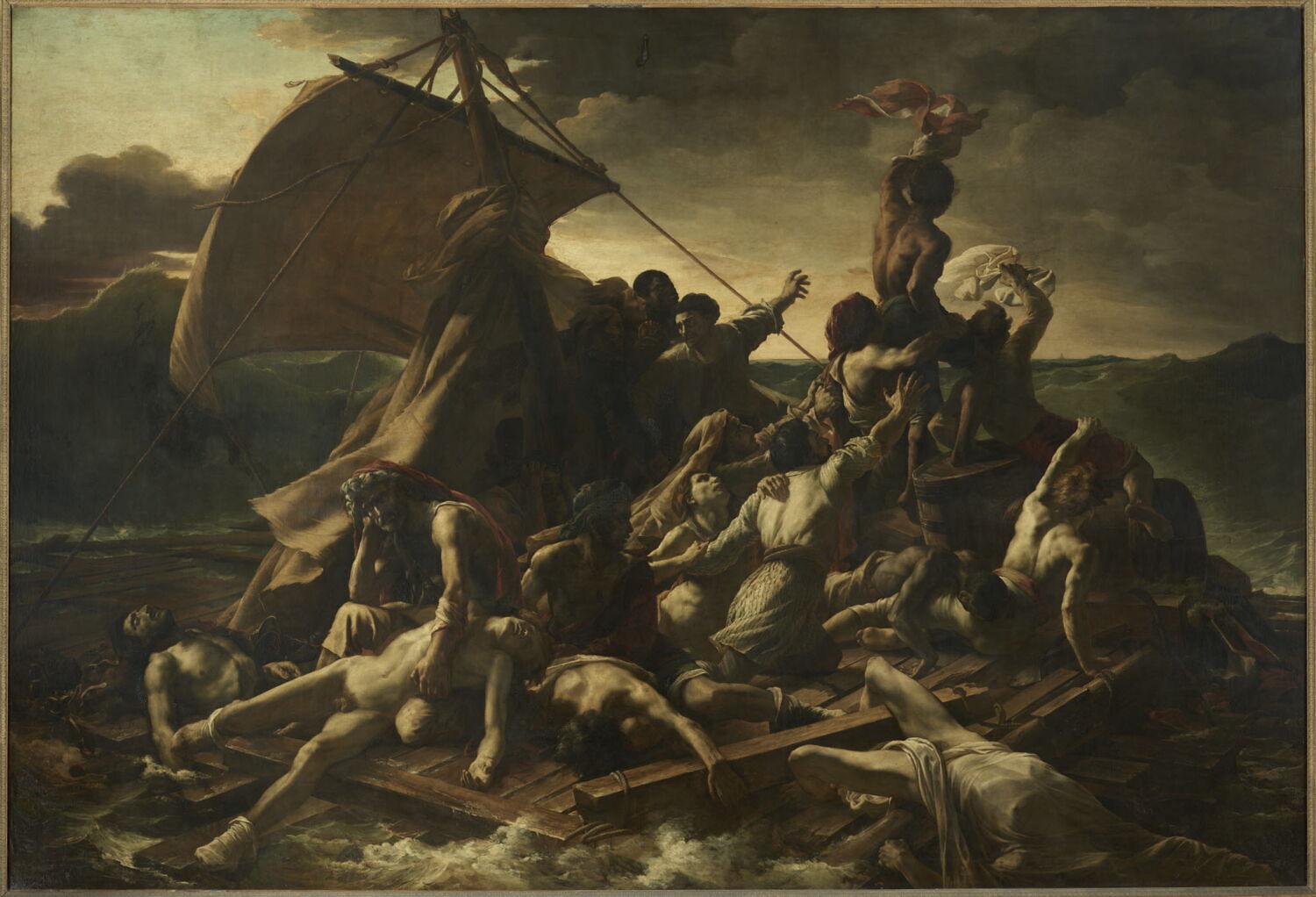
In the autumn 2026 records, the Raft was in room 700, Denon wing, level 1. Allow enough distance to see the upward pull of the figures before inspecting individual faces. Near the bottom, bodies have become weight that can no longer help itself. Higher up, arms and cloth become signals. The picture asks the eye to travel between those two conditions. Its scale makes the figures hard to dismiss, while its horizon makes the means of saving them almost impossibly small.
Two earlier paintings in that same room on our autumn 2026 check make a useful prelude. The Charging Chasseur entered the Salon in 1812 as an equestrian portrait of Monsieur Dieudonné. The horse turns one way while its rider looks back, and the composition seems wound around their conflicting movements. Géricault was only twenty-one. This was an ambitious way to introduce himself: a portrait with the physical scale and urgency of a public event.
By the 1814 Salon, movement had changed direction in The Wounded Cuirassier. The soldier is on foot, leading his horse away. His armour has not made him invulnerable, and the descent looks laborious. Both military canvases remained with Géricault until his death, passed through Louis-Philippe's collection and entered the Louvre together in 1851. Read them as a pair before returning to the shipwreck: the grand human figure has already become someone who needs to get out alive.
Upstairs at the Louvre: speed, then a face
A horse dealer helped supply another world to paint. In England, Géricault stayed with Adam Elmore, and The 1821 Derby at Epsom became a gift to his host. Despite its familiar title, the Musée de la Vie romantique's research treats the scene as an imagined tribute to racing, rather than a record of that year's race. Four riders cross the canvas beneath a threatening sky. On our autumn 2026 check, the painting was in room 941, Sully wing, level 2.
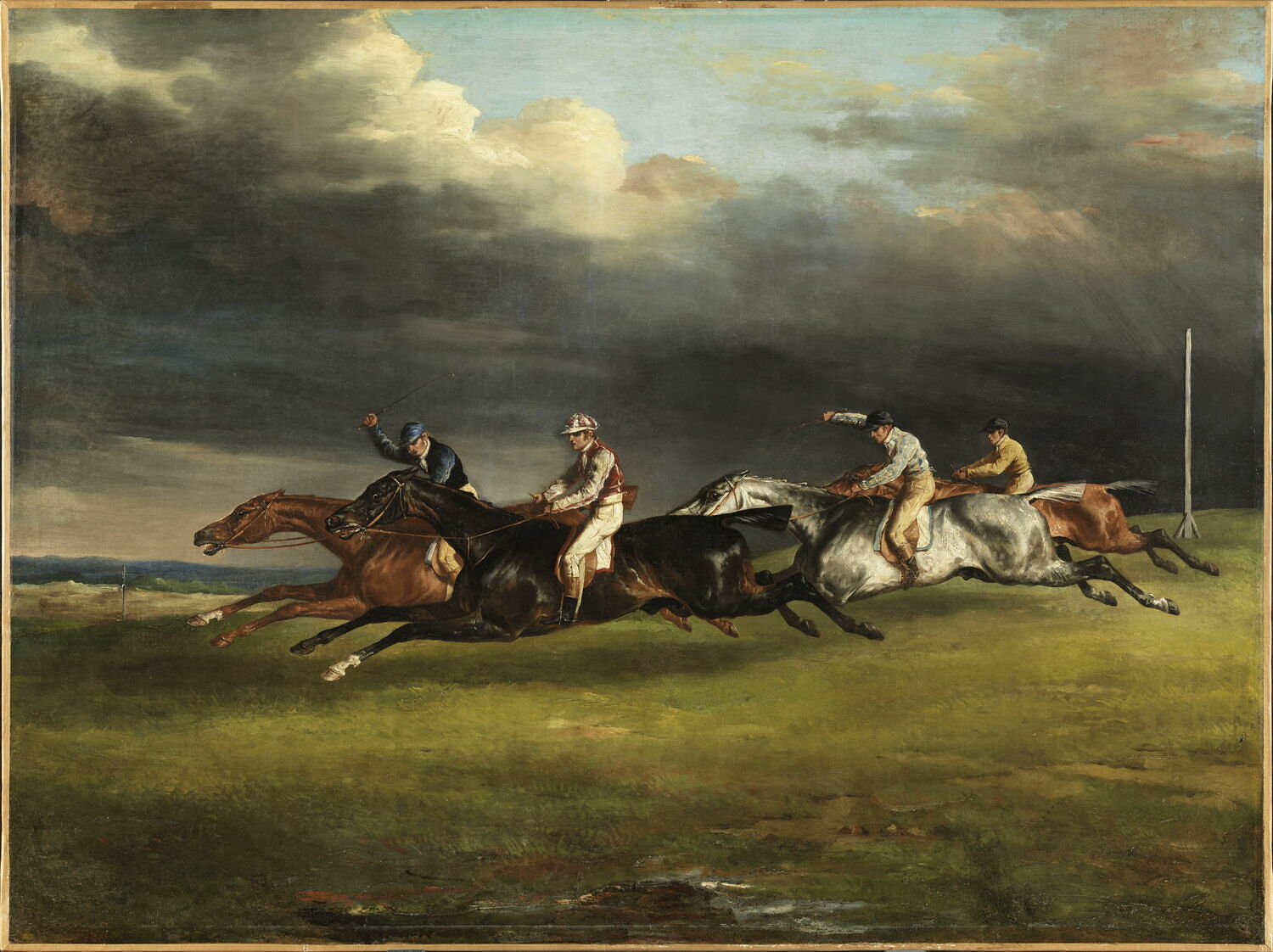
Looking at the horses together, the eye accepts speed before it has checked any individual leg. That is part of the pleasure. The riders lean into a shared direction, the dark ground passes beneath them, and the sky seems too heavy for creatures moving so lightly. After the labour of the shipwreck and the descending cuirassier, this sudden freedom feels exhilarating. It is also fragile: nothing in the weather promises an easy finish.
The Louvre declined The Woman with a Gambling Mania when it was offered in 1866; the portrait finally arrived in 1938 through the museum's friends. Its provenance leads back to the physician Étienne-Jean Georget. The title preserves the language of historical classification, but it does not exhaust the person looking past us. Leave the label for a moment and attend to the face. Our autumn 2026 check recorded this painting in room 941 too: a much quieter meeting after the race.
London and New York: fear without a crowd
Lightning produces stillness in the National Gallery's A Horse Frightened by Lightning. Géricault does not make the animal rear. It freezes in profile, with the white of its eye just visible and a trace of saliva at its mouth. No rider supplies a human response for us to follow. The painting may relate to his studies at the imperial stables at Versailles. However it began, the attention given to this particular coat and posture makes the horse an individual, not simply an emblem of terror.
Men bathe beneath a vast structure in Evening: Landscape with an Aqueduct at New York's Metropolitan Museum. Géricault painted it in 1818 for a projected sequence of the times of day, drawing on memories of Italy and the aqueduct at Spoleto. The canvas exceeds two metres in height. Our autumn 2026 check placed it in gallery 802. Architecture and evening light do the dramatic work here; the people can be small because the landscape carries so much weight.
Give your Louvre itinerary time for both rooms 700 and 941, and check the day's access before building your route between them. The smaller paintings are worth reaching while you still have energy to look. Finish with a horse or the woman's portrait and carry that image out of the museum. Géricault's great disaster will remain in your memory without help; the quieter encounter may need a little protection from it.
På forsiden: Medusas Tømmerflåde — Théodore Géricault. © 2015 GrandPalaisRmn (musée du Louvre) / Michel Urtado
Mere at læse
Where to see an artist →Can I see it?
Where to See Hans Memling: Bruges Merchants, Private Prayers and Travelling Pictures
A necklace has moved, a banker is praying towards a missing image, and the Magi are sailing home. Memling's paintings reward the visitor who notices what happens around the main event.
Can I see it?
Where to See Chardin: The Ray, the Strawberry Basket and Children at Play
Nearly ten thousand donors helped bring a basket of strawberries into the Louvre. Chardin makes a convincing case for why a few pieces of fruit, a spinning top or an unfinished kitchen task deserve such attention.
Can I see it?
Where to See Pontormo: Joseph's Staircase and a City Under Siege
A wedding bedroom, a refuge from the plague, a newly purchased house under threat: Pontormo's pictures begin in rooms where ordinary life has become precarious.