Can I see it?
Where to See Hans Memling: Bruges Merchants, Private Prayers and Travelling Pictures
A necklace has moved, a banker is praying towards a missing image, and the Magi are sailing home. Memling's paintings reward the visitor who notices what happens around the main event.
2. november 2026 · 7 min. læsning · ART WIKI’s redaktion
Maria Portinari's necklace casts tiny shadows on her neck. Look above it and there are other dark marks, traces of where Memling originally placed the jewellery before moving it. In the Metropolitan Museum's portraits of Tommaso and Maria Portinari, the illusion is so persuasive that a revision can be mistaken for another observed detail. These people pray towards a central devotional panel that is now missing. Their attention remains fixed even though its object has disappeared.
Bruges supplied Memling with patrons who understood the value of an image travelling well. Born in the German town of Seligenstadt, he was established in Bruges by 1465 and worked for its prosperous citizens and foreign merchants. He probably spent time in Rogier van der Weyden's Brussels workshop, though his early training is not fully documented. His paintings can now be followed through collections far from the city where he made his career. Faces, small altarpieces and crowded sacred landscapes each preserve a different sort of encounter.
New York: a marriage, a face and an interrupted reading
Banking and marriage meet in the Portinari portraits. Tommaso managed the Medici bank's Bruges branch; he married Maria Baroncelli in 1470, when she was about fourteen. The portraits belong to that moment of prestige. His later loans to the Burgundian court proved disastrous, but no financial anxiety enters these composed likenesses. On our autumn 2026 check, the pair was in the Met's gallery 602. The jewellery, joined hands and dark clothes hold the marriage at its carefully presented beginning.
A much smaller panel in gallery 602 on our autumn 2026 check, Portrait of an Old Man, makes a different claim on memory. The Met interprets it as a likeness intended to preserve its sitter's appearance towards the end of his life, rather than as part of a devotional scene. No famous name is available to do the work for us. The face has to hold our attention unaided. It does: you can feel the difference between learning who someone was and studying how someone looked.

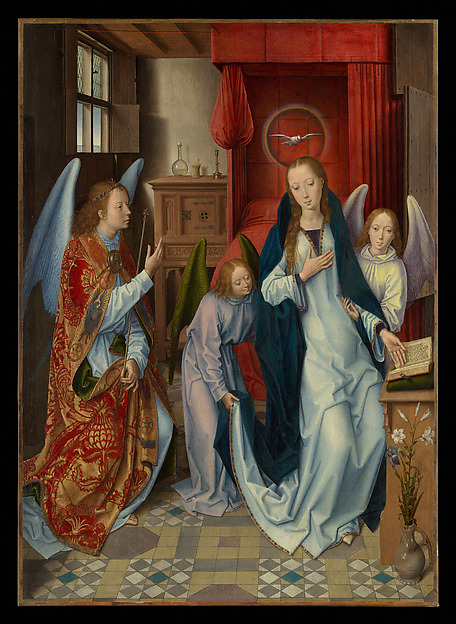
Mary needs support when Gabriel arrives in The Annunciation, in the Robert Lehman Collection at the Met. Two angels steady her as she rises from reading and seems to faint at the news. An empty candleholder anticipates her role in bearing Christ, understood as the light of the world. The picture was in gallery 953 on our autumn 2026 check. Its domestic setting makes the interruption tangible: a reader has been caught between the book she was following and a future she has only just been told.
Munich: the Magi have a return journey
The kings do not disappear after delivering their gifts in Advent and Triumph of Christ, also known as The Seven Joys of Mary, at the Alte Pinakothek. Memling follows their story from watching for the star to a voyage home by sea, alongside episodes from Mary's life and events after Christ's Resurrection. Pieter Bultinc and Katalijne van Ryebeke commissioned the panel in 1480 for the tanners' guild chapel in Bruges's Church of Our Lady. They remain visible at its lower corners.

Reading this landscape takes a different rhythm from looking at a single scene. You can follow a road, arrive at an event, then recognise a familiar person appearing again elsewhere. Distance does the work that a page turn might do in a book. The repeated figures do not need to obey one instant of time. Let the small architecture guide you, and resist the temptation to identify everything before enjoying the routes between the episodes.
Madrid and Paris: alterations, removals and a new audience
Opening the Prado's Adoration of the Magi Triptych reveals the Nativity, the kings' visit and the Presentation in the Temple. Technical study has shown that the images on its outer faces were later additions by another hand. Inside, small gaps in the architecture let blue sky show through. Such passages are easy to miss among the figures and gifts, yet they stop the buildings becoming a flat backdrop. Memling makes even a narrow crack useful in establishing how far the eye can travel.
A less peaceful journey lies behind the Louvre's Madonna of Jacob Floreins. Its original patron is uncertain despite the customary name. General Jean-Claude Darmagnac brought it from Spain after serving there under Napoleon; the Louvre's record places this acquisition within his removal of pictures from churches around Burgos. The Duchâtel family later owned it, and a bequest brought it to the museum in 1878. Our autumn 2026 check recorded room 818, Richelieu wing, level 2. A calm devotional assembly can have a decidedly unsettled history.
Frankfurt and the Frick: an unknown sitter gets a world
A red cap does much of the introducing in Portrait of a Man in a Red Hat at Frankfurt's Städel. The sitter's name is unknown. A ring, a coat and a glimpse through a window give him a setting and possessions without supplying a biography. In the Frick Collection's Portrait of a Man, the landscape opens more freely behind the figure. The Frick regards this as possibly one of Memling's earliest surviving portraits to use such a background. The person occupies a place, even when we cannot recover his name.
If the Met is your destination, mark galleries 602 and 953 before setting off; these paintings belong to different parts of the collection. Elsewhere, choose one portrait and one narrative panel rather than trying to collect every Memling in a city. Check availability, then put the list away. Give yourself time to notice a tiny change of paint or an incidental road: the details that survived five centuries deserve more than the few seconds needed to recognise the subject.
På forsiden: The Annunciation — Hans Memling. Open Access (CC0)
Mere at læse
Where to see an artist →Can I see it?
Where to See Chardin: The Ray, the Strawberry Basket and Children at Play
Nearly ten thousand donors helped bring a basket of strawberries into the Louvre. Chardin makes a convincing case for why a few pieces of fruit, a spinning top or an unfinished kitchen task deserve such attention.
Can I see it?
Where to See Pontormo: Joseph's Staircase and a City Under Siege
A wedding bedroom, a refuge from the plague, a newly purchased house under threat: Pontormo's pictures begin in rooms where ordinary life has become precarious.
Can I see it?
Where to See Toulouse-Lautrec: Inside the Moulin Rouge and After the Show
A dancer learns her steps, an Englishman's ear turns red, and a star takes her old act to a fairground. Toulouse-Lautrec makes Parisian nightlife personal.