 Théodore GéricaultFrankrig, 1791–1824
Medusas Tømmerflåde
Le radeau de la Méduse
Kan det ses?
Ja, udstillet nu
Hvor er »Medusas Tømmerflåde« i dag? Louvre, Salle 700, Aile Denon, Niveau 1, Paris. Ja, udstillet nu. Kontrolleret 26. september 2026.

Lukket· åbner kl. 9.00
Udstillet for publikum.
- Kontrolleret
- Uændret siden
- Kilde
- Museet
Om maleriet
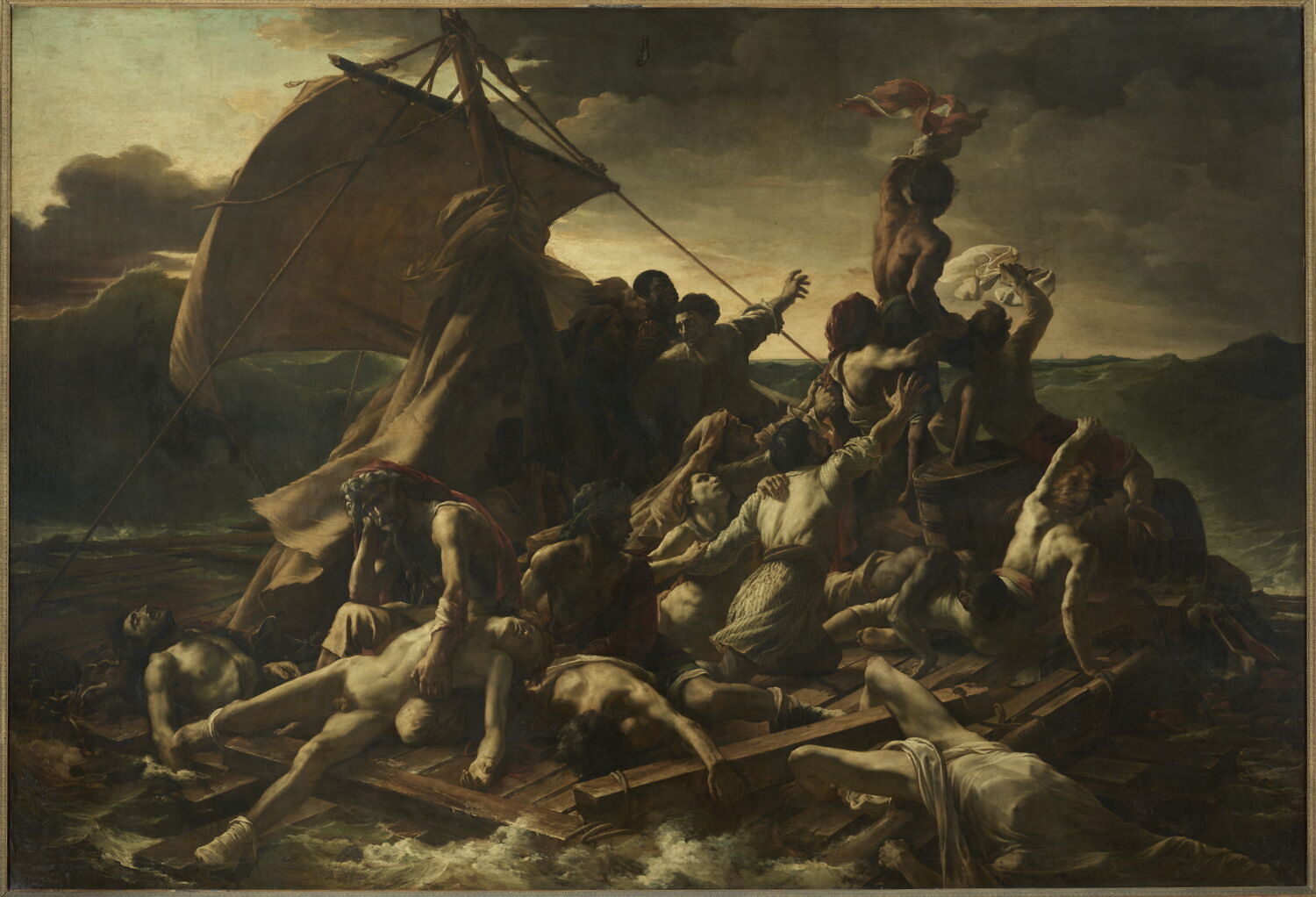
The Raft of the Medusa (French: Le Radeau de la Méduse )—originally titled Scène de Naufrage (Shipwreck Scene)—is an oil painting of 1818–1819 by the French Romantic painter and lithographer Théodore Géricault (1791–1824). Completed when the artist was 27, the work has become an icon of French Romanticism. At 491 by 716 cm (16 ft 1 in by 23 ft 6 in), it is an over-life-size painting that depicts a moment from the aftermath of the wreck of the French naval frigate Méduse, which ran aground off the coast of today's Mauritania on 2 July 1816. On 5 July 1816, at least 150 people were set adrift on a hurriedly constructed raft; all but 15 died in the 13 days before their rescue, and those who survived endured starvation and dehydration and practiced cannibalism. The event became an international scandal, in part because its cause was widely attributed to the incompetence of the French captain. Géricault chose this large-scale uncommissioned work to launch his career, using a subject that had already generated widespread public interest. The event fascinated him.
Læs videre
Théodore Géricault's social circles had close family connections with the French Navy and were directly involved in France's colonies and France's slave trade. Indeed, one of these relations, a naval officer and a slave owner, died defending France's colonial interests on the coast of west Africa in 1779 not far from the site of the Méduse shipwreck decades later.
Before Géricault began work on the final painting, he undertook extensive research and produced many preparatory sketches. He interviewed two of the survivors and constructed a detailed scale model of the raft. He visited hospitals and morgues where he could view, first-hand, the colour and texture of the flesh of the dying and dead. As he had anticipated, the painting proved highly controversial at its first appearance in the Salon of 1819, attracting passionate praise and condemnation in equal measure. However, it established his international reputation and today is widely seen as seminal in the early history of the Romantic movement in French painting.
Although The Raft of the Medusa retains elements of the traditions of history painting, in both its choice of subject matter and its dramatic presentation, it represents a break from the calm and order of the prevailing Neoclassical school. Géricault's work attracted wide attention from its first showing and was then exhibited in London. The Louvre acquired it soon after the artist's death at the age of 32. The painting's influence can be seen in the works of Eugène Delacroix, J. M. W. Turner, Gustave Courbet, and Édouard Manet.
Oplysninger
- Inventarnummer
- INV 4884
I kataloget
Kilder
- Louvre
- Billede: Louvre — © 2015 GrandPalaisRmn (musée du Louvre) / Michel Urtado
Imens i livet hos Théodore Géricault
Hele livet1816–1817
Naples and Rome: the shock of Michelangelo
Géricault visited Naples, drawing the landscapes and people, but spent most of his time in Rome. The frescoes of the Sistine Chapel shook him: Michelangelo's monumentality of form inspired his pen drawings, such as “Man Felling a Bull”, among the most interesting made in Rome.
autumn 1817
The book on the wreck of the Méduse reaches Géricault
In the autumn of 1817 the book “The Wreck of the Frigate Medusa” appeared, in which the eyewitnesses, the geographer-engineer Alexandre Corréard and the physician Henri Savigny, described the thirteen-day drift of the raft after the ship ran aground off the coast of Mauritania. The book reached Géricault, who saw in it the subject for the large painting he had long dreamed of.
1817–1818
Investigating the disaster: survivors, a model raft, morgues
Géricault re-created the event by studying the available materials and meeting witnesses: he got to know Corréard and Savigny, a carpenter from the Méduse made a scale model of the raft for him, and the artist modelled wax figures himself. He visited hospital morgues, drawing dead heads, emaciated bodies and severed limbs, and the preparation ended with a trip to Le Havre, where he painted studies of sea and sky.
1819
“The Raft of the Medusa” sparks a political controversy at the Salon
When first exhibited at the Paris Salon of 1819, “The Raft of the Medusa” ignited political controversy: it indicted a corrupt establishment, in which the captain had left the crew and passengers to die, but also dramatized the eternal struggle of man against nature.
12 June – 30 December 1820
London: 50,000 visitors and 20,000 francs
The entrepreneur Bullock exhibited “The Raft of the Medusa” in London from 12 June to 30 December 1820; about 50,000 people saw it, critics called it a masterpiece, and its author was compared to Michelangelo and Caravaggio. Géricault was entitled to a third of the ticket receipts and received 20,000 francs.
1821–1824
Illness and falls from horses after his return from England
After returning to Paris from England Géricault was often ill, and his condition was made worse by several falls during horseback rides.