City guide
Art in Compiègne: Winterhalter, Tissot and Lavinia Fontana in One Day
One empress appears twice: first surrounded by silk and attendants, then in black beside her son in exile. Between the portraits, Compiègne reveals how a court made itself look at ease.
2. november 2026 · 7 min. læsning · ART WIKI’s redaktion
The dresses seem to have organised the gathering. White, pink and green spread across Winterhalter’s Empress Eugénie Surrounded by Her Ladies in Waiting, leaving faces and hands to emerge from the fabric. It is tempting to treat the picture as a beautiful social photograph. But these women have jobs at court, their positions matter, and the apparent ease has been carefully made. Compiègne is a good place to ask what that ease cost.
Plan a day divided between the Château de Compiègne and the Musée Antoine-Vivenel, with the palace park as breathing space. Start by checking access to the château’s Second Empire collections: their hours differ from those of the historic apartments. The most useful sequence is imperial portraits first, the rooms that sustained court life next, then a walk into town for Lavinia Fontana. Three paintings can carry the day without turning it into a royal genealogy lesson.
Winterhalter’s garden party had a hierarchy
Painted for the Paris Universal Exhibition of 1855, the enormous group portrait was probably paid for by Eugénie herself. The empress sits among eight women from her household. Their company makes her approachable, but it also gives a new sovereign the appearance of an established court. Contemporary critics complained about the attention lavished on clothes and the shortage of imperial grandeur. The informality that attracts a modern viewer could look like a failure of royal portraiture to its first audience.
A small omission complicates the scene. When the palace ladies performed official evening or ceremonial duties, they wore an insignia with a crowned imperial monogram. Queen Victoria noticed these jewels during Eugénie’s visit to Britain in April 1855. They do not appear in Winterhalter’s painting. The museum’s research places the introduction of the badge around that year; its absence is a reminder that the canvas cannot simply be read as an inventory of a particular afternoon.
Let your eye move across the skirts before returning to the people wearing them. Fabric gives the group its continuity, while the faces establish differences. The painting is over four metres wide, enough to make a social circle into a public spectacle. You can enjoy the fluency of the brush without accepting the scene’s promise that power is effortless. The women’s shared setting is also an arrangement of proximity: belonging is the subject as much as beauty.

A week at the palace, with breakfast chosen on a form
An invitation to a Compiègne “series” meant a week in the company of Napoleon III and Eugénie. From 1856, groups of roughly a hundred guests followed one another during the court’s autumn stays. This was hospitality on an institutional scale, bringing the imperial couple into contact with political, business, artistic and scientific circles. The palace becomes easier to understand when imagined as accommodation for people who needed to be entertained, introduced and fed.
Guests travelled by special train and were collected at the station by court carriages. Some arrived with about twenty trunks. A printed form let them choose the next morning’s breakfast, from tea or coffee to a more substantial meal. Those details make the historical apartments more legible than an uninterrupted recital of decorative styles. Behind the impression of intimacy lay an operation capable of handling luggage, meals and the preferences of a large temporary population.
The restored guest apartments numbered 33 and 34 retain the logic of that operation. Their nineteenth-century arrangement included a bedroom for a servant as well as accommodation for the guest. Matching printed cotton and wallpaper supplied comfort without the expense of imperial silk. Access is by guided visit, so consult the programme if this side of the palace interests you. A small service room may explain a grand reception better than another gilded surface.
Even the château’s regular appearance conceals an adjustment. Gabriel’s eighteenth-century rebuilding had to fit a triangular site determined by the old town defences. The long garden frontage forms the diagonal of that plan. Walk outside after the interiors and compare the building’s orderly face with its awkward footprint. Architecture here performs a task much like Winterhalter’s painting: it persuades the eye that a complicated arrangement has settled naturally into place.
Tissot: the same empress after the court has gone
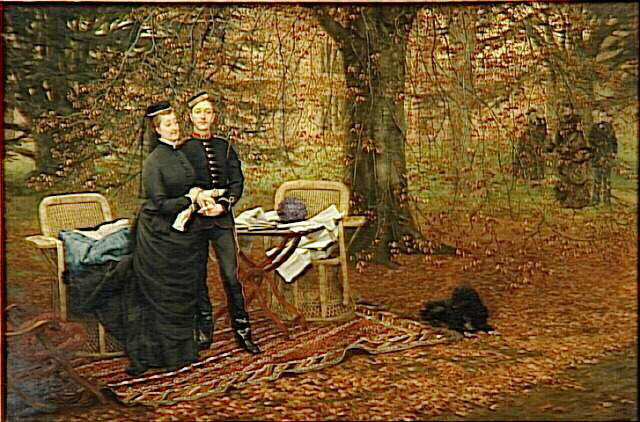
Almost twenty years separate Winterhalter’s group from Tissot’s Empress Eugénie and the Prince Imperial at Camden Place. Painted in 1874–75, it places the widowed empress beside her son in their English exile. Her black dress replaces the pale silk of the earlier image. The prince wears his Woolwich cadet uniform, and a small surviving court stands further back among the trees. The composition has lost the easy abundance of attendants.
Camden Place was a home from which return remained imaginable. Napoleon III joined his family there in 1871 after captivity in Germany, and died in the house in January 1873. His son’s coming of age in 1874 brought celebrations to Chislehurst. These were people living with political hopes as well as bereavement. Avoid reading the portrait solely through what happened later: for its sitters, the future was still undecided.
The Royal Academy rejected Tissot’s painting in 1875, although it accepted his other submissions. Whether diplomatic unease about the subject explains the rejection remains a hypothesis. That uncertainty is more telling than a neat story of censorship. A picture of a mother and son could still carry a claim about France’s future. Set it mentally beside the 1855 portrait and watch how the meaning of an outdoor gathering changes when the people at its centre no longer govern.
Vivenel and Fontana: another kind of authority
Leave the imperial household behind for a collector whose museum was meant to teach. Antoine Vivenel, an architect and building contractor, assembled objects for what he called a Musée des Études. His acquisitions extended across periods and cultures; the aim included practical and visual education. This gives the municipal museum a different purpose from the palace. A thing could be worth preserving because someone might learn to make, draw or judge better by studying it.
Lavinia Fontana’s Presentation in the Temple, dated 1586, adds another working life to the route. Fontana’s marriage agreement with Gian Paolo Zappi had protected her continued employment as a painter rather than requiring a conventional dowry. Her earnings supported the household, and her husband helped manage family responsibilities. The eleven children born during the marriage did not end her career. Such arrangements are part of the material history of a painting, just as surely as canvas and pigment.
Two doves and a small dog occupy the lower right of the religious scene. Give those ordinary creatures a moment before following the human ceremony. The canvas later acquired a local devotional history: it was given to Compiègne’s Notre-Dame de Bon Secours chapel in 1869. It entered the municipal museum in 1994. Its journey through the town therefore continued long after the founder’s collecting years, a useful correction to the idea that a named museum is one person’s collection frozen in time.

Choose a Wednesday, Thursday or weekend if the Second Empire museums are your priority: the timetable we checked in autumn 2026 advertised their independent visiting window from ten until noon on those days. Verify the timetable again before travelling, and leave Vivenel for the afternoon. Reserve a guest-apartment tour separately if you want it. Most of all, keep the park interval; after so much careful staging of human company, an unscheduled walk makes a welcome change.
På forsiden: Portrait de l'Impératrice Eugénie entourée de ses dames d'honneur — Franz Xaver Winterhalter. © Réunion des musées nationaux - utilisation soumise à autorisation; Ministère de la Culture (France), base Joconde
Mere at læse
Art city by city →City guide
Art in Avignon: Botticelli, Carpaccio and the Palace of the Popes in One Day
A banking scandal brought Italian paintings to the papal city. Follow their journey from a mother’s touch to a pope’s imaginary woodland, then to a museum gate made by a former prizewinner.
City guide
Art in Clermont-Ferrand: Gustave Doré, Chassériau and the Black Cathedral in One Day
A clown’s injured child and a nation’s ancient hero share a museum in Montferrand. Follow them back to Clermont’s volcanic cathedral, whose apparently medieval skyline has a much later ending.
City guide
Art in Pont-Aven: Sérusier, Émile Bernard and Maurice Denis in a Day by the River
A servant’s misnamed portrait and two pigs at a trough tell the story of modern painting unusually well. Begin with the women who kept the painters’ lodgings running, then follow the Aven into the woods.