City guide
Art in Avignon: Botticelli, Carpaccio and the Palace of the Popes in One Day
A banking scandal brought Italian paintings to the papal city. Follow their journey from a mother’s touch to a pope’s imaginary woodland, then to a museum gate made by a former prizewinner.
2. november 2026 · 7 min. læsning · ART WIKI’s redaktion
A mother touches her baby’s cheek while preparing to feed him. Outside, on the Place du Palais, papal architecture conducts its much louder business of towers, battlements and enormous walls. The distance between those two kinds of authority is a good reason to come to Avignon for art. Botticelli’s Madonna and Child belongs to the Petit Palais collection, across the square from the palace of the popes. Give the small gesture as much time as the great building.
Plan around two temporary closures announced for autumn 2026: the Petit Palais is due to close from 16 to 30 November, and the Musée Calvet has announced its reopening for 8 December. Outside those periods, a day can join the papal quarter to the quieter streets around rue Joseph-Vernet. In November, check the dates before buying travel tickets; the arrangement of this itinerary matters less than which doors will open.
The Petit Palais: a collection bought after a scandal
Giampietro Campana wanted to assemble a history of Italian civilisation. In Rome, where he directed the papal pawn bank, he collected antiquities and then began buying early Italian paintings through agents across the peninsula. His appetite extended to painters whom nineteenth-century taste had often overlooked. The result was a museum on a private scale so ambitious that it could make early Renaissance Italy seem available for inspection, room after room. Then the finances collapsed into public disgrace.
Proceedings for embezzlement brought the collection’s seizure and dispersal. In 1861 Alexander II bought important pieces for Russia; Napoleon III acquired more than ten thousand objects for France. The Avignon museum opened in 1976, with paintings reunited there through a major Louvre deposit. So the Italian presence on this square has two very different histories. Medieval churchmen brought artists to a papal court; a nineteenth-century banking scandal eventually helped bring a collection to a twentieth-century museum. Neither story can quite explain the other.
Within that collection, the Madonna and Child is small enough to reward attention to fingertips rather than spectacle. Mary’s right hand meets the child’s face; her other hand prepares to nurse him. Behind them an arched opening gives onto a rough landscape. The architecture encloses a bodily exchange, intimate and necessary. The thin halos do little to interrupt it. A visitor expecting an aloof Renaissance beauty instead finds a mother occupied with a child who wants something now.
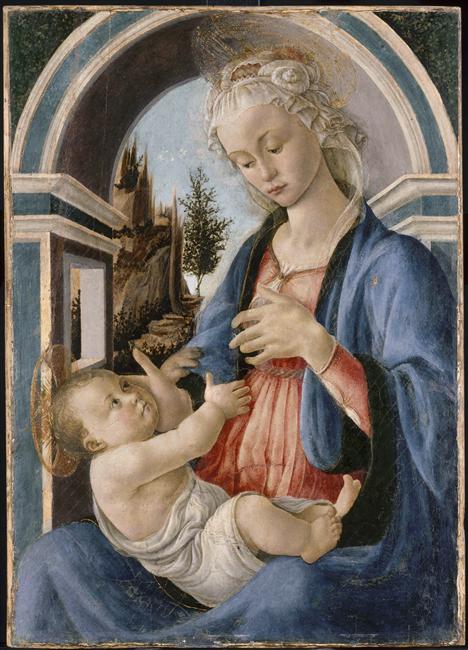
The authorship has its own unfinished conversation. The Petit Palais’s 2017 publication names Botticelli; the Louvre’s catalogue also lists Filippino Lippi. That difference deserves to remain visible, rather than being tidied into certainty. The panel passed through Périgueux on a long deposit, from 1872 to 1956, before reaching Avignon in 1976. Its 72-centimetre height makes those journeys feel almost disproportionate: empires, museums and scholarly arguments have gathered around a picture whose central event occupies a few inches.
Carpaccio: the sacred gathering with room for sewing
Someone is doing needlework in Carpaccio’s Sacred Conversation. Someone else reads. Prayer, music and ordinary occupation share the same landscape, with Mary and the child at its centre. This is what makes the painting worth seeking beyond the familiar Botticelli name: the holy company has been given things to do. The term “conversation” need not mean a scene of lively talk. The figures can coexist through quiet attention, each keeping a different pace.
Painted around 1500, the scene opens beneath a huge natural arch towards a distant town. Smaller episodes populate the landscape, which includes a bridge, river and rocky shelters. The French national catalogue identifies Zacharias reading, Anne praying and Elizabeth sewing; it also records preparatory drawings for the composition and individual figures. A family gathering that initially seems almost casual was worked out on paper. Let the landscape occupy part of your visit rather than treating it as wallpaper behind the saints.
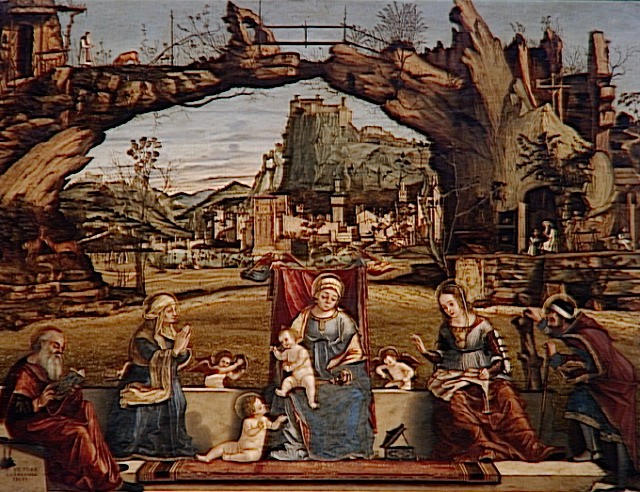
There is a useful change of viewing distance between these two panels. The Madonna and Child pulls attention towards a hand and a cheek. The Sacred Conversation sends it wandering through an inhabited world. Try remembering one small action from each before moving on. That gives the visit a sharper shape than collecting a list of painters’ names, and it makes the return to the immense papal square more interesting: architecture can surround a private gesture or organise an entire society.
The papal palace: a ruler’s imaginary woodland
Clément VI’s study was painted in 1343 with hunting and fishing scenes. Men gather fruit and raid birds’ nests; hunters use a ferret; fish are caught in a pond. The room known as the Chambre du Cerf turns outdoor aristocratic pleasures into an indoor panorama. Its Franco-Italian painters gave the pope a controlled woodland, where human activity fits comfortably among the trees. After all the stone outside, the imagined abundance is almost startling. Power here means having the countryside brought inside.
The palace makes an effective second visit after the Petit Palais because scale changes the questions. A portable panel can be held within the field of vision. A decorated interior needs a moving body, a turn of the head, an awareness of what is behind you. Resist trying to make the building into a succession of photographs. Spend part of the visit considering how decoration answers the room itself: where a wall stops, where an opening cuts through it, what a seated occupant might have faced.
Rue Joseph-Vernet: a doctor leaves instructions
Esprit Calvet thought about what would happen after his death with the practical care of a collector who knew that objects need upkeep. In his 1810 will, the Avignon physician left his library and collections for public benefit and supplied property to support their future. Three executors were charged with protecting his intentions. The museum bearing his name therefore begins with an administrative act as well as a generous one: somebody had to pay for the curiosity to continue.
Calvet also provided for a drawing prize for young people under twenty-four. One later winner, Noël Biret, became an Avignon ironworker and made the museum’s entrance gate. His workshop and collecting ran together; he eventually donated thousands of pieces of ironwork. Pause at the entrance on rue Joseph-Vernet and the connection becomes unusually direct. The institution encouraged a young draughtsman, and the craftsman he became helped shape the threshold through which its visitors pass.
Once both museums have reopened, keep the Petit Palais and papal palace together, then leave the Calvet for a separate stretch of the afternoon. Check the museums’ current calendars, including Monday closures, and ask about a particular painting if your journey depends on seeing it. Allow a proper break between the papal square and rue Joseph-Vernet. The town is easier to read when lunch interrupts the procession of saints, and the last museum need not become a test of endurance.
På forsiden: LA VIERGE ET L'ENFANT — Sandro Botticelli. © René-Gabriel Ojéda ; Réunion des musées nationaux - utilisation soumise à autorisation; Ministère de la Culture (France), base Joconde
Mere at læse
Art city by city →City guide
Art in Clermont-Ferrand: Gustave Doré, Chassériau and the Black Cathedral in One Day
A clown’s injured child and a nation’s ancient hero share a museum in Montferrand. Follow them back to Clermont’s volcanic cathedral, whose apparently medieval skyline has a much later ending.
City guide
Art in Pont-Aven: Sérusier, Émile Bernard and Maurice Denis in a Day by the River
A servant’s misnamed portrait and two pigs at a trough tell the story of modern painting unusually well. Begin with the women who kept the painters’ lodgings running, then follow the Aven into the woods.
City guide
Art in Bayeux: Caillebotte, Gros and the Cathedral in One Day
A wedding gift and a queen’s invented workshop open a route through Bayeux beyond the story of the Norman Conquest. Start with the paintings, then read the cathedral’s changing walls.