City guide
Art in Reims: The Cathedral, Saint-Remi and the Paintings Worth Returning For
A cement roof hides above the cathedral, and an evacuation label survives behind a Monet. Reims rewards a visit now, while its fine-arts museum prepares to reopen in 2027.
2. november 2026 · 7 min. læsning · ART WIKI’s redaktion
Above the cathedral’s stone vaults, Reims has a roof structure made from reinforced cement. The medieval skyline conceals a twentieth-century answer to catastrophe. After the fire of 19 September 1914, architect Henri Deneux replaced the lost timber structure with an assembly of small prefabricated elements. A visit to the towers can reveal this unexpected construction. It is a good beginning for a city where the history of art includes the work of keeping buildings and paintings alive.
One practical fact shapes this guide. In autumn 2026, the Musée des Beaux-Arts remains closed for renovation, with reopening announced for 2027. Plan a present-day walk around the cathedral and Saint-Remi, and treat the paintings below as reasons to follow the museum’s reopening and temporary projects. They belong to its collection; this is not a promise that they will be accessible on your travel dates. The city still offers a full day of looking, with a second visit already taking shape.
A roof rebuilt like a construction kit
Deneux reached back to a Renaissance idea to solve a modern problem. Philibert Delorme had proposed roof structures assembled from small wooden pieces; Deneux adapted the principle to reinforced cement. His new framework went up in 1924–26. The parts could be manufactured and moved without the burden of enormous beams, then fitted together. When you look up at the cathedral from the pavement, try to hold that hidden assembly in mind. What seems an uninterrupted inheritance has required decisions about materials, weight and fire.
The distinction matters when planning the walk. Looking at a façade, entering a church and joining a tower visit are different experiences; leave enough time for the one you choose. Begin outdoors, where you can judge the whole building, before concentrating on small details. Reims encourages close attention to repairs as well as to original carving. A monument can preserve its identity through a change in construction, just as a painting can retain its image while acquiring labels and scars on the back.
The champagne director who needed a larger house
Henry Vasnier’s collection grew until his home could no longer contain it comfortably. In 1890 he moved into a larger house to arrange his purchases like a private museum. He was commercial director of Pommery, and the prosperity of champagne gave his interest in contemporary art material consequences for Reims. After his death in 1907, the city received the collection. In 1913 it joined the municipal holdings in the former abbey of Saint-Denis, the building now undergoing renovation.
Two paintings from that bequest lead in very different directions: Monet’s Rocks at Belle-Île and Dinet’s On the Banks of the Wadi. Brittany and Algeria share a collector without becoming interchangeable destinations. Think of Vasnier’s rooms as a place where different kinds of travel met. The paintings brought weather, bodies and distant settings into a champagne city; the collector’s choice gave them a shared civic future. A museum’s geography often begins with such private decisions.
Monet finds that the Atlantic will not behave
For Rocks at Belle-Île, the useful story begins with Monet losing his usual confidence. During his stay on the island from September to November 1886, he wrote to Gustave Caillebotte about a sea whose colours surprised him. Experience painting the Channel had given him habits; the Atlantic demanded something else. Changeable weather and difficult access to the sites complicated the task. This makes the picture a record of adjustment as much as a view of a coast.
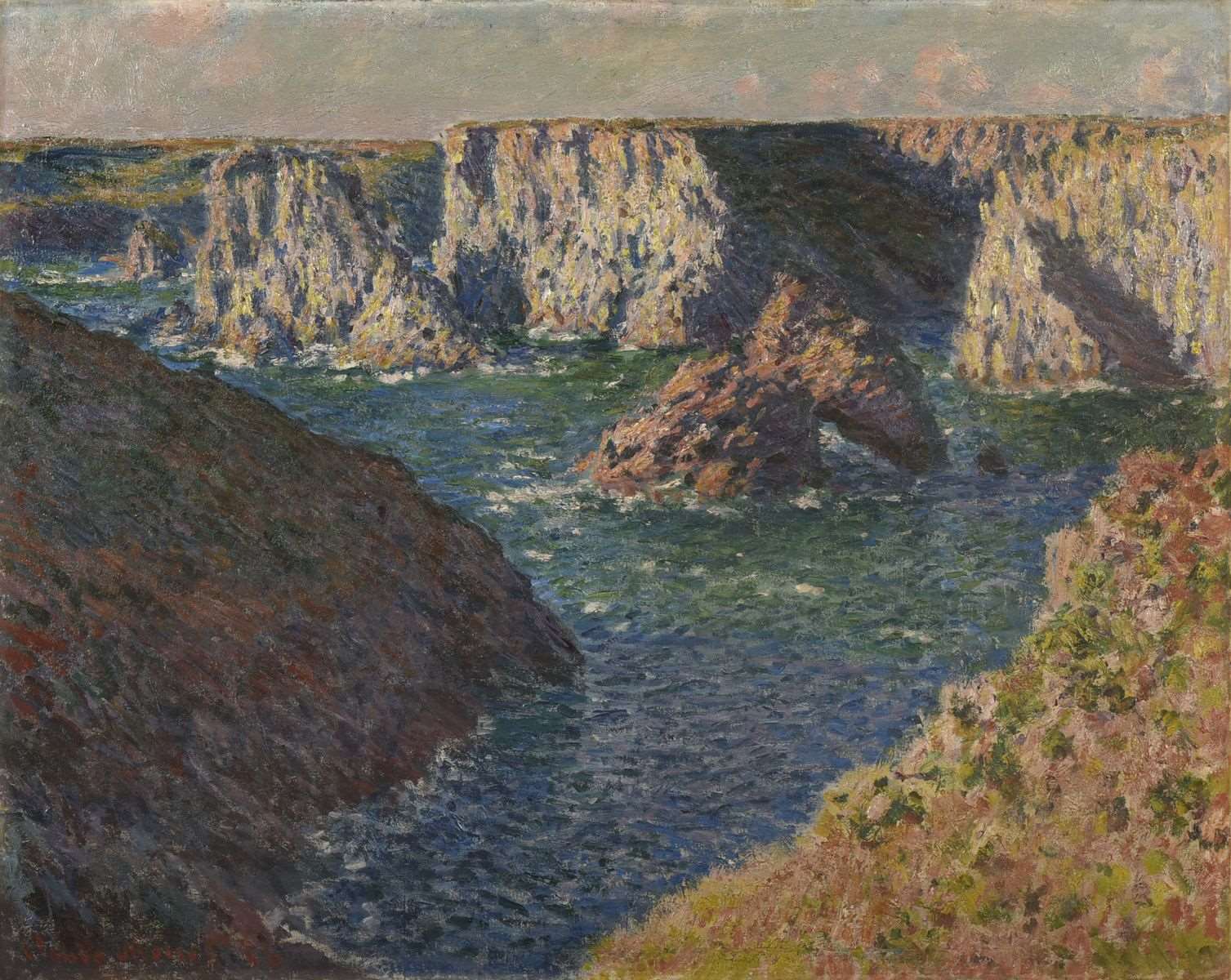
The Reims canvas sets cliffs and broken rock against the sea, with warm and cool colours refusing to settle into a simple division between land and water. Its reverse carries another journey: the catalogue records an evacuation label from June 1917. There is no need to invent the circumstances of its packing to understand what that small piece of paper means. A coast painted in peace became an object that had to be moved during war. The label belongs to the picture’s history as surely as the signature.
Dinet’s Algeria, and the limits of a beautiful image
A woman lies beside water in On the Banks of the Wadi, her jewellery and headdress retained although she is otherwise nude. The museum dates the painting before 1899; Vasnier acquired it in that year. Here the questions differ from those raised by Monet’s rocks. We can examine the figure and setting, but the picture does not give us the woman’s name or permission to invent her thoughts. The title identifies a place of repose, not a biography.
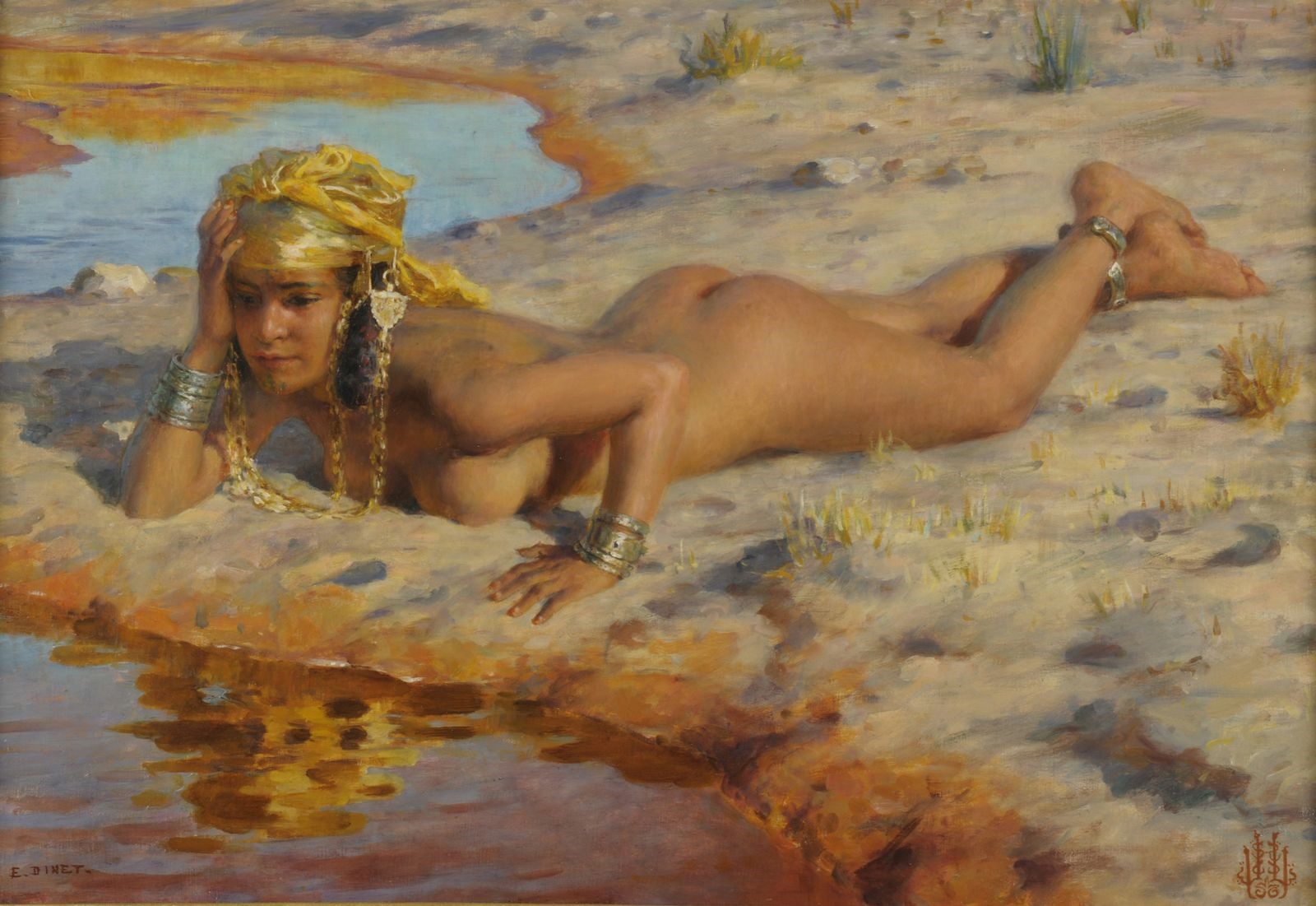
Dinet’s own biography helps, provided it does not silence questions about the image. After first visiting Algeria in 1884, he returned, learnt Arabic and developed close ties with Bou-Saâda and Sliman Ben Ibrahim. He converted to Islam in 1913, taking the name Nasreddine, and defended Muslim soldiers’ interests during the First World War. These commitments complicate the easy picture of a passing European visitor. They cannot turn any single painted body into a complete account of Algerian life. Allow the painting and the biography to remain distinct.
Marcello chooses whom to face
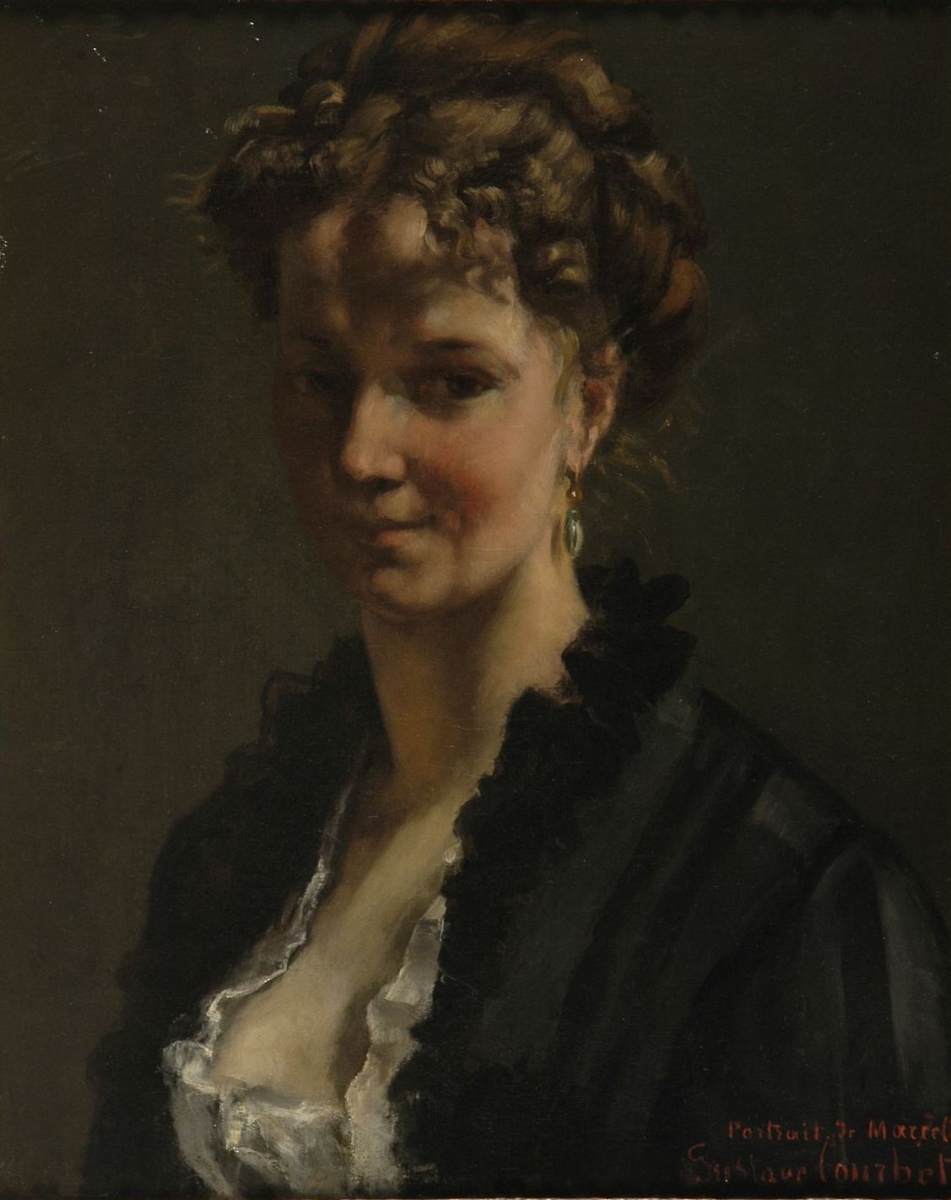
Adèle d’Affry had already made one decision about being painted: she declined Manet’s offer, concerned about association with a controversial painter. Yet she sat for Courbet in 1870. The apparent inconsistency is part of the interest. A woman pursuing a public career in sculpture could make careful, individual calculations about reputation without behaving according to a rule that later viewers find convenient.
Courbet’s The Sculptor Marcello identifies her by the professional name she used at the Salon. Widowed only nine months after marrying Carlo Colonna, she devoted herself to art and adopted a masculine pseudonym to resist being treated as an aristocratic amateur. The portrait gives us raised hair, a hanging earring and an uncovered neck. Read its title slowly: the sitter is a sculptor. That profession deserves at least as much attention as the duchess’s rank appended to her name.
Saint-Remi: a staircase remembers another fire
At the Musée Saint-Remi, the former abbey offers a further lesson in repair. Its ceremonial staircase was built in 1700 with stone balusters. Fire damaged them in 1774; the restoration introduced an iron railing by the Reims craftsmen Lecoq and Revel. Elsewhere, the chapter house preserves carved capitals from around 1130. Move between these different dates without trying to make the building belong to a single century. The changes are part of what there is to see.
For a visit before the fine-arts museum reopens, give the cathedral your morning and Saint-Remi the afternoon, with a proper break between them. Check tower access and the municipal museums’ programme when fixing the date. If Monet or Courbet is the reason for travelling, wait for a confirmed reopening and ask about the individual painting. Better to leave Reims with one building well remembered than with a hurried photograph of a museum door you expected to find open.
På forsiden: Au bord de l'Oued — Etienne Dinet. © Christian DEVLEESCHAUWER; Ministère de la Culture (France), base Joconde
Mere at læse
Art city by city →City guide
Art in Fontainebleau: Rosa Bonheur, Royal Portraits and the Renaissance Palace in a Day
A basket of Cupids and a monumental hay cart make an unexpected pair of reasons to visit a royal palace. Follow the paintings through Fontainebleau, from a king’s private gallery to the friend who preserved Rosa Bonheur’s memory.
City guide
Art in Autun: Eve, Jean Hey and the Musée Rolin in One Day
A medieval Eve survived inside a house wall; a cardinal brought his dog into the Nativity. Follow their stories between Autun’s temporary museum exhibition, cathedral and Roman ruins.
City guide
Art in Rennes: Rubens, Veronese and the Parlement de Bretagne in Two Days
A Bavarian prince’s hunting picture reached Rennes after a military seizure. Start with its smallest animal, then follow the city’s art from a private cabinet to a palace rescued from fire.