City guide
Art in Le Mans: Philippe de Champaigne at the Musée de Tessé, the Cathedral and Roman Walls
A tulip, a skull and an hourglass ask for more time than their little panel seems to need. Begin at Tessé, then follow a royal painting’s journey and a cathedral that crossed the city wall.
2. november 2026 · 7 min. læsning · ART WIKI’s redaktion
The tulip has been given its own glass, the skull its own interval of darkness. At the other end of the stone shelf, sand measures a duration that the painted flower cannot outlast. The Vanitas associated with Philippe de Champaigne is only 37.4 centimetres wide. Its plain arrangement is easy to remember and much harder to finish looking at. There is enough empty space between the objects to make each seem deliberately alone.
Build an art day in Le Mans around that small panel and the much larger biblical scene by Champaigne in the Musée de Tessé. Afterwards, walk towards Saint-Julien Cathedral and the Roman wall of the old town. The sequence moves from a private meditation to a royal commission and then to buildings that successive generations altered for their own purposes. It is a route through different uses of time, with a park and the streets of the Cité Plantagenêt between the longer stops.
A small panel bought at auction
The museum acquired the still life at the Bonnaire sale in 1884. Its authorship needs one qualification: the national collection record calls it attributed to Philippe de Champaigne, while the museum’s recent publications present it under his name. A cautious title preserves that distinction. Nor does the surviving evidence justify attaching the picture to a particular bereavement or private crisis. The arrangement can speak about death without supplying a diary entry from the painter’s life.
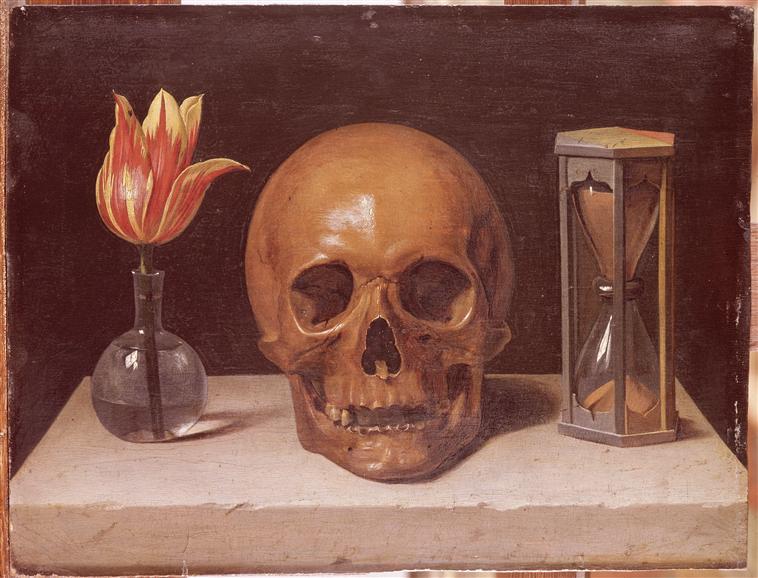
Start with the glass rather than the skull. Its transparency requires light to describe something almost absent; the bone beside it is opaque and solid. The flower introduces a different vulnerability. Read as symbols, these things make a succinct warning about mortality. Read as painted surfaces, they demand close attention to differences that a quick explanation can flatten. Once the objects have been translated into meanings, go back and look at the objects again. The picture has not become redundant because its subject is understood.
A later encounter gives the panel another history. After returning from Los Angeles, Carole Benzaken established a studio in Mayenne in 2006 and repeatedly visited Tessé. The painting entered her thinking about time and the limits of what images can disclose. Her own approach did not simply repeat its moral warning. That exchange eventually informed a museum exhibition in 2025–2026. A small seventeenth-century still life had become part of a living painter’s work, through repeated visits rather than a single revelation.
The angel arrives with a different answer
An exhausted body lies across the foreground of The Prophet Elijah’s Dream. Above it, an angel intervenes; bread and a vessel are set nearby. Champaigne painted the scene in 1650–1655 for the queen’s rooms at the Val-de-Grâce in Paris. The precise room is uncertain, but the royal destination is recorded. This was a picture made to inhabit an architectural setting, with a human figure large enough to meet a viewer on very different terms from the little still life.
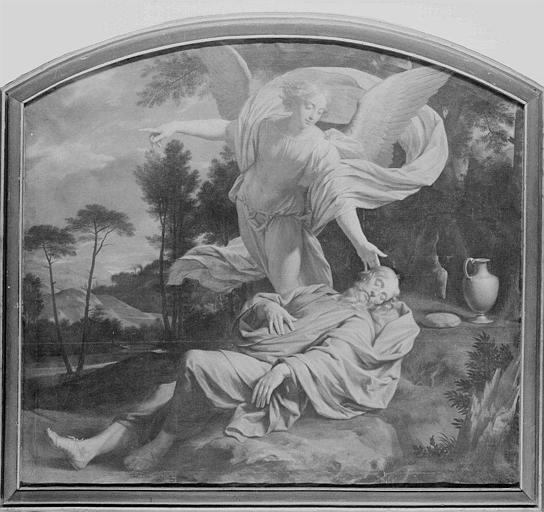
Anne of Austria had established a Benedictine community there and kept private apartments where she could withdraw from court life. The rebuilding begun in 1645 was bound to her thanksgiving for the birth of the future Louis XIV. Those circumstances place the painting within royal devotion, even though its subject has none of the furnishings of a royal portrait. A sleeping man receiving help could occupy a queen’s retreat. Patronage did not require every commissioned picture to display the patron’s worldly possessions.
Compare the direction of the bodies. Elijah’s weight settles across the earth, while the angel brings another movement into the scene. The landscape leaves room around them, so the intervention does not require a crowd of witnesses. Near the prophet’s head, the provisions introduce ordinary physical needs into a religious event. Hunger and sleep belong to the story. This makes a useful second encounter after the skull: the body is still vulnerable, but the action concerns sustaining it and waking it.
Champaigne had worked for Louis XIII and Richelieu after arriving in Paris from Brussels in 1621. His career began amid major court decorations; later, his attachment to Jansenism drew him towards more austere devotional art and portraits. These histories overlapped rather than fitting into separate compartments. The queen’s commission is a reason to resist imagining him as a painter detached from powerful clients. Religious seriousness and court employment could occupy the same career, sometimes the same painting.
Revolutionary removals, an episcopal house and a museum
The Elijah painting was seized during the Revolution and deposited in Le Mans in 1799. Other confiscations from churches and emigrant owners helped form the local museum’s first collections, with the Tessé family’s holdings providing a substantial nucleus. The museum’s name consequently carries the memory of a private collection that entered public life through political rupture. It is not simply the name of a building in which paintings happened to be assembled.
The present house occupies the site of the family’s former residence, but it is a later building, constructed as an episcopal residence in the nineteenth century. During the First World War it became a hospital. In 1927 it became a museum. Those changes matter when imagining the rooms as a collector’s domestic interior: the collection and the address have related histories, not identical ones. The grounds offer a sensible pause before the walk into the old town, especially after the concentrated stillness of the two Champaigne subjects.
A cathedral asks permission to cross a wall
In 1217 Philip Augustus permitted the cathedral’s builders to extend beyond the Roman enclosure. The Gothic choir needed space the older boundary could not provide. Its consecration followed in 1254, and its height exceeded that of the nave. Saint-Julien therefore preserves the meeting of different building campaigns rather than one uniform design. Walk around the eastern end as well as through the interior: the supports make the effort of extending and raising the church physically legible.
Archaeologists returned to that meeting of cathedral and fortification in 2017. A tower cut down during the medieval expansion had left a double row of foundation piles; another tower yielded unexpected chevron decoration. These are discoveries about construction, not just a succession of dates. They help recover the work beneath the finished view. The church did not rise over an empty site, and what its builders removed could still leave traces below the level of their new monument.
Continue towards the wall along the Sarthe side of the old town. Recent university research dates the enclosure to AD 320–360 and explains its coloured masonry through local building materials. Red brick alternates with sandstone and limestone in geometric patterns. Defence could have a carefully composed surface. After the small painted shelf at Tessé, a long stretch of masonry asks the eye to follow another arrangement of colours and intervals, this time with the city resting behind it.
Keep the museum’s midday break in mind when planning the day, and ask directly about the two paintings: access to them remains unverified in the supplied records. Allow daylight for the cathedral exterior and the wall, where changes of material deserve more than a hurried photograph. With a half-day available, concentrate on Tessé and the cathedral and shorten the street walk. The point is to leave time for the little panel, not merely time to locate it.
På forsiden: VANITE — Philippe de Champaigne. Réunion des musées nationaux - utilisation soumise à autorisation; Ministère de la Culture (France), base Joconde
Mere at læse
Art city by city →City guide
Art in Urbino: Raphael, Piero della Francesca and Paolo Uccello in the Ducal Palace
Two paintings survived a theft and a sale staged by undercover police. Back in Urbino’s story, they lead from a woman without a name to a room full of daylight and a troubling Renaissance legend.
City guide
Art in Castres: Goya, a Bishop’s Palace and the Houses Along the Agout
A royal meeting with an empty chair and a customer holding his own name give Castres an unexpected Spanish history. Follow Goya from a family bequest to the working houses along the river.
City guide
Art in Reims: The Cathedral, Saint-Remi and the Paintings Worth Returning For
A cement roof hides above the cathedral, and an evacuation label survives behind a Monet. Reims rewards a visit now, while its fine-arts museum prepares to reopen in 2027.