City guide
Art in Castres: Goya, a Bishop’s Palace and the Houses Along the Agout
A royal meeting with an empty chair and a customer holding his own name give Castres an unexpected Spanish history. Follow Goya from a family bequest to the working houses along the river.
2. november 2026 · 7 min. læsning · ART WIKI’s redaktion
The king occupies the centre, but the floor gets most of the attention. In Goya’s The Junta of the Philippines, rows of men retreat towards a distant table, leaving a great stretch of empty space between authority and the spectator. A meeting has become an architectural problem: how much room does power require? This enormous, uncomfortable painting belongs to Castres, a town where a walk beside the Agout can lead into the financial and political machinery of the Spanish empire.
Build a day around the Musée Goya, then give its former episcopal palace, garden and neighbouring riverfront time of their own. Two Goya paintings provide a manageable centre of gravity. Their arrival also answers the obvious question: why should a town in the Tarn have such a close connection with a painter from Aragón? The answer involves a French painter’s education in Spain, a purchase in Madrid and a family whose collection outlived both father and son.
A Spanish education, followed by a family bequest
Marcel Briguiboul knew Spain as a student before he knew it as a collector. His merchant family had settled in Barcelona, where he attended art school in 1854–55; training in Madrid followed. Researchers tracing his education found his name appearing almost daily in the Prado’s copyists’ register from September 1856 to mid-October 1857. Looking, returning and looking again had been part of his working life long before he acquired a Goya.
In 1881 he bought the paintings in Madrid. Marcel died in 1892, his son Pierre in 1893; Pierre’s bequest entered the museum in 1894. It brought almost eighty objects to a municipal collection that had opened in 1840 with nine paintings. There is a painful compression in those dates. A collection developed through years of travel became a public inheritance within two successive bereavements. The museum adopted Goya’s name in 1947, when curator Gaston Poulain made its Spanish direction explicit.
The royal visit that left an empty chair
Approach The Junta of the Philippines first as a record of company business. In March 1815 Ferdinand VII attended a shareholders’ meeting in Madrid; the company subsequently obtained permission to commemorate his visit. Its commercial horizon reached through Manila to Asian trade. This was royal attention bestowed on a colonial enterprise, with the participants arranged according to rank. The distant monarch is the point towards which the room’s perspective converges.
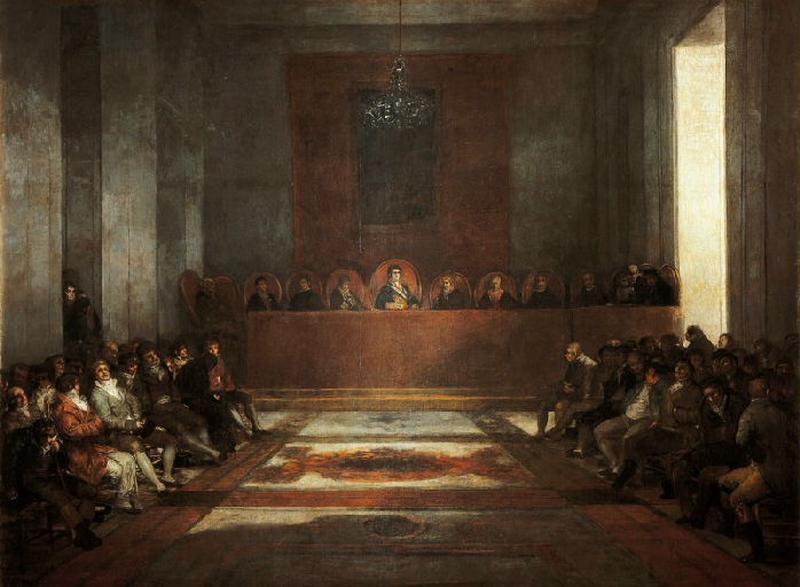
The commission acquired a political complication while Goya was working. Miguel de Lardizábal, the minister who had supported Ferdinand during the French occupation, fell from royal favour and was exiled. Curator Jean-Louis Augé interpreted the figure in the left doorway and the vacant seat as Goya’s response to that reversal. The Goya Foundation records another possibility for the chair: it may refer to vacancies the meeting intended to fill. Keep both readings in mind; an empty seat cannot explain its own history.
That uncertainty makes looking more rewarding. Follow the light across the seated men, then let your eye travel over the unoccupied floor. Some heads turn away from the business at the back. The king has the central position, yet the composition gives us ample time to inspect everyone around him. A corporate picture meant to preserve a royal honour can also leave its viewers wondering about obedience, boredom and the people who are permitted to be present.
A customer with a name on his letter
A piece of paper identifies the sitter in Portrait of Francisco del Mazo. His name appears in the address. The dark coat and high collar make a compact frame for a broad face; one hand disappears inside the clothing, the other is largely concealed by the letter. Goya’s correspondence records that visible hands increased the price of a portrait. That fact makes the arrangement tempting to read as an economy, although it does not preserve this customer’s bill.
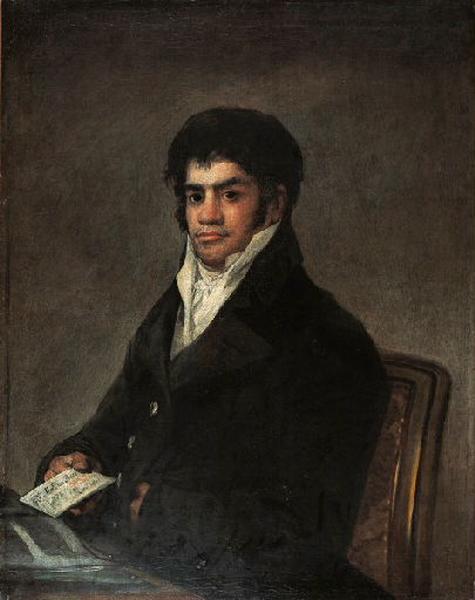
Del Mazo belonged to financial circles and held the office of chief bailiff to the Inquisition in Logroño. The French catalogue suggests that this latter role may have been honorary. His connections brought him within reach of Goya, but a commission is insufficient evidence of friendship or shared convictions. This paying customer restores a practical dimension to the visit: painting required patrons, introductions and negotiations, including with people whose politics might differ from the painter’s.
From the bishop’s geometry to the tanners’ river
Outside the paintings, two kinds of order await. The palace was built in 1665–73; its garden began in 1676 and took shape through the end of the century, with patterned beds in the manner of André Le Nôtre’s royal gardens. Beyond this controlled geometry, the houses along the Agout were organised around work. Their riverside cellars accommodated washing and lime vats for treating hides; upper floors provided drying space. The picturesque frontage once belonged to a production process.
Follow the garden paths with the painted meeting still in mind. Both compositions require the spectator to find a position from which the arrangement becomes legible. Yet the garden lets you move through its geometry. Take a side path and the apparent symmetry begins to separate into individual turns and patches of planting. A few minutes outside give the eyes something the large company picture deliberately withholds: the freedom to walk into the space.
Beside the river, the arrangement of space answers more ordinary demands. Imagine the work that required these different levels: water and heavy wet material below, room for drying above. Reading a facade now means looking upwards, following a hide through the workshop. The walk usefully balances the palace garden. Formal ceremony determined one arrangement; daily operations shaped the other. The coloured houses remain beautiful, but their beauty no longer seems like a backdrop assembled for a photograph.
Allow a generous museum visit, then take the garden and riverfront slowly. The houses are homes, so enjoy them from the quays. Before choosing a travel date specifically for one painting, ask the museum whether it will be available; collection ownership alone cannot settle that question. Try recalling the empty chair and the addressed letter without consulting your phone. They give this short route two very different ways of looking at a person.
På forsiden: L'Assemblée de la Compagnie Royale des Philippines dite La Junte des Philippines — Francisco de Goya. © Castres ; musée Goya, photographe : Pascal Bru; Ministère de la Culture (France), base Joconde
Mere at læse
Art city by city →City guide
Art in Reims: The Cathedral, Saint-Remi and the Paintings Worth Returning For
A cement roof hides above the cathedral, and an evacuation label survives behind a Monet. Reims rewards a visit now, while its fine-arts museum prepares to reopen in 2027.
City guide
Art in Fontainebleau: Rosa Bonheur, Royal Portraits and the Renaissance Palace in a Day
A basket of Cupids and a monumental hay cart make an unexpected pair of reasons to visit a royal palace. Follow the paintings through Fontainebleau, from a king’s private gallery to the friend who preserved Rosa Bonheur’s memory.
City guide
Art in Autun: Eve, Jean Hey and the Musée Rolin in One Day
A medieval Eve survived inside a house wall; a cardinal brought his dog into the Nativity. Follow their stories between Autun’s temporary museum exhibition, cathedral and Roman ruins.