City guide
Art in Clermont-Ferrand: Gustave Doré, Chassériau and the Black Cathedral in One Day
A clown’s injured child and a nation’s ancient hero share a museum in Montferrand. Follow them back to Clermont’s volcanic cathedral, whose apparently medieval skyline has a much later ending.
2. november 2026 · 7 min. læsning · ART WIKI’s redaktion
The clown is still dressed for work. His child has fallen, his wife holds the injured boy, and the bright costume has become unbearable. Gustave Doré’s The Acrobats, or The Wounded Child gives Clermont-Ferrand an image far removed from the reassuring pleasures of a picturesque town. It is a painting to make time for. So is Chassériau’s enormous scene of Gaulish resistance: in this city, nineteenth-century painters turn private suffering and public history into almost physical encounters.
Make your principal stop the Musée d’Art Roger-Quilliot, usually called the MARQ, in Montferrand, then return to Clermont’s cathedral quarter. There is a practical change to older itineraries: the Musée Bargoin closed for renovation on 31 July 2026. Its future will centre on archaeology and the history of the territory. For now, keep your museum time for the MARQ and allow the journey between the two historic centres to remain part of the day.
Montferrand: the other town in the name
Montferrand was already several centuries old when a royal decision joined it to Clermont in 1630. Founded around 1120, it had been a substantial Auvergne town in its own right; effective absorption took another century. Its later life included a period as a wine-growing settlement and then industrial transformation, with arrivals of workers, refugees and prisoners. The hyphen in Clermont-Ferrand compresses a difficult relationship. Travelling out to the museum gives some of that history its space back.
The MARQ occupies a former Ursuline convent, but the experience of entering it belongs to modern architecture. Adrien Fainsilber and Claude Gaillard reorganised the building around light and open views; engineer Peter Rice designed its glazed atrium. A gently rising ramp helps make movement part of the interior. The old religious enclosure has become a place where you can see across and between levels. Before concentrating on a canvas, notice how the building lets one visitor’s route briefly intersect with another’s.
Doré: what remains when the act stops
A fortune-teller’s cards lie near the mother in The Acrobats. The boy’s head is bandaged; the father sits apart in his stage clothes. Painted in 1874, the scene follows a tightrope accident, with the props and animals still surrounding the family. Nothing has been cleared away to give grief a dignified setting. Work has simply stopped in the middle of itself. The costume which ought to make strangers laugh now gives the father no protection at all.
Doré knew how to perform. He was a capable acrobat and sometimes appeared as Pierrot at costume parties. That facility helped shape a public image which also worked against him: a man who could do so many things so easily could be dismissed as an entertainer. The Musée d’Orsay’s account of his career suggests that his sympathy with travelling performers may have carried something of his own exclusion from official painting. It is an interpretation, not a key that locks every figure into autobiography.
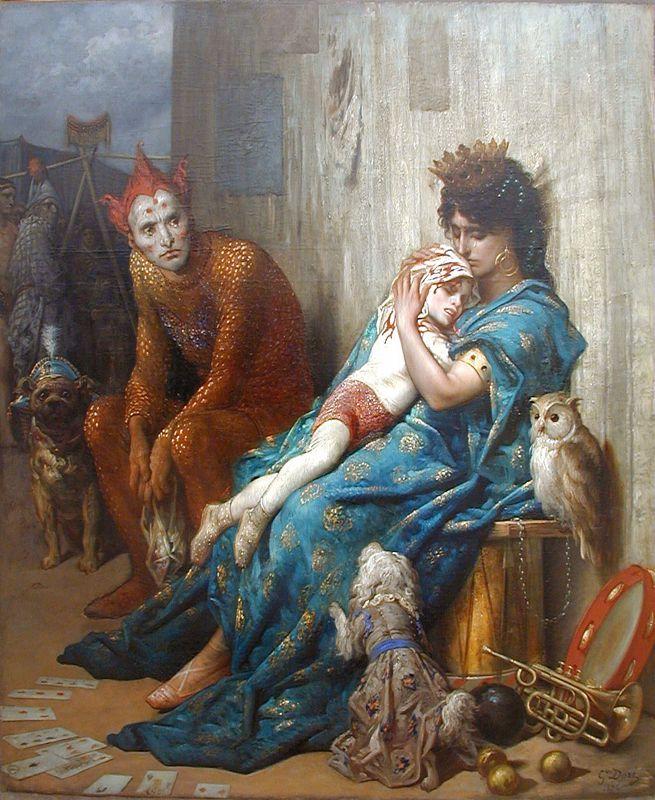
The mother and child recall a Pietà, with the weight of the young body crossing the woman’s lap. That resemblance gives a marginal family the gravity usually reserved for sacred mourning. Then the eye drops to the animals. A small dog puts a paw against the mother; the owl faces outwards. They complicate the human drama without needing a fixed dictionary of symbols. The dog’s contact is particularly hard to overlook: it offers the sort of ordinary attention for which no explanation is needed.
At 2.24 metres high, The Acrobats also refuses the small scale of a casual genre scene. Doré makes these people occupy the space of a major history painting. Clermont acquired the canvas in 1937, but its demand on the viewer has little to do with municipal pride. Stand far enough away to register the whole family before examining the scattered objects. The painting gives the father a little distance from the central embrace; do not let that make him disappear from your account of it.
Chassériau: a victory manufactured on a giant canvas
Women lift children above the fighting on the ramparts in The Defence of the Gauls by Vercingetorix. Below them, weapons and bodies crowd the canvas. Chassériau painted it in 1855 for the year of the Paris Universal Exhibition, drawing on the episode at Gergovia in Caesar’s account. This is victory, rather than the later surrender at Alesia. The distinction matters in Auvergne: the nineteenth century could make its Gaulish hero both an opponent who defeats Rome and a defeated man whose sacrifice serves a nation.
The height is more than five metres. A composition on that scale must organise the viewer’s body as well as the painted bodies: your gaze climbs from the dead at the bottom towards the people above. Vercingetorix looks upwards in an attitude the museum’s historians compare to a Christian figure. Chassériau borrowed the authority of older pictorial traditions for an ancient national subject. Historical painting here is an active construction, made for a modern audience with modern desires.

That national image was still relatively new. The museum’s study of Gaulish imagery traces Vercingetorix’s wider historical and popular recognition to the 1820s and 1830s. Set the date of the canvas beside that short interval, and the supposed ancestral memory begins to look freshly made. You need not reject the drama to see how it works. Compare the mothers in this picture with Doré’s: one painting mobilises family feeling to urge men into battle; the other stops the action around a single injured child.
Clermont: a dark cathedral with a modern ending
The cathedral’s black exterior comes from the volcanic stone of Volvic. It was a deliberate material choice when the Gothic building began in 1248, replacing the paler stone familiar in the region. Yet the silhouette that seems to belong wholly to the Middle Ages is partly a nineteenth-century achievement. After a very long interruption, Viollet-le-Duc and his successors completed the western end. The town’s most apparently ancient profile contains the same century that produced the two large paintings at the MARQ.
At the north portal, Euclid carries the instruments of geometry while Pythagoras has bells. Boethius counts nearby; the thinkers give bodies and occupations to the liberal arts. Learning has become something that can be recognised through a hand, a tool or an occupation. After the theatrical size of the museum canvases, these smaller signs reward a different attention. Let the cathedral be a place for particulars as well as a dark shape against the sky. Its architecture was meant to be read at more than one distance.
For the simplest journey, use tram line A to the stop named Musée d’Art Roger-Quilliot and give Montferrand an unhurried morning. Return towards the cathedral for lunch and the afternoon. Check museum hours and current cathedral access before setting out: restoration works were affecting the exterior and approaches in autumn 2026. Do not replace the closed Bargoin with a rush to another building. A little time outdoors after Doré will probably be more useful than one more admission ticket.
På forsiden: Les Saltimbanques (L'enfant blessé) — Gustave Doré. Ville de Clermont-Ferrand MARQ; Ministère de la Culture (France), base Joconde
Mere at læse
Art city by city →City guide
Art in Pont-Aven: Sérusier, Émile Bernard and Maurice Denis in a Day by the River
A servant’s misnamed portrait and two pigs at a trough tell the story of modern painting unusually well. Begin with the women who kept the painters’ lodgings running, then follow the Aven into the woods.
City guide
Art in Bayeux: Caillebotte, Gros and the Cathedral in One Day
A wedding gift and a queen’s invented workshop open a route through Bayeux beyond the story of the Norman Conquest. Start with the paintings, then read the cathedral’s changing walls.
City guide
Art in Rueil-Malmaison: Napoleon, Joséphine and the Paintings of Their Country House
At Malmaison, broken beams became Roman columns and dead generals entered a poet’s heaven. Spend a day exploring the ingenuity and imagination behind an imperial retreat.