City guide
Art in Bayeux: Caillebotte, Gros and the Cathedral in One Day
A wedding gift and a queen’s invented workshop open a route through Bayeux beyond the story of the Norman Conquest. Start with the paintings, then read the cathedral’s changing walls.
2. november 2026 · 7 min. læsning · ART WIKI’s redaktion
The wedding present contained four women, three sewing projects and no bride. In 1887 Gustave Caillebotte came to Bayeux as a witness at his cousin Zoé’s marriage and gave her a painting of the family garden at Yerres. Her sister appears in it; Zoé does not. That small absence opens a different route into a city whose reputation can otherwise seem entirely occupied by William the Conqueror.
Bayeux rewards a day divided between the former episcopal palace, the cathedral next door and a walk beside the Aure. There is one substantial change for travellers in autumn 2026: the museum devoted to the medieval embroidery closed in September 2025 for rebuilding, with reopening scheduled for October 2027. Make the Musée Baron Gérard, or MAHB the centre of your art day. Its paintings lead from family affection to ancient poetry and the manufacture of Norman memory.
A wedding gift with a long afterlife
Caillebotte’s Portraits in the Countryside dates from 1876. The blue dress nearest us belongs to his cousin Marie; farther back his mother reads. He selected the canvas for the third Impressionist exhibition in April 1877. A quiet afternoon among relatives thus entered the public argument about what modern painting should look like, a decade before it became Zoé’s wedding gift.
The women share a garden without assembling for us. Chairs and clothing occupy more of our attention than expressions. Needlework and reading give each figure a reason to look down, away from the painter. This is a family portrait organised around the right to be left alone. The blue dress makes an immediate claim on the eye, while the seated figures behind it require a slower search. We enter the scene as an interruption that nobody acknowledges.

Zoé’s daughter Suzanne Chaplain fulfilled her mother’s wishes by giving the picture to Bayeux in 1947. Another Caillebotte from the same family, Landscape at Argenteuil, followed a longer administrative path: her grandson sought its transfer through payment of inheritance tax in art in 1995; a state deposit brought it to Bayeux in 2020. The paintings’ separation and reunion make the museum’s collection feel less like an impersonal accumulation than an inheritance carefully passed beyond the family.
Sappho holds on to her instrument
A general commissioned the moonlit tragedy. The Louvre’s study of Gros’s preparatory drawing identifies General Dessolles as the patron of Sappho at Leucate, conceived during the painter’s Italian years, begun in Milan and completed after his return to Paris. Shown at the Salon of 1801, it places the Greek poet on the edge of a dark sea. Military patronage could buy private anguish as readily as a victorious uniform.
Gros gives Sappho a lyre to clutch and a veil that the wind can move. Her body is still sufficiently upright to make the coming fall difficult to imagine. The instrument seems almost another body, held close when everything else is about to be relinquished. Moonlight does not explain the landscape so much as remove its ordinary solidity: the shore is less a place one could visit than the last margin of a life.
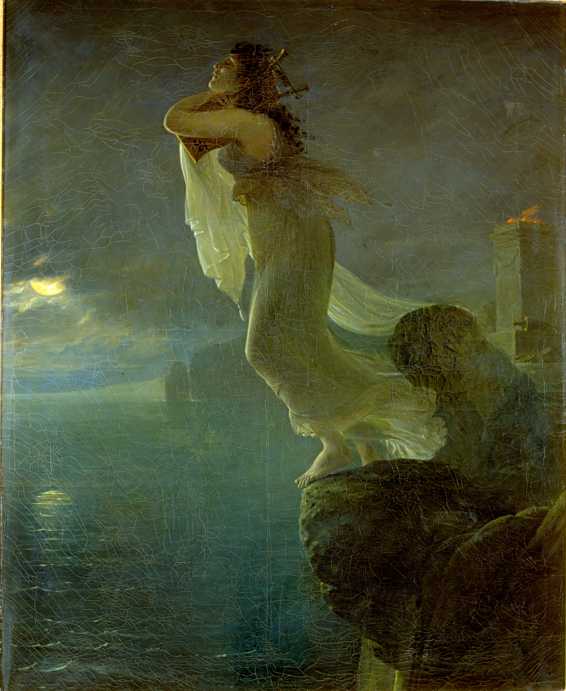
The distinction matters. Sappho’s death for love of the ferryman Phaon is a literary invention, not established biography. The Musée de la Vie romantique’s study of Romantic heroines follows the way later writers and painters recast the ancient poet as a woman destroyed by unrequited love. Looking at Gros, we can admire the precarious figure and still ask what happened to her poetry when her imagined death became the subject everyone wanted to paint.
The queen who supervised a legend
Another woman acquires a persuasive invented occupation in Alfred Guillard’s Queen Matilda Working on the Cloth of the Conquest, painted in 1848. Matilda sits above her attendants, directing the embroidery. The blue gown and elevated chair organise the hierarchy before we have examined a single stitch. Even needlework has become a court ceremony: the women’s hands labour, the queen’s hand gives instructions.
Guillard fitted the scene into a canvas only thirty centimetres high and almost a metre wide. The long room echoes the long textile. Romanesque ornament supplies an apparently convincing Norman setting, but the authorship story is unsupported. The makers of the eleventh-century embroidery remain unidentified; most scholars favour an English origin and Bishop Odo as commissioner. A picture can be precise about costume and architecture while giving a doubtful story the comfortable appearance of fact.

Caillebotte’s women sewing in a garden offer an unexpectedly useful comparison. Their work occupies time; Guillard’s work creates history and dynastic authority. Neither arrangement is innocent, though the paintings ask very different things of us. Returning mentally to the blue dress in the garden after Matilda’s blue gown makes the distance between an observed family afternoon and an invented national past unusually easy to see.
A chapel concealed in a bakery
The museum itself has a gift story with conditions attached. In 1899 Baron Henri-Alexandre Gérard, nephew of the painter François Gérard, offered Bayeux thirty-seven paintings on the understanding that they would have a proper art museum independent of the municipal library. The palace provided that home. During the much later renovation, remains of a Gothic chapel emerged inside an old bakery, and its pointed windows were incorporated into the visitor route when the MAHB reopened in 2013.
Outside, the cathedral makes a longer argument through its walls. William attended its dedication in 1077, but the building is not a single surviving eleventh-century moment. The Romanesque crypt and western towers belong to its early history; the nave was rebuilt and the thirteenth century gave the church much of its Gothic form. Even the central tower acquired its final crown only in the nineteenth century. Walk around before entering: changes of period are part of the pleasure, not defects to overlook.
Give the MAHB an unhurried morning, check cathedral access around services, then follow the bronze pavement markers through the old town. The municipal circuit runs for about two and a half kilometres; the Aure offers a shorter pause whenever you want one. Its former tanners’ and dyers’ quarter is a good place to finish, with moving water after so many painted women required to remain perfectly still.
På forsiden: Sapho — Antoine-Jean Gros. @ Bayeux – MAHB; Ministère de la Culture (France), base Joconde
Mere at læse
Art city by city →City guide
Art in Rueil-Malmaison: Napoleon, Joséphine and the Paintings of Their Country House
At Malmaison, broken beams became Roman columns and dead generals entered a poet’s heaven. Spend a day exploring the ingenuity and imagination behind an imperial retreat.
City guide
Art in Valenciennes: Rubens, Watteau and a Walk Through Carpeaux’s City
A restored Rubens, a disputed little dance and a fountain full of actors tell the story of Valenciennes. With the museum closed for renovation, begin in the streets and plan the collection for a return visit.
City guide
Art in Dieppe: Courbet, Renoir, Gonzalès and Pissarro from Castle to Harbour
A story about borrowed trousers, a welcoming household and a window above the quays connect Dieppe to four painters. Follow their stories from the castle heights down to the working port.