City guide
Art in Rueil-Malmaison: Napoleon, Joséphine and the Paintings of Their Country House
At Malmaison, broken beams became Roman columns and dead generals entered a poet’s heaven. Spend a day exploring the ingenuity and imagination behind an imperial retreat.
2. november 2026 · 7 min. læsning · ART WIKI’s redaktion
Two broken beams helped turn Malmaison into a Roman house. Rather than replace them, the architects supported them with wooden posts dressed as stucco columns. The repair became an atrium. In Napoleon and Joséphine’s country retreat, the antique appearance conceals a cheap repair to an awkward old building.
A visit to the Château de Malmaison works best as a day in Rueil, with time for the garden and the town’s church of Saint-Pierre-Saint-Paul. Joséphine bought the estate in 1799; after their divorce she remained here until her death in 1814. Paintings made for the house reveal how its owners wanted to place themselves in history. Two particularly rewarding examples invent gatherings that could never have happened, with very different results.
A government inside a tent
Percier and Fontaine initially proposed replacing the old house with a new classical villa. Bonaparte insisted on renovation. Their ingenuity extended beyond the columns: sliding mirrors could open the entrance hall into adjoining reception rooms. Such devices change the way one reads the interior. Behind the solemn vocabulary of antiquity is a house designed to expand for guests, conceal awkward construction and make its owners look entirely at ease.
The council chamber was fitted out in ten days, according to the museum’s historical account, and hosted 169 councils in 1801 and 1802. Its fabric walls and supporting military emblems made government resemble an encampment. In the library, a concealed staircase connected Bonaparte’s work space to his private rooms. Public authority and private convenience occupied the same small building. Instead of looking for the largest room, follow the shifts between conversation, work and sleep: those transitions explain the house’s scale.
All the Enlightenment invited at once
Lemonnier’s In the Salon of Madame Geoffrin in 1755 gives a hostess an impossible guest list. Painted in 1812 for Joséphine, it assembles writers, thinkers and artists around a reading of Voltaire’s play The Orphan of China. The actor Lekain reads; Voltaire attends as a bust. Diderot, Montesquieu and other intellectual luminaries fill a room that seems to contain an entire century’s conversation.
The title offers a date with the confidence of an eyewitness report. Yet Lemonnier openly described his intention as bringing together the distinguished people of an era, and the gathering is imaginary. That difference is easy to miss because the clothes, faces and furniture are so specific. The painted listeners lean towards one another in chairs pulled close together. The speaker appears to have paused for breath; it is easy to trust such apparently casual movements.

Read it as a portrait of cultural ambition. The hostess occupies a world whose importance depends on her ability to convene people. For Joséphine, commissioning this subject could offer a model of influence exercised through hospitality and taste. The painting invites us to notice the woman who makes the conversation possible as well as the men whose names dominate it. Its crowdedness becomes meaningful: the room is doing work that a throne room usually claims for itself.
Dead generals enter a poet’s sky
Girodet devised a much less plausible reception in The Apotheosis of the French Heroes Who Died for Their Country. Bonaparte ordered it in 1800. French generals killed during the Revolutionary wars, including Desaix and Kléber, arrive in a supernatural world where Ossian welcomes them. Above the gathering, Victory and a Gallic cockerel drive away the Austrian eagle. National rivalry continues even beyond the grave.
Ossian was supposedly an ancient bard whose poems James Macpherson had translated. Their claim to antiquity concealed extensive modern invention, but the poems’ dreams, mist and voices of the dead gave European readers a powerful imaginative territory. Girodet returned to these visions in drawings as well as paintings. The patron’s preference for Ossian offered him a route away from the solid, clearly bounded bodies associated with his teacher David.
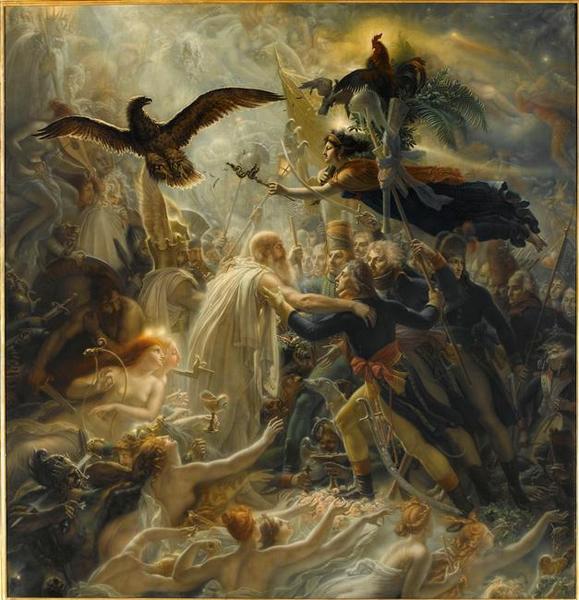
The difficulty of sorting out the bodies is part of the experience. Figures seem to emerge from other figures; light belongs to no ordinary daylight. Uniformed men cross into a world that cannot support their weight in the usual way. Where Lemonnier makes an invented meeting look socially convincing, Girodet allows invention to remain strange. Together, the paintings show how much imaginative freedom could fit inside the decoration of a politician’s country house.
Joséphine’s roses had to be moved
The garden brings a useful correction to another attractive story. The museum explains that Joséphine did not have a rose garden in the later, specialised sense of the term. Roses grew in beds and containers; pots could be moved outside for the season, and flowers also supplied rooms, hairstyles and dresses. Redouté’s publications helped create the subsequent legend. A garden that now seems inseparable from one woman’s name was also a demanding operation of heating, moving, watering and replacement.
Let the walk restore some physical effort to the elegant interiors. A flower in a room has been cut, carried and arranged; an apparently effortless gathering requires servants, food and maintenance. Malmaison becomes more interesting when those actions are allowed back into the picture. The grounds are also a good pause between the two painted assemblies: after so many people compressed into a rectangle, space without an audience feels particularly welcome.
A family inscription after the empire
Joséphine’s death created an immediate bureaucratic problem for Rueil. Napoleon had abdicated only weeks earlier, and the municipality hesitated over how to record her identity. Her children’s plan for a monument then required years of negotiation. Royal permission specified a simple dedication from Eugène and Hortense to their mother. The permanent burial followed in 1825. At Saint-Pierre-Saint-Paul, family remembrance and the discomforts of a changed regime belong to the same story.
Begin with the château while your attention is fresh, leave the park for a pause, and make the church and town centre your last stop. Check the museum’s opening hours before travelling, since a country-house visit is easily spoiled by arriving at a midday closure. Allow enough time to walk between the two parts of Rueil: the distance is useful, giving the elaborate painted afterlives time to settle before the quieter business of remembering a mother.
På forsiden: Lecture de la tragédie de l'orphelin de la Chine de Voltaire dans le salon de madame Geoffrin — Anicet Charles Gabriel Lemonnier. © Arnaudet ; © Réunion des musées nationaux - utilisation soumise à autorisation; Ministère de la Culture (France), base Joconde
Mere at læse
Art city by city →City guide
Art in Valenciennes: Rubens, Watteau and a Walk Through Carpeaux’s City
A restored Rubens, a disputed little dance and a fountain full of actors tell the story of Valenciennes. With the museum closed for renovation, begin in the streets and plan the collection for a return visit.
City guide
Art in Dieppe: Courbet, Renoir, Gonzalès and Pissarro from Castle to Harbour
A story about borrowed trousers, a welcoming household and a window above the quays connect Dieppe to four painters. Follow their stories from the castle heights down to the working port.
City guide
Art in Arbois: Courbet, Pointelin and a Day beside the Cuisance
A mathematics teacher painted the Jura from memory; his neighbour Louis Pasteur helped him make a career. Follow their friendship through a family museum and along the river.