City guide
Art in Cherbourg: David, Millet and the Paintings That Taught a Town
Anonymous gifts created Cherbourg’s museum, and a young Millet came to copy them. Follow that exchange through an academic nude, portraits of his first wife and a fragment of an Italian garden.
2. november 2026 · 7 min. læsning · ART WIKI’s redaktion
Parcels began arriving in Cherbourg in 1831 without a donor’s name. Inside were paintings intended to give the town a public collection. The sender was Thomas Henry, a local man who had made a career in the art trade. By 1835 his gifts had become a museum. Among the young people who learned by copying its pictures was Jean-François Millet. A private collection had supplied the town with something more consequential than decoration: a place where a painter could begin.
That exchange between giving and learning shapes a day in Cherbourg-en-Cotentin. Spend the main part at the Musée Thomas Henry in Le Quasar, then walk to Emmanuel Liais’s garden. If you have a second day and transport, continue west to Millet’s birthplace at Gruchy. Keep the museum visit spacious. The most absorbing encounters here involve looking at a body, a face or a small patch of garden until the subject becomes less familiar than it first appeared.
Thomas Henry: a gift with a public purpose
Henry was sixty-five when he decided to give a substantial part of his collection to his native town, on condition that it establish a museum. The selection had an educational purpose. At the Musée Thomas Henry, that intention is worth remembering before individual names take over. These were pictures chosen to be encountered together, making different kinds of painting available to people who could not simply spend their days in Parisian collections.
Millet’s presence in the story changes the direction of the gift. The young man copying paintings would eventually become one of the reasons people travelled to this museum. Works associated with his first wife’s family entered through the Ono bequest in 1915. The collection that had helped educate him thus acquired a record of his own early life. It is an unusually personal form of return, carrying family memory back into a public institution.
David: the hero turns his back
The title Patroclus promises a scene from heroic antiquity. Jacques-Louis David’s Male Nude, formerly called Patroclus, however, begins with the much more practical demands of an academy exercise. He made the painting in Rome around 1780 as part of his training at the French Academy. The assignment required a figure at natural size. A student had to make a body convincing before anyone needed to believe in the hero attached to it.
The man turns his back. His face cannot carry the picture’s meaning, so the eye has to work through the torso, limbs and the weight of the pose. This is an excellent place to test how much portraiture teaches us to depend on an expression. Here a shoulder must do work usually assigned to a mouth or eyes. The old mythological title can remain in the background while you consider what painting alone has to accomplish.
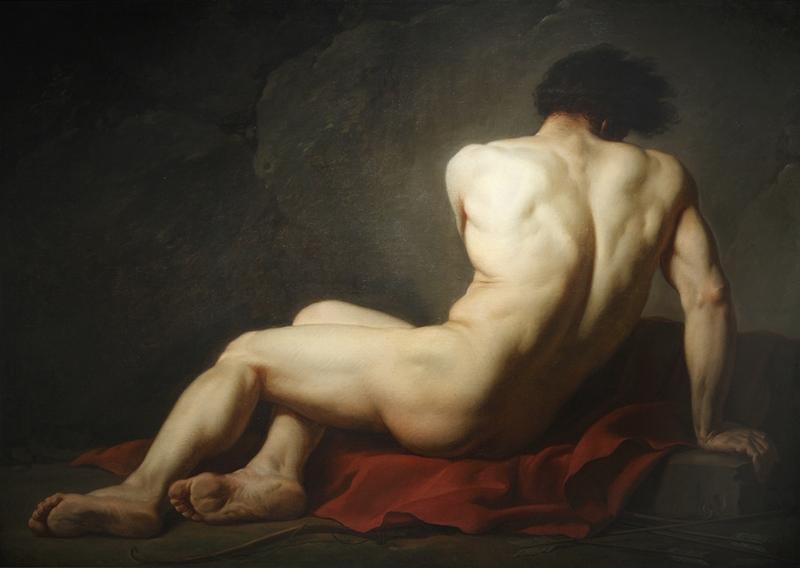
Henry gave the canvas in 1835. Its later life as a public lesson fits its first purpose as an exercise, although the audience changed completely. A visitor need not know the rules of eighteenth-century artistic training to feel the difficulty of the pose. Try mentally straightening the figure and notice how much would disappear. The arrangement of a body, rather than an unfolding action, is the event the picture asks you to follow.
Millet: Pauline before and during illness
Pauline Ono was a tailor’s daughter whom Millet met in Cherbourg. They married in 1841; she died of tuberculosis in 1844. In Portrait of Pauline Ono in Morning Dress, painted in 1843–44, her clothing has an almost theatrical presence, including the red fabric around her head. The knowledge that this was her final year changes the act of looking. A portrait can preserve someone’s presence while refusing to make illness its only subject.
The museum also owns Pauline Ono in a Blue Dress, from 1841–42. Put the two images beside one another in your mind. The earlier date lies close to the marriage, the later one close to her death. Those dates should not overwhelm the person between them. Look at the choice of dress and the way the painter gives attention to a particular woman, rather than treating the pictures merely as evidence for a sad biography.
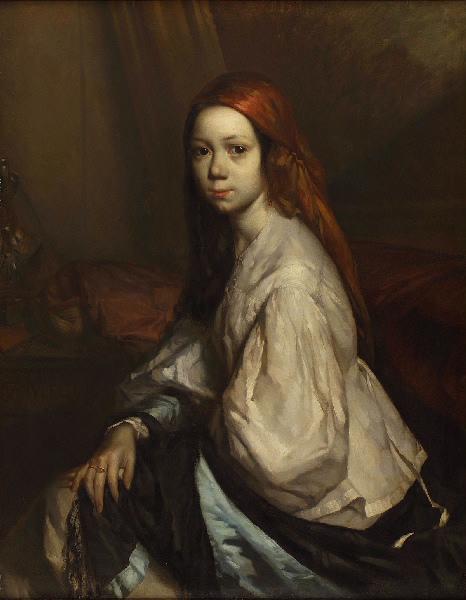
The museum’s account of the later portrait draws attention to warm ochres and reds that soften the appearance of pallor, and to the care given to fabrics. That reading leaves room for tenderness without requiring a theatrical claim about Millet’s feelings. What can be seen is a painter working with colour and clothing. What can be established is a short marriage and an approaching death. The space between those things is where the portrait becomes difficult to leave.
A garden cut from a larger world
Augustine sits beneath a fig tree in The Conversion of Saint Augustine, attributed by the museum to Fra Angelico. The episode comes from the account of his conversion in Milan: a voice tells him to take up a book and read, and a passage of Saint Paul changes his life. A garden becomes the setting for an inward event. Instead of demanding a large public gesture, the story depends on attention to a few words.
The panel measures barely twenty-two by thirty-four centimetres and once belonged to a larger composition that was cut apart. Its present edges therefore conceal a history of the art market. You can enjoy the concentrated scene, but it is also worth imagining the missing space beyond the frame. What looks like a perfectly self-contained museum object may have begun as one part of a much wider painted world.

Scholars have tried to reconnect the scattered fragments; the French heritage catalogue records a reconstruction proposed by Michel Laclotte in 2011. Such work changes the meaning of close looking. A tree, a contour or an edge may help recover relationships that a sale once broke. Henry’s gift made the fragment public, and later study continued the task of understanding what exactly had arrived in Cherbourg.
Outside: another collector’s garden
Emmanuel Liais sent plants from Brazil to Cherbourg and entrusted their acclimatisation to the horticulturist César Cavron. An astronomer and former director of the observatory in Rio de Janeiro, he developed a garden at his family property, with an observation tower. It offers a generous change of pace after the paintings. Paths through trees replace the museum’s deliberate sequence, while the story remains one of things brought from elsewhere and made part of local life.
For a longer stay, Gruchy adds Millet’s childhood landscape about twenty kilometres west of Cherbourg. He was born there in 1814 and helped with farm work as a boy; the birthplace is now a seasonal visitor site. Treat it as a separate excursion, with time to walk in the hamlet, rather than an errand squeezed between trains. The portraits in town and the countryside of his childhood deserve different kinds of attention.
Book your museum day from Tuesday to Sunday, checking the midday break on weekdays and the later weekend opening. For a quieter visit, the museum recommends late weekday afternoons among its less busy periods. Take the garden walk afterwards, and verify the seasonal calendar before travelling to Gruchy. Leave one painting unfinished in your mind: the pleasure of this collection is that you can carry a face or a turned shoulder into the rest of the day.
På forsiden: Académie d'homme ; Patrocle (ancien titre) — Jacques-Louis David. © Daniel Sohier - utilisation soumise à autorisation; Ministère de la Culture (France), base Joconde
Mere at læse
Art city by city →City guide
Art in Bourg-en-Bresse: The Tombs of Brou, Gustave Doré and Gustave Moreau
Margaret of Austria built a monastery she never saw completed. Its tombs and paintings lead from a widow’s public image to the ice of Doré’s hell.
City guide
Art in Agen: Goya, Corot and the Museum’s New Home in the Jacobins Church
Goya’s face survived a knife and a journey to Switzerland. Its home collection now leads visitors through another change of address, from old town houses to a medieval church.
City guide
Art in Agde: Ancient Bronzes, the Éphèbe Museum and Château Laurens in One Day
A diver found a bronze body beside the town’s quays; its missing leg emerged months later downstream. Follow that discovery from the Hérault to a museum built to bring it home.