City guide
Art in Brest: Sérusier, Maurice Denis and a Walk through the Rebuilt City
Brest rebuilt its art collection after losing its museum to fire. With the galleries closed again, paintings, an outdoor exhibition and the glass of Saint-Louis offer ways into the city’s history.
2. november 2026 · 7 min. læsning · ART WIKI’s redaktion
The evacuation was scheduled for 9 July. Four nights earlier, in 1941, fire following an air raid destroyed Brest’s museum and the works that had not yet left. That narrow interval belongs in any account of art here. Brest had to rebuild a collection as well as a city. Its pictures acquired after the war carry an extra weight: they helped make an artistic past available again in a place where so much had disappeared.
An autumn 2026 visit requires another adjustment. The Musée des Beaux-Arts building has been closed since 2025 following the discovery of mould, and its programme has moved beyond the galleries. Begin with the outdoor exhibition on Place Wilson, continue towards the rebuilt city’s architecture and Saint-Louis church, and use the collection’s pictures to look more closely at both. The collection includes all the pictures in this guide; contact the museum about access to any particular canvas.
Place Wilson: a museum steps outside
A passer-by can enter this part of the museum’s programme without finding a door. Brest, l’art pour raconter la ville, an outdoor exhibition announced for 27 August to 30 November 2026 on Place Wilson, brings artistic views into a walk through the city. Its subject is Brest’s history and transformation. The setting makes the comparison unusually direct: look at an image, lift your eyes, and the rebuilt town continues beyond it.
The closed Musée des Beaux-Arts on rue Traverse is part of that postwar landscape. Its present building opened in 1968. The collection’s reconstruction was an extended undertaking, supported by purchases, gifts and state assistance. A museum can seem inevitable once it has a fixed address and a catalogue. Brest makes it easier to see the choices underneath: somebody had to decide what a city that had lost so much should collect next.
Even the provisional museum had suffered a second catastrophe. It opened in June 1947, then was partly damaged the following month by the explosion of the cargo ship Ocean Liberty. The touring exhibition had already moved on, and the evacuated historic collections had not yet returned. This time absence protected the pictures. Keep that reversal in mind when a closure feels like a blank on an itinerary: looking after a collection sometimes means separating it from its public.
Sérusier: a field with a long journey home
A green wheatfield offers a quieter point of entry. Paul Sérusier painted Green Wheat at Le Pouldu in 1890, turning towards a coastal village in southern Finistère. The canvas is only about half a metre across. That intimacy matters after the scale of Brest’s destruction and rebuilding: a regional collection could be renewed through a picture of growing crops as well as through grand historical subjects.
The catalogue raisonné follows its later movements through Paris and London dealers before its purchase for Brest in 1983. It had passed through Galerie Druet and a London owner, then other galleries, before reaching a public collection in Brittany. A painting of nearby country need not have spent its life nearby. Its arrival is a small example of the patient buying through which a museum learns to speak about its region.
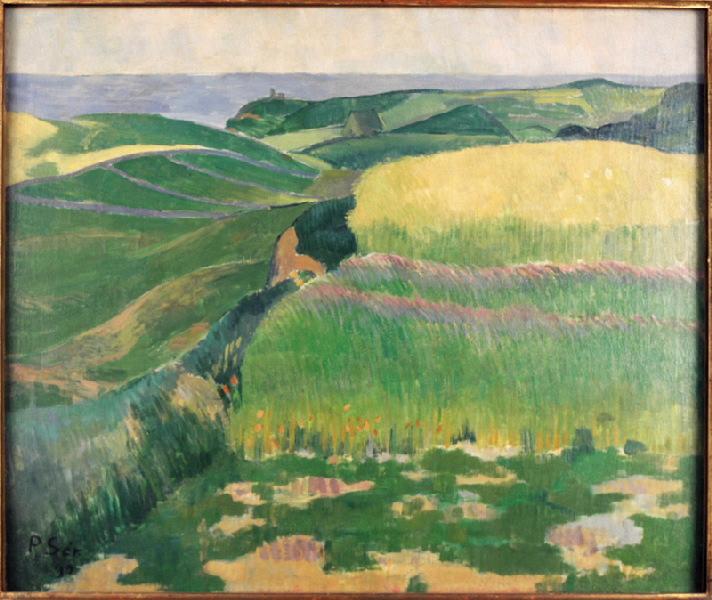
For Green Wheat at Le Pouldu, start with the simplest question its title raises: why show the crop before harvest? Green wheat has yet to become the familiar gold of abundance. Reading the subject this way puts the emphasis on an unfinished season, on a landscape still doing something. That is a useful thought to carry back into a city where rebuilding and adapting have repeatedly interrupted the apparent permanence of streets and institutions.
Bernard: two women crossing industrial country
Two ragpickers pass close to the viewer in Émile Bernard’s Two Women on the Footbridge at Asnières, also known as Ragpickers of Clichy. Painted in 1887, it looks towards the industrial banks of the Seine. The foreground belongs to the women’s profiles, while factory smoke and the river extend behind them. An urban crossing, with people earning a living at the margins, becomes the subject of an experiment in painting.
The bridge’s geometry holds the scene together; dark outlines divide broad areas of colour. Bernard makes faces, water and industrial structures coexist on the same emphatic surface. Try following one contour rather than searching for a distant vanishing point. The result feels closer to assembling a picture from separate pieces than to looking through a window. The women do not dissolve into the view: they remain an obstacle to treating the riverbank as pleasant scenery.

That picture gives a useful counterweight to the fields. A collection associated with Brittany also preserves experiments made around Paris, and a maritime city has reasons to recognise an industrial river. The connection is not a claim that Bernard painted Brest. It is a way of looking at what the museum chose to bring here, where working waterfronts are part of everyday experience rather than an exotic artistic discovery.
Denis and Saint-Louis: colour against concrete
Maurice Denis approached Brest itself in The Port of Brest, painted in 1932. Warships lie at anchor, a tug is busy nearby, and only a few people can be made out on the quays. The water takes on violet tones. In this account of the harbour, military equipment shares a calm, sunlit arrangement with reflections. The painter makes a place built for organised force seem momentarily available to stillness.
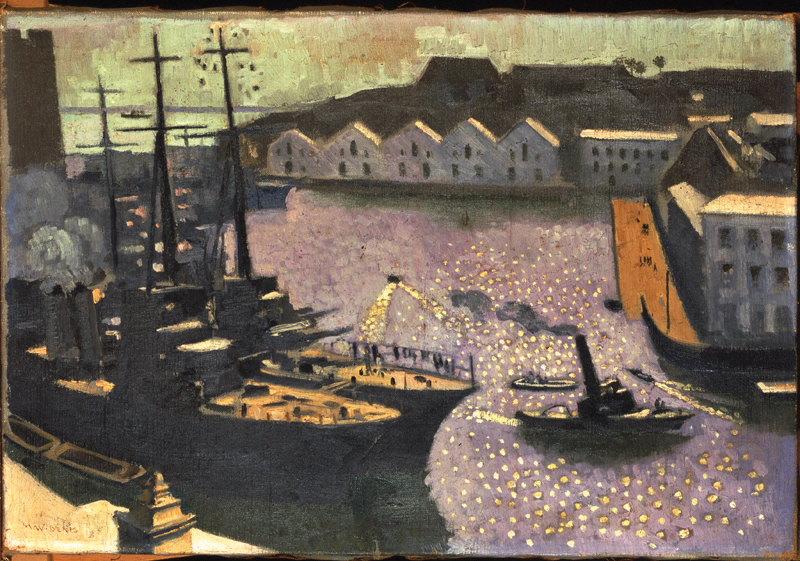
Carry that attention to colour towards Saint-Louis church, consecrated in 1958. Its reconstructed setting belongs to a later Brest. The building uses concrete with Logonna stone facing, and the enormous nave makes daylight an architectural material. The largely closed western wall protects the interior from driving rain; opposite it, tall stained-glass windows admit colour. Weather has helped determine where the images can live.
Maurice Rocher, Paul and Jacques Bony, and Léon Zack contributed glazing to the church. The glass works with the scale of the building rather than offering a row of small pictures to inspect. Stand still long enough to notice how coloured light changes the surrounding surfaces. After the museum’s story of loss and acquisition, this is another form of making art public: commissions conceived for a new space, in a city learning to inhabit its reconstruction.
For now, plan Brest around the outdoor programme and the architecture, allowing for services when visiting Saint-Louis. Check the museum’s current events before travelling, particularly after the Place Wilson exhibition ends in November 2026. Do not build a day around the old gallery opening hours still repeated elsewhere. Leave the harbour walk until you have time to stop: Denis’s violet water is a good reason to look twice at whatever colour the real water happens to be.
På forsiden: Les blés verts au Pouldu — Sérusier, Paul. Jacques Bocoyran; Ministère de la Culture (France), base Joconde
Mere at læse
Art city by city →City guide
Art in Cherbourg: David, Millet and the Paintings That Taught a Town
Anonymous gifts created Cherbourg’s museum, and a young Millet came to copy them. Follow that exchange through an academic nude, portraits of his first wife and a fragment of an Italian garden.
City guide
Art in Bourg-en-Bresse: The Tombs of Brou, Gustave Doré and Gustave Moreau
Margaret of Austria built a monastery she never saw completed. Its tombs and paintings lead from a widow’s public image to the ice of Doré’s hell.
City guide
Art in Agen: Goya, Corot and the Museum’s New Home in the Jacobins Church
Goya’s face survived a knife and a journey to Switzerland. Its home collection now leads visitors through another change of address, from old town houses to a medieval church.