City guide
Art in Arbois: Courbet, Pointelin and a Day beside the Cuisance
A mathematics teacher painted the Jura from memory; his neighbour Louis Pasteur helped him make a career. Follow their friendship through a family museum and along the river.
2. november 2026 · 7 min. læsning · ART WIKI’s redaktion
Two houses face one another across the Cuisance, close enough for their occupants to meet over dinner. One belonged to Louis Pasteur; the other was home to Auguste Pointelin, a mathematics teacher who painted the Jura from memory. The scientist helped the painter find work and buyers, and the painter supplied the landscapes that accompanied the scientist indoors. Here a riverbank can explain an artistic career.
Start with Sarret de Grozon and follow the town’s connections with Pasteur and wine. Plan the date first: the art museum has a short public season, with access outside it principally for booked groups. Arbois rewards a deliberate journey. A small Courbet, a teacher’s persistent attachment to home and an inherited house provide more to think about than a hurried circuit through larger collections.
Sarret de Grozon: the house that kept its owner waiting
In 1902 the Sarret de Grozon family left its house and collections to the town, but the gift did not immediately become a museum. Madame Sarret retained the right to live there until her death in 1931. The Musée Sarret de Grozon finally opened in 1934. Imagine that interval when you enter: for nearly three decades a future public collection was still someone’s home, with all the routines and attachments that the word implies.
The staircase helps preserve that distinction. Its wrought iron and the stucco decoration belong to the experience of entering a prosperous eighteenth-century residence. Furniture, porcelain and silver accompany the pictures. Take a moment before seeking a particular painter; the route through the house records how things were collected and lived with. A painting above a piece of furniture changes the experience of looking compared with an isolated canvas against a blank wall.
Courbet’s Landscape near Ornans had already travelled before it became municipal property. The French heritage record traces it to the family’s residence in the rue de Moscou in Paris and records its acquisition by bequest in 1933. A Jura landscape was brought home from the capital. That round trip is a useful correction to the notion of a provincial collection formed entirely from whatever happened to be nearby.
Courbet: Paris on the back, the Jura on the front
Turn the painting over in your imagination. Its canvas carries the stamp of Donnet, a supplier on the quai des Orfèvres; the stretcher bears a Paris packing firm’s label. On the front, the subject is the country around Ornans, with trees and rock. These modest commercial traces connect the apparent solitude of a landscape to shops, transport and collecting. Even a secluded valley reaches a museum through other people’s labour.
The painted surface of Landscape near Ornans measures only about 39 by 46 centimetres. Its alternative French title uses reculée, directing attention to the shape of a valley rather than to a monument or a picturesque inhabitant. Try reading that title as an instruction: follow the land before looking for a story within it. Courbet signed the canvas but did not date it, and a precise year would pretend to know more than the record supplies.
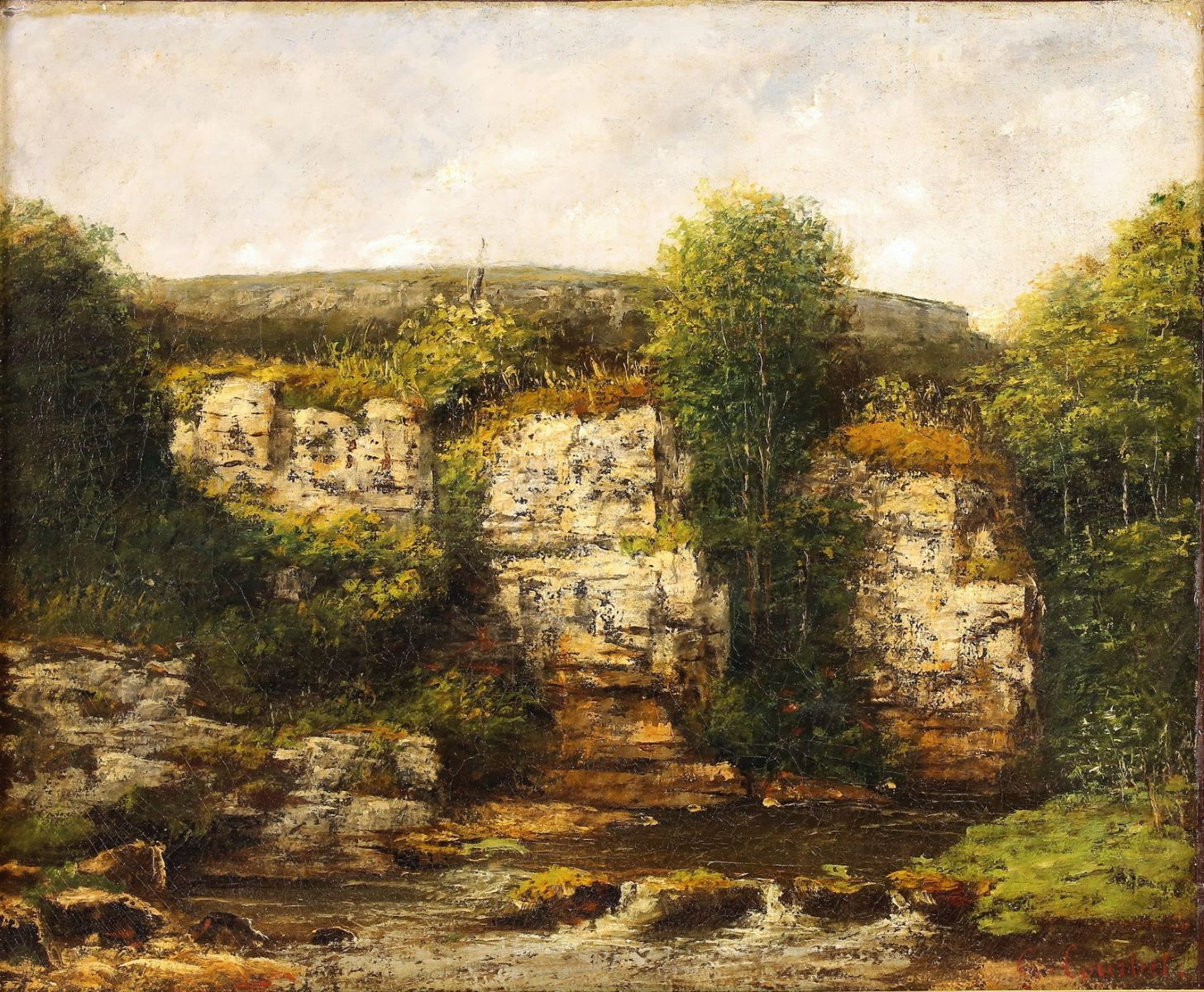
Its scale is a good reason to slow down. A small picture does not announce where the viewer should stop; you have to find the distance at which its separate forms hold together. After the domestic staircase and the family’s possessions, this encounter feels appropriately close. Keep that physical experience in mind when you move to Pointelin, whose relationship with the region depended so often on being away from it.
Pointelin: the landscape after the school bell
Pointelin’s working day had another subject entirely. He earned his living teaching mathematics, first in northern France and later in Paris, while continuing to paint and exhibit. Born into a winegrowing family in Arbois in 1839, he had been encouraged by his drawing teacher Victor Maire. The secure profession did not cancel the other vocation. It paid for a life in which remembered hills could occupy the hours left after teaching.
The museum’s Valley Bottom offers an entry into that long preoccupation. Pointelin often worked from recollection or from sketches made during holidays in Arbois, rather than insisting on painting every landscape outdoors. The distinction matters. A remembered place loses details and keeps others with unreasonable clarity. Look for what seems necessary to the image, then consider how little a landscape needs before it can still feel like home.

Pasteur gave practical assistance. He helped secure a state purchase after the Salon of 1876 and supported Pointelin’s move to a teaching post at the lycée Louis-le-Grand in 1878. The two men also had dinner together. Their bond was geographical, professional and affectionate at once. Walking beside the Cuisance after the museum restores ordinary distances to a story that can otherwise disappear into appointments, exhibition dates and letters of recommendation.
Pasteur and Pécauld: what the hills were for
Pasteur himself had drawn portraits as a boy, making studies of relatives and people in Arbois. This early interest makes his later friendships with painters less surprising. His riverside house grew out of his father’s modest tannery; he altered it into a comfortable retreat with a private laboratory. Domestic life and investigation occupied the same address. Seeing the house after the art museum gives the scientist back his neighbours and his appetite for pictures.
A restored visitor route and a new exhibition about microbes were inaugurated in September 2026. Allow roughly an hour and a quarter to an hour and a half for the expanded visit, subject to its seasonal calendar. The change gives a traveller another reason to check arrangements directly. A historic house is not frozen merely because its furniture and laboratory preserve an earlier life; the way visitors encounter it can change considerably.
Finish at the Musée de la Vigne et du Vin du Jura in Château Pécauld. Its round tower once belonged to the town’s defences; the building later served as a presbytery and boys’ school before the wine museum opened in 1993. Around it, planted vines explain seasonal work and regional varieties. After the landscapes, this is the useful return to cultivation: the country painted or remembered by these men was also ground from which families had to make a living.
For a trip centred on painting, choose July or August, when Sarret de Grozon lists daily afternoon opening, or confirm one of its September afternoons. Outside that season, ask about the group arrangements before booking travel. Leave space between the house museum, the river and Château Pécauld for a meal. In Arbois, the most satisfying day is one in which a landscape remains in your head long enough to meet the actual country outside.
På forsiden: Paysage aux environs d'Ornans ; Reculée aux environs d’Ornans (autre titre) — Gustave Courbet. © musée Sarret de Grozon, Arbois ; © Henri Bertand; Ministère de la Culture (France), base Joconde
Mere at læse
Art city by city →City guide
Art in Brest: Sérusier, Maurice Denis and a Walk through the Rebuilt City
Brest rebuilt its art collection after losing its museum to fire. With the galleries closed again, paintings, an outdoor exhibition and the glass of Saint-Louis offer ways into the city’s history.
City guide
Art in Cherbourg: David, Millet and the Paintings That Taught a Town
Anonymous gifts created Cherbourg’s museum, and a young Millet came to copy them. Follow that exchange through an academic nude, portraits of his first wife and a fragment of an Italian garden.
City guide
Art in Bourg-en-Bresse: The Tombs of Brou, Gustave Doré and Gustave Moreau
Margaret of Austria built a monastery she never saw completed. Its tombs and paintings lead from a widow’s public image to the ice of Doré’s hell.