 Henri MatisseFrankrig, 1869–1954
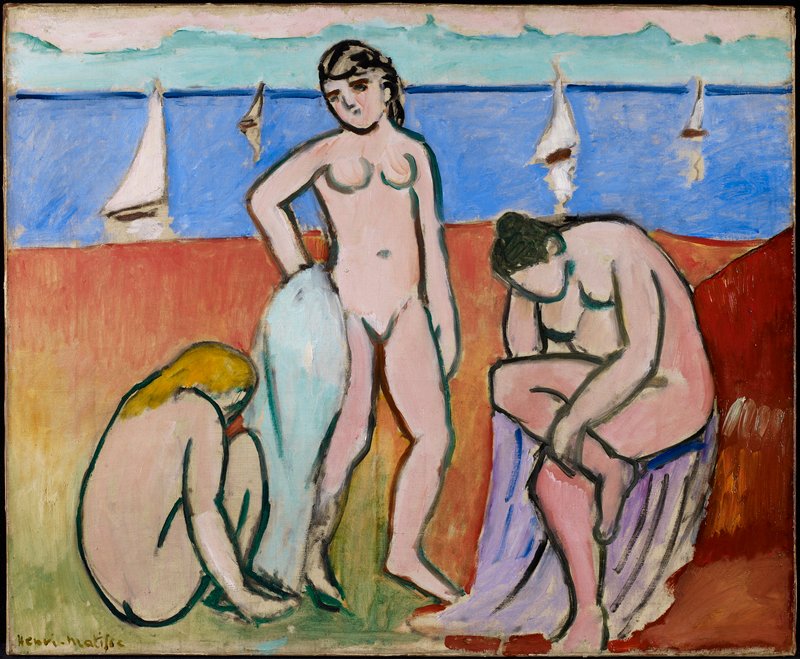
Three Bathers
Må man se det?
Tager ikke imod for tiden

Minneapolis Institute of Art
Minneapolis, USA
Det hører til samlingen, men er ikke udstillet for tiden.
- Kontrolleret
- Uændret siden
- Kilde
- Museets egne samlingsdata
About the painting
This painting, like Boy with a Butterfly Net, dates from Matisse’s immediate post-Fauvist period, and is a characteristic example of his painting to its most elemental. Broad blocks of color indicate land, water and sky. The thick contour lines defining the bathers seem pictorial and sculptural at the same time, and indicate Matisse’s struggle to reconcile volume and two-dimensional design through reductive means.
Three Bathers relates to Matisse’s much larger Bathers with a Turtle from 1908, now in the St. Louis Art Museum. These paintings inaugurated a period of artistic experimentation that culminated in Matisse’s monumental painting known as The Dance.
Minneapolis Institute of Art
Oplysninger
- Inventarnummer
- 61.36.14
I kataloget
Kilder
- Minneapolis Institute of Art: the museum's own open data · hentet for 7 dage siden
- Billede: Minneapolis Institute of Art — public domain
Imens i livet hos Henri Matisse
Hele livetsummer 1904
Summer in Saint-Tropez with Signac
Together with the Neo-Impressionists Paul Signac and Henri Cross, Matisse went to Saint-Tropez, where he began working in the Divisionist technique. There he painted his first masterpiece, "Luxe, Calme et Volupté" (1904/1905).
summer 1905
Collioure: The Birth of Fauvism
Matisse spent the summer of 1905 with André Derain and Maurice de Vlaminck in the fishing village of Collioure on the Mediterranean. Together with Derain he created a new style that entered art history as Fauvism.
October 1905
Scandal at the Salon d'Automne
Matisse showed "The Open Window" and "Woman with a Hat"; Louis Vauxcelles's review of 17 October 1905 gave the group the nickname "fauves" ("wild beasts"). "Woman with a Hat" was bought by Leo Stein for 500 francs, which raised the market value of the artist's work.
1906
Meeting Pablo Picasso
The first meeting between Matisse and Picasso took place at the Steins' salon on the Rue de Fleurus in Paris. Their creative friendship was full of rivalry and mutual respect.
20 March 1906
"Le Bonheur de Vivre" at the Salon des Indépendants
Matisse presented "Le Bonheur de Vivre" (The Joy of Life), a painting combining pastoral and bacchanal motifs. Critics and academic circles reacted with extreme irritation, but Leo Stein purchased this painting as well.
1908
Shchukin's Commission for "Dance" and "Music"
The Russian collector Sergei Shchukin commissioned three decorative panels from Matisse for his Moscow house: "Dance," "Music," and "Bathing" (which remained at the sketch stage). The money of Russian collectors allowed the artist to finally overcome his financial difficulties.