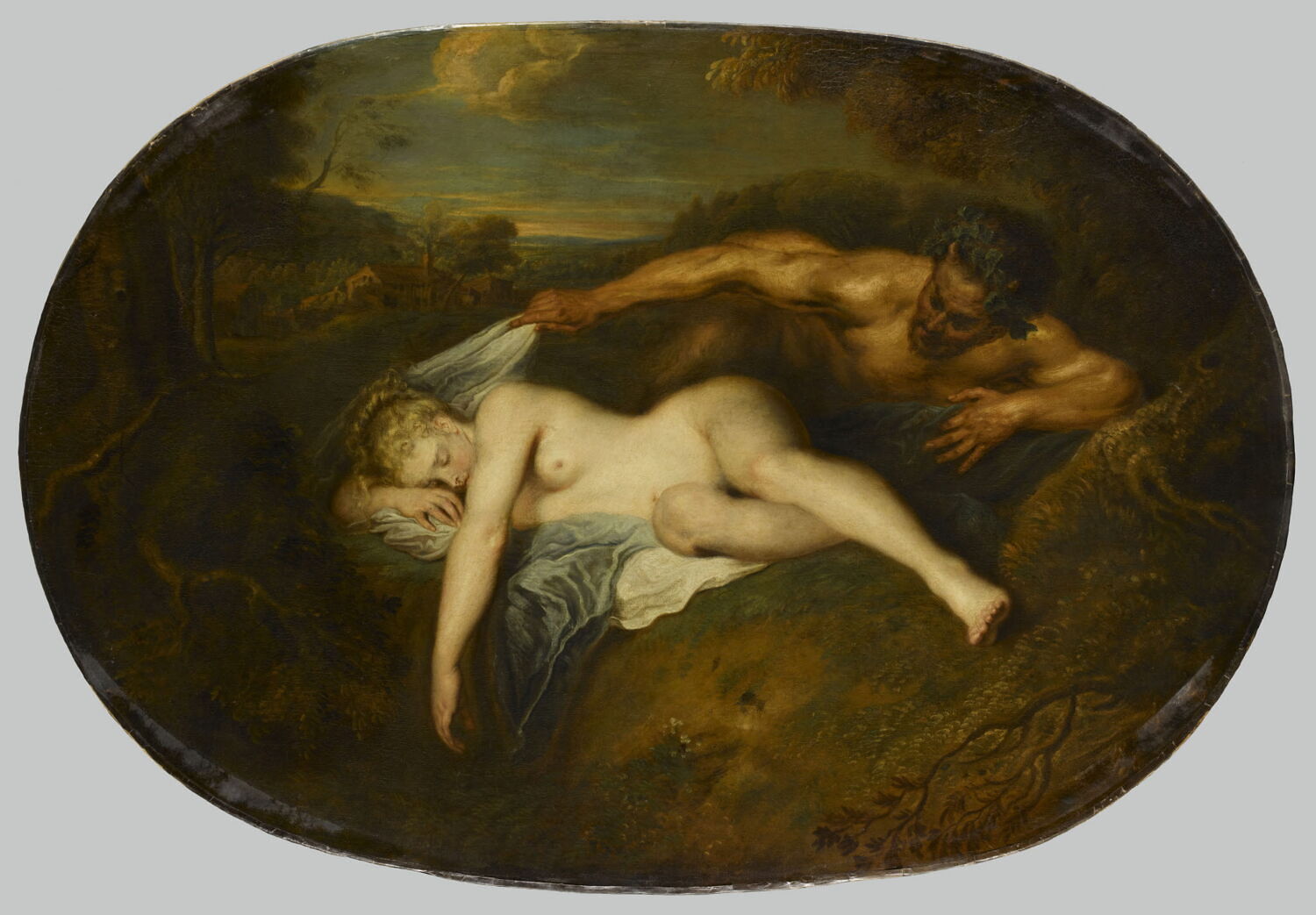
Jean-Antoine WatteauFrankrig, 1684–1721
Бивуак
Kan det ses?
Ukendt
Hvor er »Бивуак« i dag? Samling: Pusjkinmuseet, Moskva. Ukendt.

Moskva, Rusland
Ejeren er kendt; om værket er udstillet i dag, vides ikke.
- Kilde
- Museet
Oplysninger
- Inventarnummer
- Ж-1226
I kataloget
Kilder
- Pusjkinmuseet
- Billede: Pusjkinmuseet — © Pushkin State Museum of Fine Arts
Imens i livet hos Jean-Antoine Watteau
Hele livetc. 1707 – 1708
Leaves Gillot for Claude Audran
Watteau, whose touchy and difficult temperament is already showing, leaves Gillot and becomes a pupil and assistant to the noted decorator Claude Audran, curator of the art collection of the Luxembourg Palace. He never went through an academic training, but under Audran he composes scenes for wall paintings and absorbs the principles of refined ornament.
c. 1708 – 1709
The Luxembourg Palace as a school: Rubens and Poussin
Working for Audran, Watteau can study the collections of the Luxembourg Palace without restriction; the palace serves as a store for paintings, tapestries and furniture, and for him it is in effect a museum. At its heart is Rubens's cycle of 24 canvases, “The Life of Marie de’ Medici”; he also sees Poussin's mythological landscapes there.
31 August 1709
Second place in the Prix de Rome competition
In summer 1709 Watteau and four other competitors paint the set subject of David's return after his victory over Goliath. On 31 August the result is announced: he does not win the first prize and the long stay in Rome that goes with it — his picture comes second; taking the defeat hard, the 24-year-old leaves Audran and goes back to Valenciennes.
c. 1709 – 1710
The dealer Sirois buys the camp pictures
“The Departing Regiment” goes for a modest 60 livres to a man named Sirois, the father-in-law of Gersaint, and the money lets Watteau return to the home of his childhood. In Valenciennes he paints a number of small camp pictures; Sirois buys one of them, a camp-fire scene, again — this time for 200 livres.
c. 1710
Friendship with Antoine de La Roque
In Valenciennes Watteau meets Antoine de La Roque, an officer in the king's mounted gendarmerie who is recovering from a serious wound. A man of letters and later for many years the editor of the Mercure de France, he becomes one of the painter's close friends.
30 July 1712
Admitted to the Academy as an associate
Watteau seeks admission to the Royal Academy of Painting and Sculpture. According to Gersaint, the academician Charles de La Fosse, having seen his work, urges him to apply and helps to get him accepted among the Academy's associate members.