 Jean-Antoine WatteauFrankrig, 1684–1721
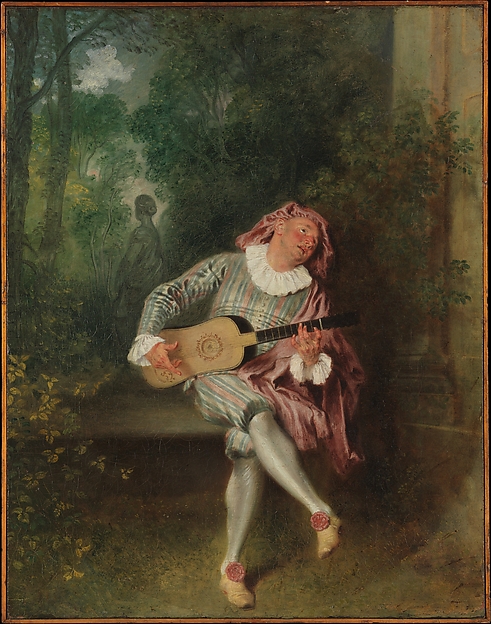
Mezzetin
Må man se det?
Ja, det tager imod

Metropolitan Museum of Art
Sal629New York City, USA
Udstillet for publikum. Hvem der står inde for det, står nedenfor.
- Kontrolleret
- Uændret siden
- Kilde
- Museets egne samlingsdata
Om maleriet
Mezzetino (transl. Mezzetin; French: Mézetin) is an oil-on-canvas painting in the Metropolitan Museum of Art, New York, by the French Rococo painter Jean-Antoine Watteau. Dated within 1717–1720, Mezzetino forms a full-length single-figure composition, depicting the eponymous character in commedia dell'arte. In the 18th century, Mezzetino was owned by Jean de Jullienne, the friend and patron of Watteau who supervised the four-volume edition of prints after the artist's works, for which the picture was engraved by Benoit Audran the Elder; after Jullienne's death in 1766, it was acquired for the Hermitage in Saint Petersburg, then recently established by Empress Catherine II of Russia. During the Soviet sales in the 1920s and 1930s, Mezzetino was sold to British-American businessman Calouste Gulbenkian; it was later sold to the Wildenstein art firm in Paris and New York, from which it was bought in 1934 by the Metropolitan Museum of Art, where it remains; the institution also owns a preparatory study—a drawing of the man's head.
Læs videre
Mezzetino was a comedy character, based on Harlequin but with his own distinctive costume, who was introduced for the first time by the Théâtre italien de Paris actor Angelo Costantini on October 16, 1683. Constantini's expressive face allowed him to portray the role without a mask, a tradition kept alive by all successive Mezzetinos. That novelty attracted Watteau, who featured Mezzetino in several of his works. In the picture, Mezzetino is playing his guitar and singing, his eyes lifted as if towards an unseen balcony. The statue of Venus behind him is facing away, suggesting that his feelings are not shared by the lady she represents. Although the model for Mezzetino is not known, the fact that Jean de Jullienne, who, while selling a number of Watteau's works through his life, still kept Mezzetino, suggests he may have fulfilled the role.
Oplysninger
- Inventarnummer
- 34.138
Hvad det viser
I kataloget
Kilder
- Metropolitan Museum of Art: museets åbne data · hentet for 8 dage siden
- Billede: Metropolitan Museum of Art — Open Access (CC0)
Imens i livet hos Jean-Antoine Watteau
Hele livet1710s
Meets Edme-François Gersaint
At Sirois's house Watteau meets his son-in-law, the art dealer Edme-François Gersaint, who soon becomes a close friend.
1710s
Tuberculosis sets in
Watteau's fame grows steadily, yet he is as a rule dissatisfied with everything that comes from his brush; at the same time he develops a serious illness, tuberculosis.
c. 1717
Crozat recommends Watteau to Rosalba Carriera
Watteau's fame spreads beyond Paris: the banker Crozat writes to the celebrated portraitist Rosalba Carriera in Venice that among Paris painters he knows no one but Watteau who could produce a work worthy of being shown to her. Crozat's patronage and lucrative commissions help to launch the painter's European reputation.
28 August 1717
Elected to the Academy: a “fête galante”
By 1717 Watteau's “gallant scenes” have had such wide success that an exception is made for his reception piece, “Pilgrimage to Cythera”: in the minutes the words “pilgrimage to Cythera” are struck out and replaced by “fête galante”. Watteau is elected a full member of the Academy; the ceremony is attended by the First Painter to the King, Antoine Coypel, by Claude Gillot and by the Regent, the Duke of Orléans.
1718
Leaves Crozat's house
Watteau's independent character does not let him stay long in such luxurious but constraining circumstances, and in 1718 he leaves the house of his patron, who does not lose interest in his art. “Gilles” was probably one of the last works painted in the large studio put at his disposal in Crozat's mansion.
late 1719 – summer 1720
To London, to see Dr Richard Mead
Watteau's health is failing, and he goes to England at the invitation of Philippe Mercier, an admirer and imitator, hoping to overcome tuberculosis with the help of the well-known physician Richard Mead. The treatment brings no noticeable result and the London climate only aggravates his condition; he returns to Paris in summer 1720, gravely ill.