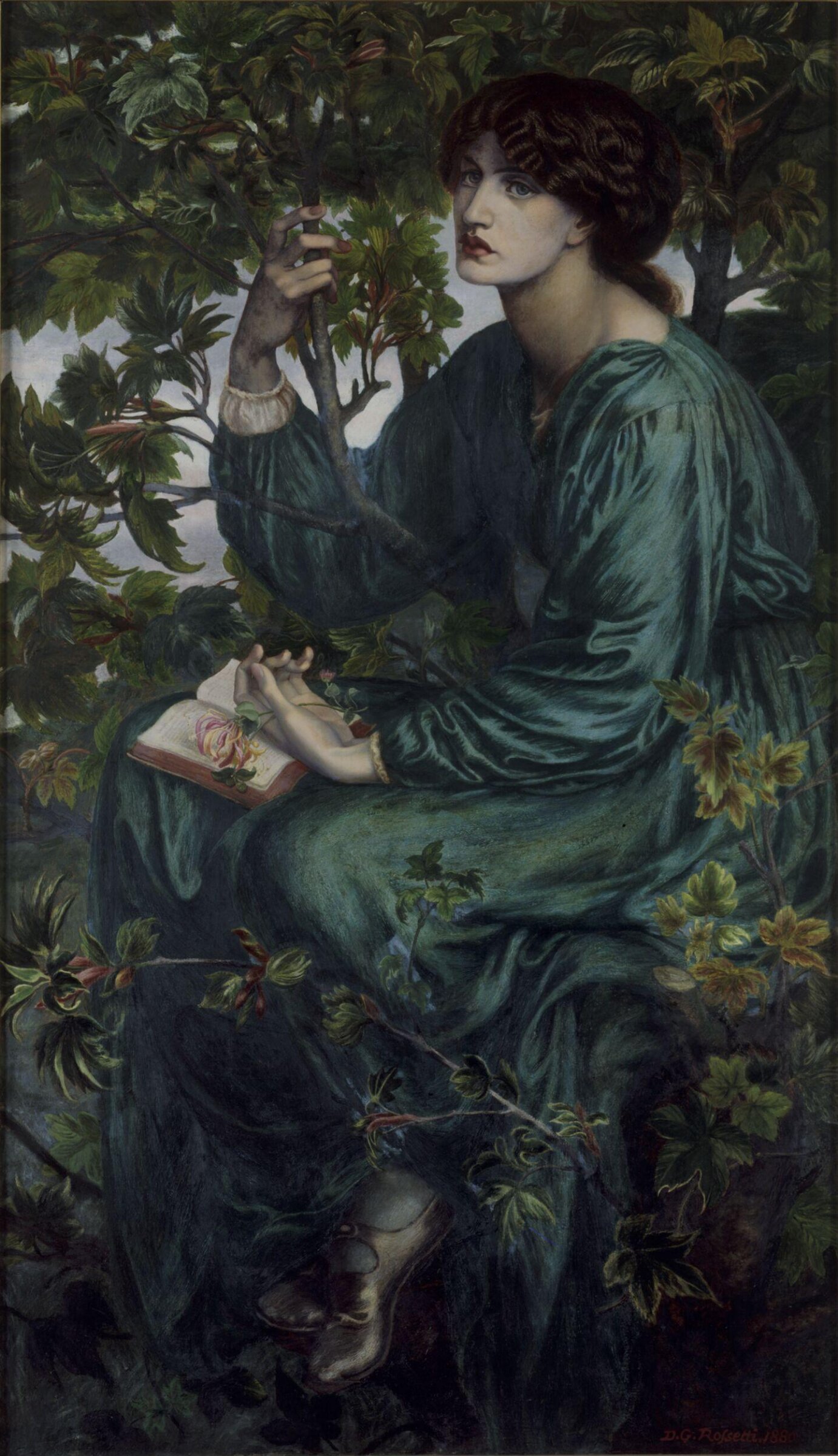
Dante Gabriel RossettiEngland, 1828–1882
A Sea-Spell
Må man se det?
Ja, det tager imod

Udstillet for publikum.
- Kontrolleret
- Uændret siden
- Kilde
- Museet
Om maleriet
A Sea-Spell was painted for Rossetti’s patron Frederick Leyland, a ship magnate who owned a large number of paintings by the artist. Rossetti first planned to illustrate lines from Coleridge’s poem Kubla Khan — “A damsel with a dulcimer / In a vision once I saw” — but the subject was ultimately derived from his own poem, inscribed on the frame that he designed. The musician’s “lashing fingers weave the sweet-strung spell” of the siren, a mythological figure whose voice lures sailors to their deaths. Although sirens were traditionally described as women with the bodies or heads of birds, Rossetti’s enchantress retains her human form. The artist evokes all of the senses in his lushly claustrophobic canvas; the siren’s dreamy mien suggests that she, too, has been bewitched by the music and by the fragrance of the surrounding flowers. The subject of the dangerous woman, or “femme fatale,” flourished in the nineteenth century.
Harvard Art Museums
Oplysninger
- Inventarnummer
- 1939.92
I kataloget
Kilder
- Harvard Art Museums
- Billede: Harvard Art Museums — © President and Fellows of Harvard College
Imens i livet hos Dante Gabriel Rossetti
Hele livet1862–1882
A Tudor house at 16 Cheyne Walk
After his wife’s death Rossetti leased a Tudor house at 16 Cheyne Walk in Chelsea, where he lived for twenty years surrounded by extravagant furnishings and a parade of exotic birds and animals.
1869–1874
Kelmscott Manor: a summer house and a retreat
In 1869 Morris and Rossetti rented Kelmscott Manor at Kelmscott, Oxfordshire, as a summer home, but it became a retreat for Rossetti and Jane Morris: they spent summers there with the Morrises’ children while William Morris travelled to Iceland in 1871 and 1873.
1874
Morris cuts Rossetti out of the firm
In 1874 Morris reorganised his decorative arts firm, cutting Rossetti out of the business, and the polite fiction that both men were in residence with Jane at Kelmscott could no longer be maintained.
1874
An abrupt departure from Kelmscott
In July 1874 Rossetti abruptly left Kelmscott and never returned.
after 1874
A recluse at Cheyne Walk
In time Rossetti’s way of life became withdrawn, and only his closest friends saw him; his late years are marked by an ever more morbid mood, abuse of alcohol and chloral hydrate, and a life as a recluse.