Edward Burne-JonesStorbritannien, 1833–1898
Flamma Vestalis
Må man se det?
Ja, det tager imod

Udstillet for publikum.
- Kontrolleret
- Uændret siden
- Kilde
- Museet
Om maleriet
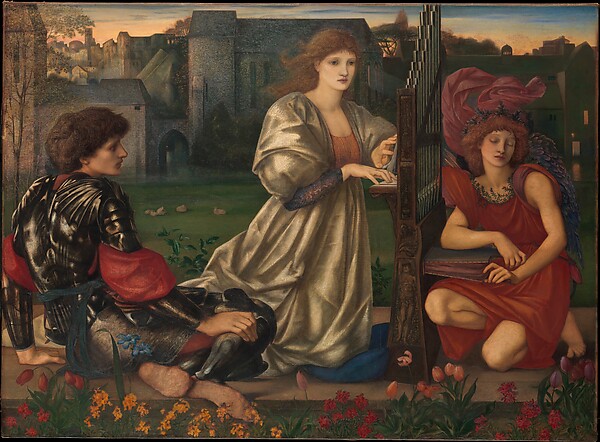
Burne-Jones’s daughter Margaret modeled for this painting. The Latin title refers to the Vestal Virgins of Rome, who tended the perpetual fire on the altar of the goddess Vesta. Begun before Margaret’s marriage in 1888, the painting aligns her with these chaste women, suggesting her innocence and purity.
Læs videre
"Flamma Vestalis" remained in England until 1922, when it was purchased by New York–based collector Grenville Winthrop and given a distinctly American frame. This style of frame was designed in the 1880s by eminent architect Stanford White. The design was known as a “U-shaped grille frame” because of the shape of its ornament. Evoking gilded lattice or lace, the grille catches and refracts light so that the painting and frame seem to shimmer. "Flamma Vestalis" is unique in this gallery: it is a British painting in a famously American frame, evidence of the collector’s preference rather than that of the artist.
Harvard Art Museums
Oplysninger
- Inventarnummer
- 1943.190
I kataloget
Kilder
- Harvard Art Museums
- Billede: Harvard Art Museums — © President and Fellows of Harvard College
Imens i livet hos Edward Burne-Jones
Hele livet1886
“The Depths of the Sea”, his only Academy showing
Elected an Associate of the Royal Academy in 1885, he exhibited there the following year for the only time, showing “The Depths of the Sea”, a mermaid carrying down a youth she has unconsciously drowned in the impetuosity of her love.
1887–1888
Exhibits pictures of the Perseus cycle
One picture of “The Story of Perseus” was exhibited in 1887 and two more in 1888, together with “The Brazen Tower”, inspired by the same legend. The Perseus series was never completed.
1890
Acclaim for the second “Legend of Briar Rose”
The second series of “The Legend of Briar Rose” was exhibited on its own and won admiration.