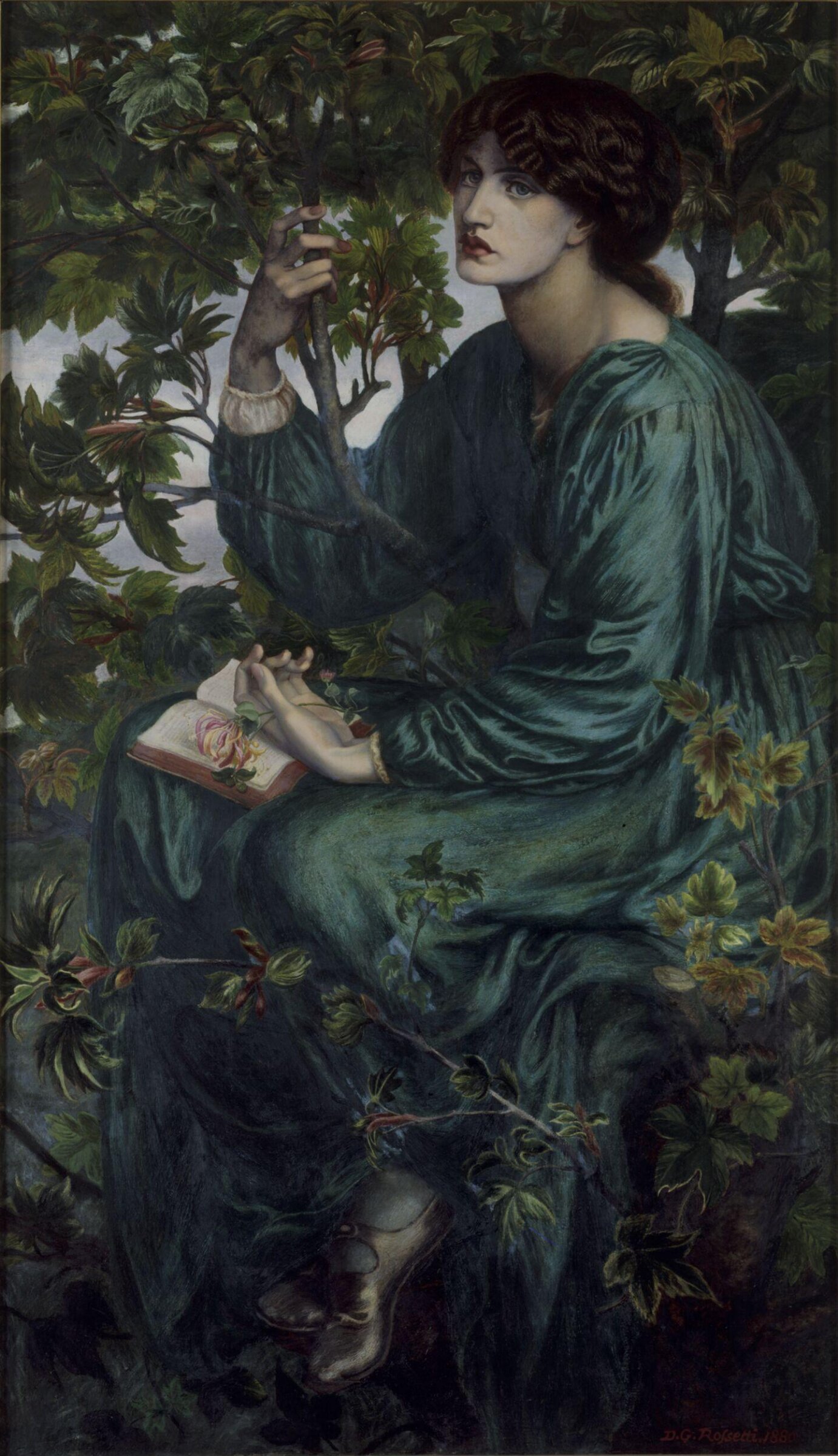
Dante Gabriel RossettiEngland, 1828–1882
Ecce Ancilla Domini
Kan det ses?
Ukendt
Hvor er »Ecce Ancilla Domini« i dag? Samling: National Gallery, London. Ukendt.

London, Storbritannien
Ejeren er kendt; om værket er udstillet i dag, vides ikke.
- Uændret siden
- Kilde
- Museet
Om maleriet
Ecce Ancilla Domini! (Latin: "Behold the handmaiden of the Lord"), or The Annunciation, is an oil painting by the English artist Dante Gabriel Rossetti, first painted in 1850 and now in Tate Britain in London. The Latin title is a quotation from the Vulgate text of the first chapter of the Gospel of Saint Luke, describing the Annunciation, where Mary accepts the message brought to her by the Angel Gabriel that she would give birth to a child (Jesus) by God.
The title is correctly Ecce Ancilla Domini!, but many sources ignore the exclamation mark.
Oplysninger
- Inventarnummer
- NG1210
I kataloget
Kilder
- Wikidata
- Billede: National Gallery — Dante Gabriel Rossetti · Public domain · Wikimedia Commons
Imens i livet hos Dante Gabriel Rossetti
Hele livet1848
Meets Holman Hunt and Millais
In 1848, at the Royal Academy exhibition, Rossetti met William Holman Hunt, who helped him, still insufficiently versed in painting, to finish “The Girlhood of Mary Virgin”; Hunt introduced him to John Everett Millais.
1848
Founding of the Pre-Raphaelite Brotherhood
In 1848 Rossetti, with William Holman Hunt and John Everett Millais, founded the Pre-Raphaelite Brotherhood, aiming to reform English art: to reject the “mechanistic” approach adopted after Raphael and Michelangelo and the formal training introduced by Sir Joshua Reynolds, and to return to the abundant detail, intense colours and complex compositions of Quattrocento Italian and Flemish art. They used pure colours on a white ground and often painted outdoors for maximum authenticity.
after 1848
A pupil of Ford Madox Brown
After leaving the Royal Academy Rossetti studied under Ford Madox Brown, with whom he retained a close relationship throughout his life.
1850
Meets Elizabeth Siddal
In 1850 Rossetti met the poet Elizabeth Siddal, who became the favourite model of the Pre-Raphaelite painters; over the next decade she was his muse, pupil and passion. She was already ill with tuberculosis, and Rossetti made many sketches of her, some of which later served as studies for paintings.
1850
Criticism of “Ecce Ancilla Domini” and a turn to watercolour
Stung by criticism of his second major painting, “Ecce Ancilla Domini,” exhibited in 1850, and by the increasingly hysterical critical reaction that greeted Pre-Raphaelitism that year, Rossetti turned to watercolours, which could be sold privately; his work later won support from John Ruskin, but Rossetti rarely exhibited thereafter.
early 1850
“The Germ”: “The Blessed Damozel” and a story about an artist
In early 1850, in the first issue of the Brotherhood’s magazine The Germ, Rossetti published his poem “The Blessed Damozel” and a story about a fictional early Italian artist inspired by a vision of a woman who bids him combine the human and the divine in his art.