 Edward Burne-JonesStorbritannien, 1833–1898
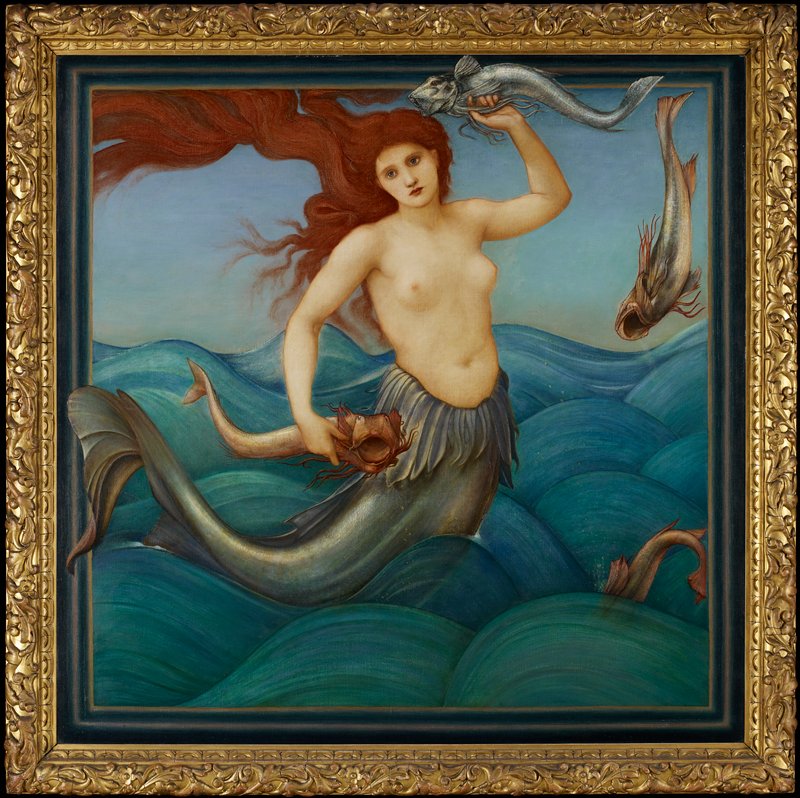
A Sea-Nymph
Kan det ses?
Ikke udstillet lige nu
Hvor er »A Sea-Nymph« i dag? Samling: Minneapolis Institute of Art, Minneapolis. Ikke udstillet lige nu. Kontrolleret 29. september 2026.

Minneapolis, USA
Det hører til samlingen, men er ikke udstillet for tiden.
- Kontrolleret
- Uændret siden
- Kilde
- Museet
Om maleriet
Edward Burne-Jones became a founding member of William Morris’s decorative art firm in 1861, where he produced countless designs and illustrations for books, tapestries, ceramic tiles, mosaics and stained glass. In 1862, he traveled to Italy where he was introduced to Botticelli, whose formal patterning profoundly influenced his subsequent development as a painter. His typical subject matter derived from medieval and classical legends charged with symbolism. In fact, he was pre-eminent in the Aesthetic movement in England and the Symbolist movement in Europe. A defining characteristic of Burne-Jones as an artist was his willful blurring of the boundaries between his painting and his decorative work, something quite evident in the conception of Sea-Nymph.
Læs videre
Sea-Nymph was conceived as a pendant to another painting, Wood-Nymph, both of which were purchased from the artist shortly after they were painted. They were separated in 1908 and the Wood-Nymph was eventually bequeathed in 1944 to the South African Museum in Cape Town.
Minneapolis Institute of Art
Oplysninger
- Inventarnummer
- 2010.83
I kataloget
Kilder
- Minneapolis Institute of Art
- Billede: Minneapolis Institute of Art — public domain
Imens i livet hos Edward Burne-Jones
Hele livet1870s
Georgiana grows close to Morris
In these difficult years Georgiana developed a friendship with Morris, whose wife Jane had fallen in love with Rossetti. If he asked her to leave her husband, she refused: both couples stayed together, and Georgiana and Morris remained close for the rest of their lives.
1880
A holiday home at Rottingdean
The Burne-Joneses bought Prospect House in Rottingdean, near Brighton, as a holiday home, and soon after the next-door Aubrey Cottage, joining them into North End House after North End Road, where their Fulham home stood.
1881
Honorary degree from Oxford
Oxford, which he had once left without a degree, gave him an honorary degree, and in 1882 made him an Honorary Fellow.
1883
Shows “The Wheel of Fortune”
The almost sombre “Wheel of Fortune” was shown in 1883; it was followed in 1884 by “King Cophetua and the Beggar Maid”, in which he once more indulged his love of gorgeous colour.