Can I see it?
Where to See Raphael: Rome, Florence and the Museums Beyond Italy
This selection follows 16 works through eight cities. Rome and the Vatican supply the large-scale starting point; Paris and Washington offer several paintings with dated room checks.
2026年11月1日 · 阅读约 6 分钟 · ART WIKI 编辑部
Raphael died in 1520 at thirty-seven, after twelve years in Rome. He had arrived there at the invitation of Julius II in 1508, having already worked in Umbria and Florence. That short career leaves a travel problem of scale. A fresco and a portable Madonna need different kinds of visits, and the collection with a familiar title is not always the one you mean. Choose the actual work before choosing the city.
Vatican City and Rome
The Vatican Museums own The School of Athens, Disputation of the Holy Sacrament and Transfiguration. Start with the first two as a pair of subjects. Ancient philosophy occupies one image, theology the other. In the gathering of philosophers, Plato and Aristotle stand at the centre; many of the surrounding identities remain disputed. A list that confidently names every face gives more certainty than the evidence allows. Our entries do not confirm present access to these works.

Rome also means separate collections. La Fornarina belongs to the Galleria Nazionale d'Arte Antica, while the Galleria Borghese owns Portrait of a Lady with a Unicorn and The Deposition, the latter dated 1507. The unicorn portrait has changed identity over time. Later overpainting turned the woman into Saint Catherine, replacing her animal with a wheel and covering her shoulders. Restoration in the 1930s removed those additions. The records give their owners, without confirmed display information.
Florence and Milan
Florence's Uffizi owns Madonna of the Goldfinch and the Self-portrait, both dated to the 1500s in our catalogue. Raphael spent roughly four years absorbing Florentine painting before the Roman commissions. Put this group ahead of Rome if you want the trip to follow that sequence. Do not read the broad dates as exact years; the entries here do not justify narrowing them.
Milan's Pinacoteca di Brera has The Marriage of the Virgin, dated 1504. It gives the itinerary an earlier fixed point than the Vatican group. A traveller staying in Milan can therefore begin with Raphael without first making a detour through Florence. These Italian holdings have no verified display status in the supplied records, so the museum address answers where to enquire, rather than guaranteeing what will be accessible during a visit.
Paris and Chantilly
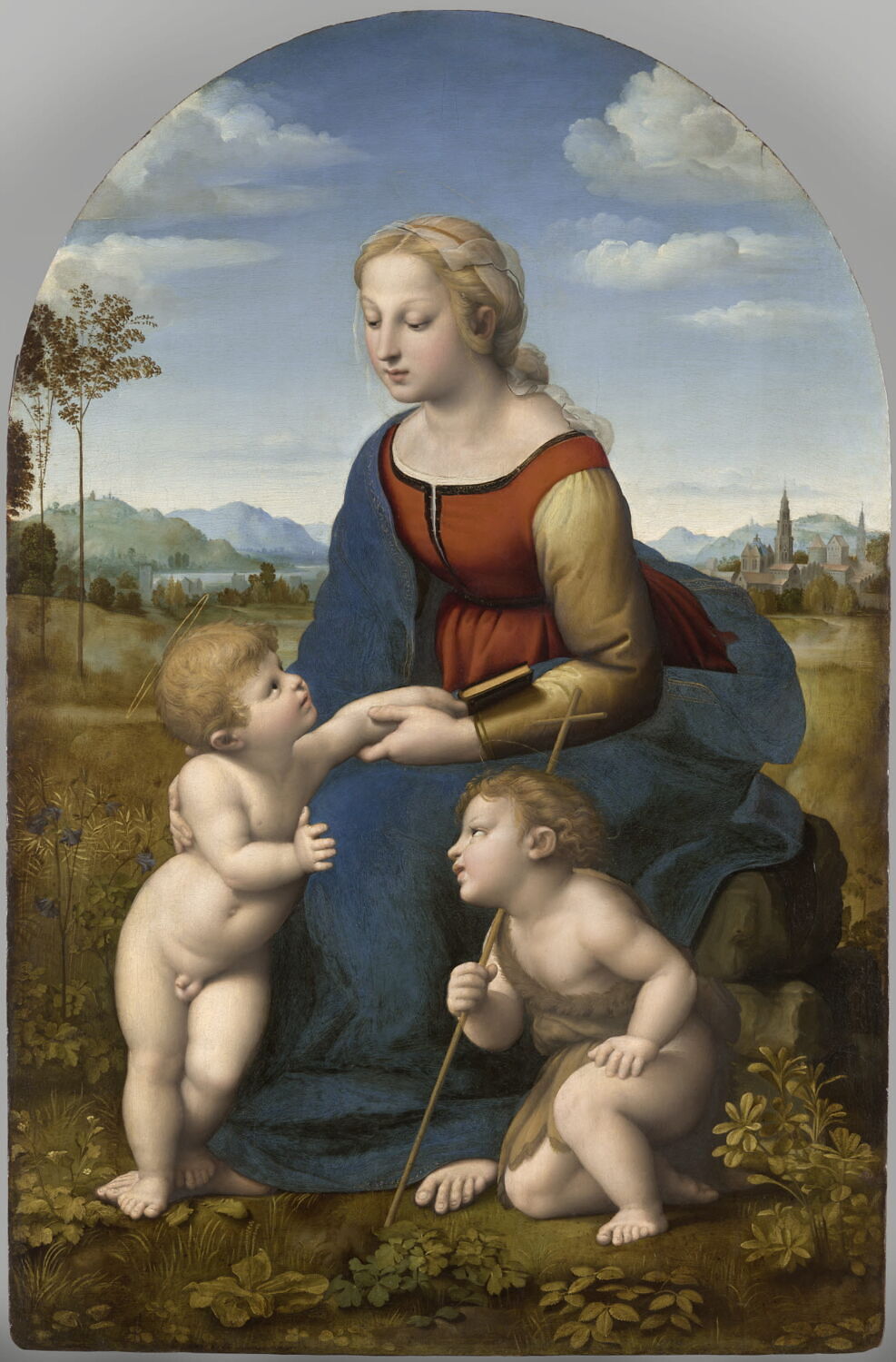
At the Louvre, La Belle Jardinière, dated 1507, was in Room 710 of the Denon wing, Level 1, on 26 September 2026. Portrait of Baldassare Castiglione, dated about 1514–1515, was in Room 712 in the same wing and on the same level. Those two room numbers allow a much more precise plan than a general search for Raphael in Paris. They also separate a Madonna from a later portrait.
Chantilly adds Three Graces at the Musée Condé. Our record dates it approximately to 1504 or 1505, without confirming display. Keep it as a separate museum visit rather than counting it among the Louvre pictures. The dates place it close to the Milan painting, so this French extension also returns you to the beginning of the itinerary's chronology. The three French works belong to two different collections in two cities.
Washington and London
Three paintings make Washington's National Gallery of Art a convenient stop. The Alba Madonna, about 1510, Portrait of Bindo Altoviti, about 1515, and The Small Cowper Madonna, about 1505, were all in M-020 on 29 September 2026. This room combines two Madonnas with a portrait, across roughly a decade. For someone with a single museum afternoon, it offers a concentrated alternative to travelling between several Italian institutions.
London's National Gallery owns The Dream of a Knight, dated about 1504. No current display is confirmed for it here. If London is your base, check that painting first; if you are planning one day around several Raphaels, the Washington cluster has the clearest room evidence in this selection. Open the linked work pages before committing to either route and look for a status check newer than the September observations used above.
封面: 雅典学院 — Raphael. Raphael · Public domain · Wikimedia Commons
Can I see it?
Where to See Goya: The Prado, the Black Paintings and Museums Abroad
Fourteen paintings across six cities show how far Goya travelled from royal portraiture. Madrid is the centre of this selection, but the most intimate account of his illness is in Minneapolis.
Can I see it?
Where to See Titian: Venus of Urbino, Mythologies and Portraits
Fifteen paintings in nine cities trace a route from Florence to Boston. Venice has the late Pietà, but several of the mythologies that shaped Titian’s reputation belong to collections outside Italy.
Can I see it?
Where to See Rembrandt: Amsterdam, The Hague and Paintings Abroad
Seventeen paintings in seven cities give a route from the civic groups to the late self-portraits. Amsterdam anchors the journey, while Paris and New York each have several works recorded together.