El Lissitzky俄罗斯, 1890–1941
Untitled

关于作品
A painter, architect, and designer as well as a photographer, El Lissitzky believed that avant-garde art could transform daily life. One of the key figures to integrate artistic developments in Russia with those in Western Europe, he began experimenting with photography seriously in Germany in 1923. Lissitzky was fascinated by the possibilities of photograms, multiple exposures, and what he called fotopis—loosely translatable as “photo-writing”—and he eventually abandoned painting to focus on combined photographic and architectural projects.
Read on
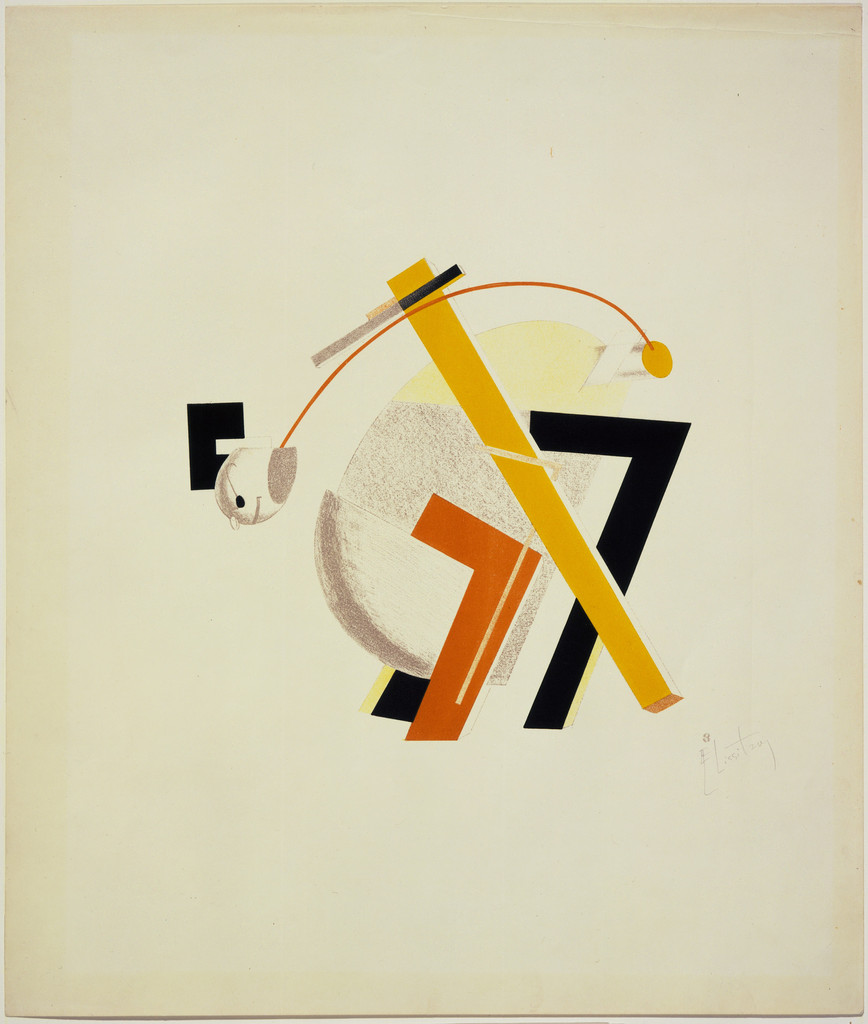
Photograms (images made by placing objects directly on photographic paper and exposing them to light, rather than with a camera) were taken up in Dada and Constructivist circles in different countries between 1919 and 1923. The primitive technology, which dispensed with lenses, permitted a merger of touch and sight that Lissitzky thematized in this picture by having himself (at left) and fellow painter and designer Vilmos Huszár appear to be the twinned pupil of a ghostly eyeball—at once pictured and the embodied agent of picturing.
This photogram incorporates circular images of El Lissitzky (with pipe) and another artist, Vilmos Huszár. It is printed on gelatin silver paper, the standard black-and-white pho-tographic paper of the 20th century. The absence of an intermediary baryta layer (a distinctive preparatory layer containing white pigment typically present in a gelatin silver print) gives it a very matte surface, while the gray tonality is most likely due to underdevelopment.
芝加哥藝術博物館CC BY 4.0
作品信息
- 馆藏编号
- 1992.100
What it shows
已收入目录
出处
- 芝加哥藝術博物館: the museum's own open data · 6天前获取
- 图片: 芝加哥藝術博物館 — © the artist or rights holder
与此同时,在El Lissitzky的生活中
完整生平1920–1921
Moscow: INKhUK, a lecture on the Prouns, VKhUTEMAS
In 1920 Lissitzky leaves Vitebsk for Moscow and becomes a member of INKhUK (the Institute of Artistic Culture, also referred to as GINKhUK); on 23 September 1921 he gives a lecture there about his Prouns. In 1921 he also starts to teach at VKhUTEMAS but soon leaves Moscow for Germany.
1921
Leaving for Germany as a “cultural emissary”
In 1921, as UNOVIS declines and suprematism begins to fracture into a utopian, spiritual half and a utilitarian one, Lissitzky aligns with neither and leaves Vitebsk: he takes a job as a “cultural emissary” of Soviet Russia and moves to Weimar Berlin to establish contacts between Russian and German artists — what exactly he did in this role remains unclear. In 1921–1925 he lives in Germany and Switzerland.
1922
First solo exhibition in Hanover
The year after the publication of his first Proun series in 1921, Kurt Schwitters introduces Lissitzky to the Hanover gallery Kestnergesellschaft, where he holds his first solo exhibition. The second Proun series, printed in Hanover in 1923, is a success.
1923
The Proun Room at the Great Berlin Art Exhibition
In 1923, for the Great Berlin Art Exhibition, Lissitzky transforms a small room (about 3 by 3 by 2.5 m) into a single work of art, the Proun Room, which lets viewers “walk into an image” and become active participants. He violates the unwritten rule of rejecting the commercialization of art by putting price tags on three elements of the room; the price tags, together with his “half-dance” during the demonstration of the room, alienate his friend Theo van Doesburg.
1923–1924
Tuberculosis and a Swiss hospital
In 1923–1924 Lissitzky is severely ill with tuberculosis and stays in a Swiss hospital; at this time he is reported even to have considered suicide. He will die of tuberculosis in 1941.
1925
Return to the USSR
Lissitzky's years in Germany and Switzerland run from 1921 to 1925; it appears that in 1925 he returns to the Soviet Union.