 Auguste Rodin法国, 1840–1917
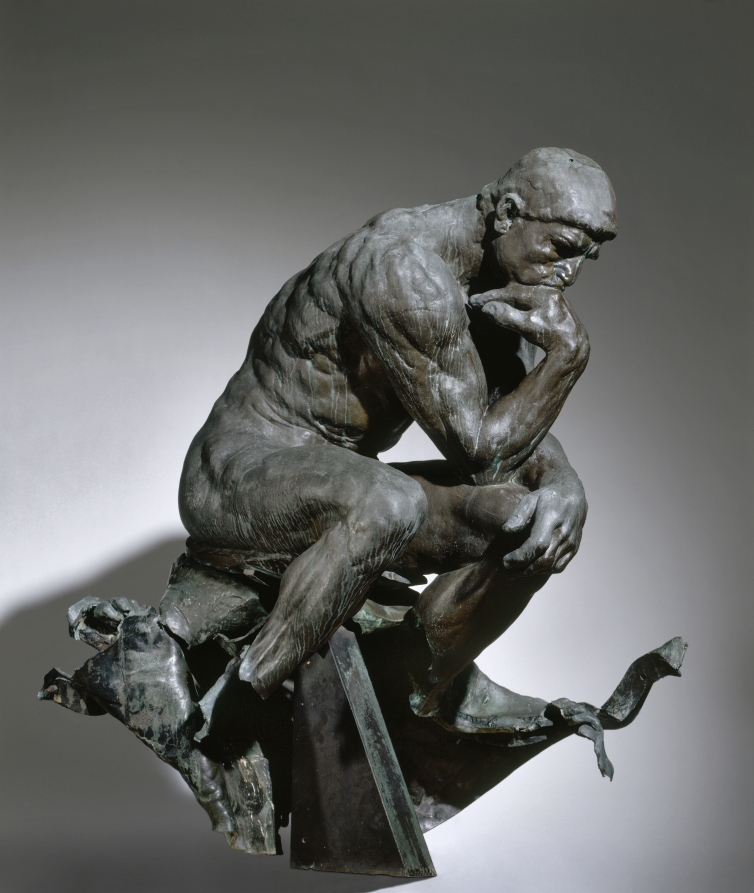
The Thinker
可否一睹真容?
可以,正在迎客

正对公众展出。由谁担保,见下文。
- 核实
- 前天
- 此状态始于
- 2026年8月19日
- 出处
- 博物馆自己的馆藏数据
About the sculpture
The Thinker was first developed as part of Rodin's The Gates of Hell, a sculptured doorway for a proposed museum of decorative arts in Paris. Intended to be part of a relief directly above the doors, the rugged figure was originally conceived as a generalized image of the Italian poet Dante Alighieri (1265–1321), who wrote the Divine Comedy.
克利夫蘭藝術博物館
作品信息
- 馆藏编号
- 1917.42
已收入目录
出处
- 克利夫蘭藝術博物館: the museum's own open data · 5天前获取
- 图片: 克利夫蘭藝術博物館 — Museum open access
与此同时,在Auguste Rodin的生活中
完整生平1877–1878
Accused of casting “The Age of Bronze” from life
The figure looked so lifelike that Rodin was accused of casting it from a live model. He wrote to the newspapers, produced photographs of the model and demanded an inquiry, and a committee of sculptors cleared him; later many of his works were deliberately made larger or smaller than life.
1878
Defeat in the competition for a monument to the defenders of Paris
The winged allegorical figure now known as “The Call to Arms” failed to impress the jury and did not even reach the shortlist. His entries for monuments to Carnot, Diderot and Rousseau also failed; only a monument to d'Alembert for the façade of the Hôtel de Ville came his way.
1880
Receives the commission for “The Gates of Hell”
His first state commission was a sculptural portal for a planned Museum of Decorative Arts; with it Rodin received two studios on the Rue de l'Université. The museum was never built and “The Gates of Hell” remained unfinished: they were first cast in bronze after the master's death.
1880
The 1880 Salon: third prize
Rodin showed “St. John the Baptist”, which won third prize. In the same Salon “The Age of Bronze” was exhibited a second time, now cast in bronze.
c. 1880 – 1881
Juliette Adam's salon and first recognition
Rodin was received at the salon of the writer Juliette Adam, where he was presented to Gambetta; Gambetta recommended him to Antonin Proust, the minister of fine arts, who bought “St. John the Baptist” for the state. It was the first recognition to reach a sculptor who was already forty.
1881
London: meeting William Ernest Henley
Rodin's friend Alphonse Legros introduced him in London to the poet William Ernest Henley, who did more than anyone to win him a British audience. Through Henley Rodin met Robert Louis Stevenson and Robert Browning.