 Félix Edouard Vallotton法国, 1865–1925
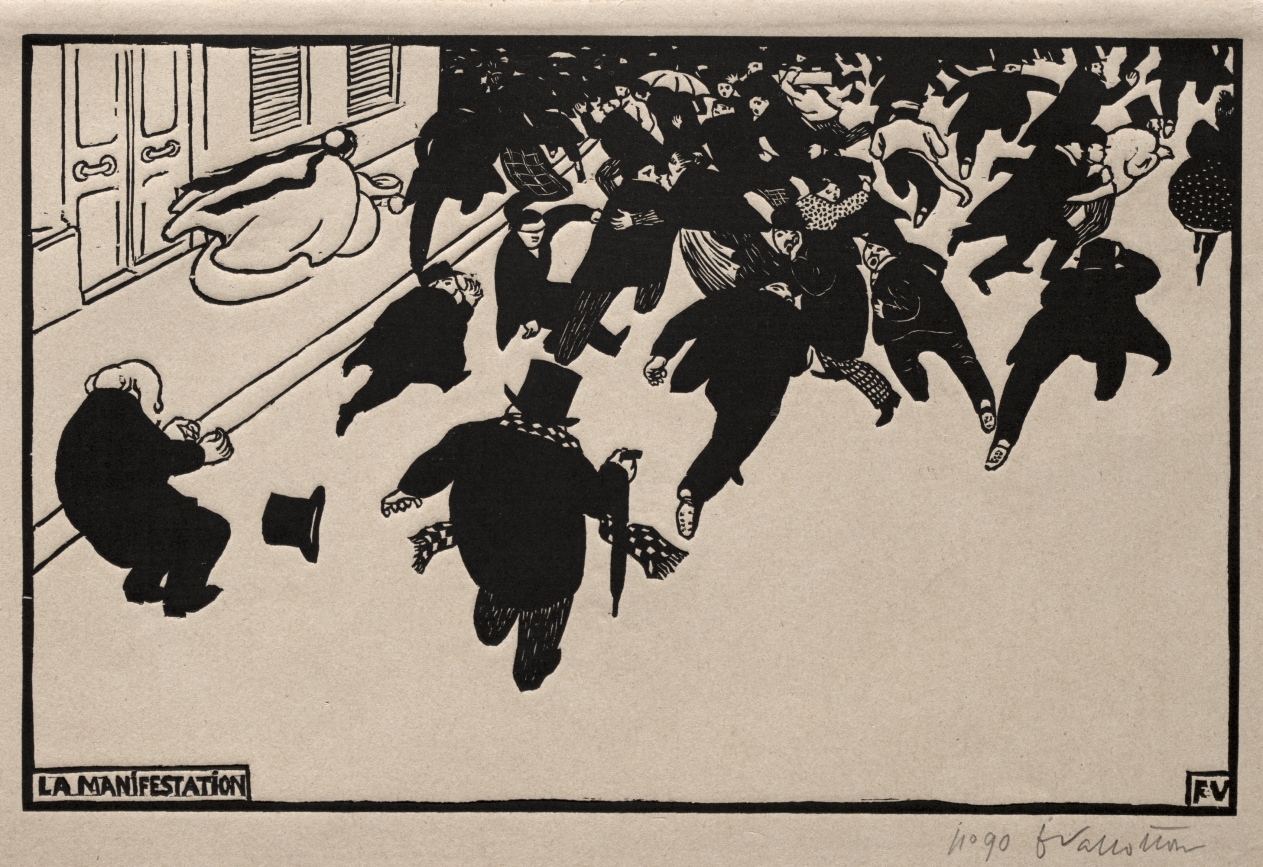
The Protest

关于作品
Inspired by the flat space, tipped perspective, and use of pattern in Japanese color woodcuts, Vallotton exploited the contrast of rich black ink and the white of the paper for a dynamic image of a mass of figures surging forward as the police break up a political demonstration. Vallatton frequently focused on social issues, especially during the 1890s when street riots were common in Paris. The blankness of the lower-right corner of the print—fully one-third of its surface area—is a bold and original concept. As a terrified crowd rushes away from the authorities, Vallotton mitigated criticism of police violence with comic touches: the man who pauses to try to grab his top hat or the corpulent waddle of the figure with an umbrella. Many would imitate his woodcut style, but few could approach the sophistication of his artistic vision.
克利夫蘭藝術博物館
作品信息
- 馆藏编号
- 1999.323
已收入目录
出处
- 克利夫蘭藝術博物館:博物馆的开放数据 · 8天前获取
- 图片: 克利夫蘭藝術博物館 — Museum open access
与此同时,在Félix Edouard Vallotton的生活中
完整生平1889–1903 · 入会
Les Nabis
1890–1897
Art critic for the Gazette de Lausanne
To earn a living Vallotton restored paintings for the dealer Henri Haro, and from 1890 he wrote for the Swiss Gazette de Lausanne — some thirty articles on the Paris art world up to 1897.
1891
Leaves the Salon for the Indépendants
Showing at the official Salon des Artistes for the last time, Vallotton exhibited six paintings at the avant-garde Salon des Indépendants for the first time. Commissions from Swiss patrons began to arrive at the same time.
1892
“The Foreign Nabi” and friendship with Vuillard
Among the Nabis — Bonnard, Roussel, Maurice Denis — Vallotton found a lifelong friend in Édouard Vuillard; he kept a little apart from the others, earning the jocular title of “the Foreign Nabi”.
1893–1897
Woodcuts for La Revue Blanche; the Natansons' patronage
His woodcuts brought Vallotton clients and financial security: he illustrated leading French periodicals, including La Revue Blanche, and foreign ones such as The Chap-Book of Chicago, and cut covers for theatre programmes and book illustrations. Thadée Natanson, publisher of La Revue Blanche, and his wife Misia became his patrons and introduced him to the Paris avant-garde elite — Mallarmé, Proust, Satie and Debussy.