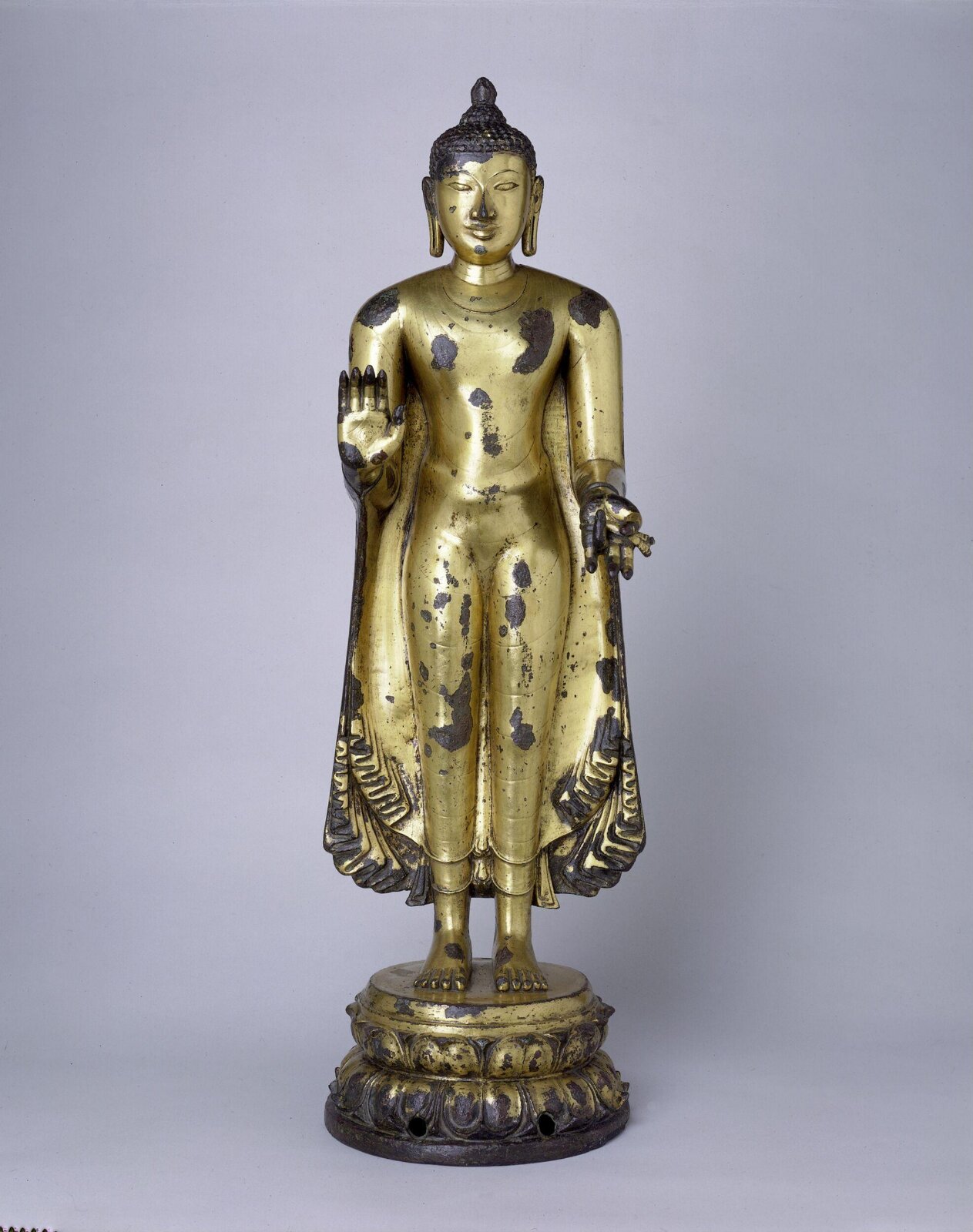
Standing Buddha
可否一睹真容?
可以,正在迎客

维多利亚和阿尔伯特博物馆
倫敦, 英国
展厅Buddhism, Room 47f, The Robert H. N. Ho Family Foundation Galleries of Buddhist Art
正对公众展出。由谁担保,见下文。
- 核实
- 9天前
- 此状态始于
- 2026年9月25日
- 出处
- 博物馆自己的馆藏数据
About the sculpture
This sculpture is one of the finest Buddhist bronzes to survive from south India. The Buddha stands on a circular double-lotus pedestal, with holes for securing the image during processional use.
He gazes outward at the viewer, with his right hand gesturing protection (‘abhaya-mudra’). His monastic robe (‘sanghati’) covers both shoulders. It clings tightly to his body and forms stylised folds at the hem, in a manner characteristic of the eastern Indian Pala style.
The figure displays a number of the auspicious marks (‘laksanas’) denoting Buddha-hood. These include the skull protruberance (‘usnisa’) which has a flame projection - a southern-style motif. The forehead mark (‘urna’) is of the southern ‘hair-curl’ type, resembling an inverted question mark, and the hands have conventional palm markings.
Read on
This figure is in the style closely associated with the port city of Nagapattinam, coastal Tamilnadu. The Buddhist monastic complex there was the largest in medieval south India. It received generous patronage, as witnessed by over 350 bronze images that have been excavated or found by chance in the vicinity of the vihara and surrounding region.
维多利亚和阿尔伯特博物馆
作品信息
- 馆藏编号
- IPN.2639
What it shows
已收入目录
出处
- 维多利亚和阿尔伯特博物馆: the museum's own open data · 9天前获取
- 图片: 维多利亚和阿尔伯特博物馆 — © Victoria and Albert Museum, London







