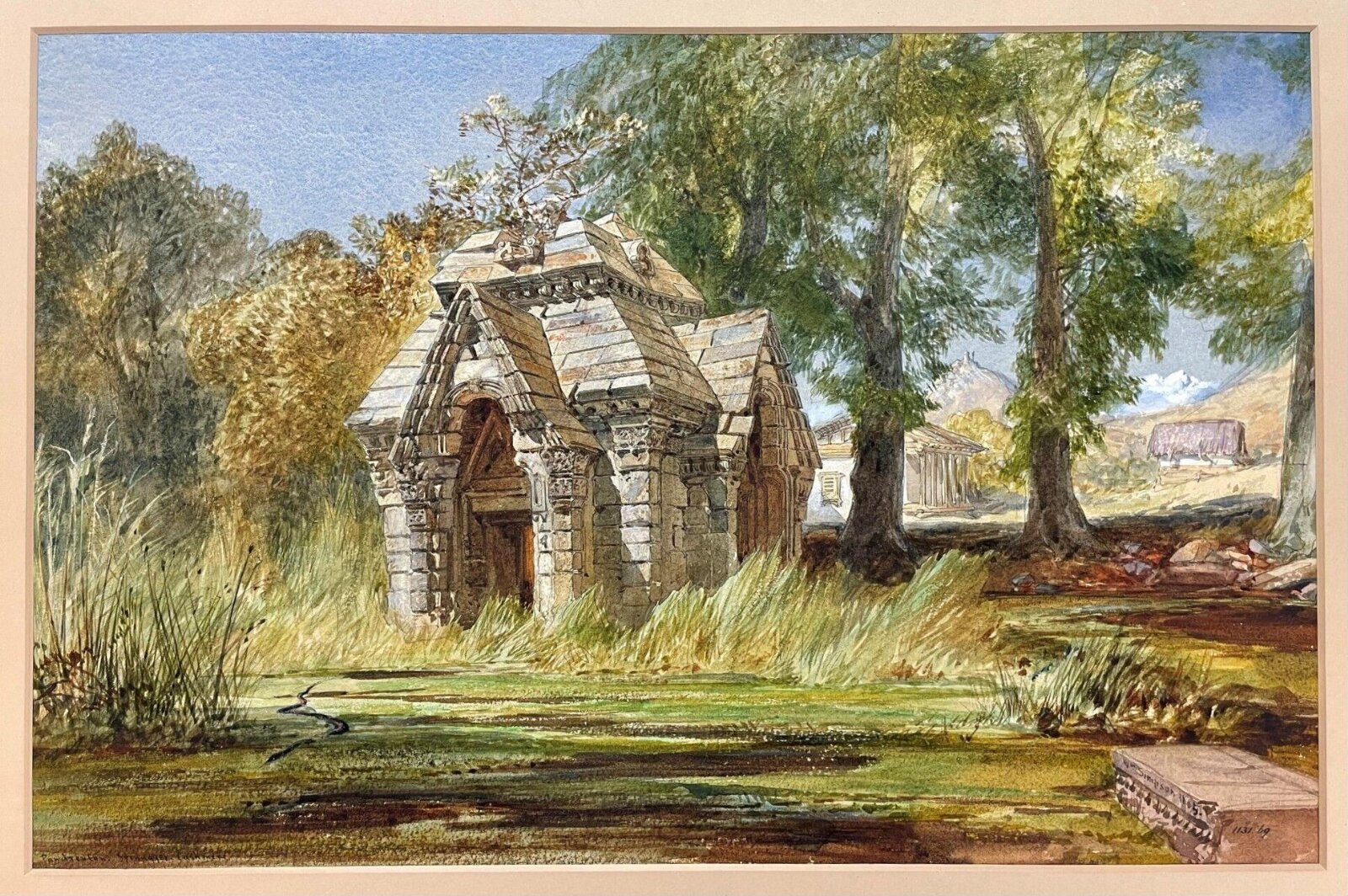
William Simpson
Pandrethan temple, Srinagar
可否一睹真容?
眼下不见客

维多利亚和阿尔伯特博物馆
倫敦, 英国
仍属馆藏,只是目前没有展出。
- 核实
- 9天前
- 此状态始于
- 2026年9月25日
- 出处
- 博物馆自己的馆藏数据
About the painting
William Simpson (1823 - 1899) was a distinguished watercolourist and war artist. Having established his reputation by documenting the Crimean war in 1854, Day and Sons, the London lithography firm, commissioned him to sketch well-known sites in and around Delhi associated with the Revolt of 1857 by Indians against the rule of the British East India Company.
Simpson arrived in Calcutta (Kolkata) in 1859 and travelled widely. His rapid pencil drawings formed the preparatory studies for his finished watercolours done after his return to London in 1862. His detailed journal, sketches and pictures from India resulted in these highly coloured, evocative, and romantic interpretations of the landscape and architecture.
Read on
Simpson visited the Meruvardhanaswami temple in Pandrethan in Jammu and Kashmir in 1859. A small village, Pandrethan, is situated a mile and a half southeast of Srinagar on the river Jhelum. Pandrethan derives its name from Puranadishthana (meaning old town). The temple was believed to be erected by a minister named Meru between 913 and 921 A.D. It was set in a spring-fed tank, and its plinth is now submerged.
The temple interior has one of the finest surviving temple ceilings in Kashmir. The stone ceiling is elaborately carved in bas-relief figures. It is formed with nine blocks of stone consisting of three intersecting squares - the lower and upper course are each constructed from four diagonally placed lintels, forming square openings that reduce in size, covered with a soffit decorated with a large lotus.
维多利亚和阿尔伯特博物馆
作品信息
- 馆藏编号
- 1131-1869
已收入目录
出处
- 维多利亚和阿尔伯特博物馆: the museum's own open data · 9天前获取
- 图片: 维多利亚和阿尔伯特博物馆 — © Victoria and Albert Museum, London